These are a few photos from the Edina Europa poetry walks, which took place during the Edinburgh Fringe Festival last month. They were taken by Alison Lloyd; my thanks to her for letting me use them here.
In the Canongate Kirkyard, looking towards the Nelson Monument on Calton Hill and the Old Royal High School.
At the grave of Johann Friedrich Lampe (1703–1751), a composer and bassonist who came to Edinburgh in 1750 to play at the recently opened Canongate Playhouse. I read from Robert Fergusson’s poem, ‘On the Canongate Playhouse in Ruins’, written after the theatre closed in 1769, and which includes the lines evoking the sounds of the playhouse:
Here shepherds, lolling in their woven bowers, In dull recitativo often sung Their loves, accompanied with clangour strong From horns, from trumpets, clarinets, bassoons; From violinos sharp, or droning bass, Or the brisk tinkling of a harpsichord.
Reading from Burns, with the Burns Monument emerging from the trees in the background.
Reading another Burns poem at the grave of Adam Smith.
Taking advantage of having the poet on hand, I asked Angus Reid to read his ‘split sonnet’ about the Scottish parliament building, dedicated to Donald Dewar and beginning with the question:
And with what sign should the gathering place be shown…
Thanks to everyone who came on the walks – it was as ever a pleasure to share the poems with you, and the unfolding conversations.
As Spring Fling x Wigtown Book Festival Writer-in-Residence for 2019, I’ve been creating new work exploring the links between birds, art and the landscape, inspired by my experiences during Spring Fling. The new work will be revealed at Wigtown Book Festival (27 September – 6 October) but in the meantime here are some insights and sneak peeks…
I’ve been researching place-names in Dumfries and Galloway which relate to birds. There are many, covering all sorts of ground, from coastal rocks to inland moors and up into the high hills. Many of these place-names are derived from Gaelic, spoken in Galloway until the 18th century.
Here are three, given with their English meanings, together with a description of the place taken from the Ordnance Survey place-name books compiled in the 1840s and 1850s. The map extracts are taken from OS maps published around the same time.
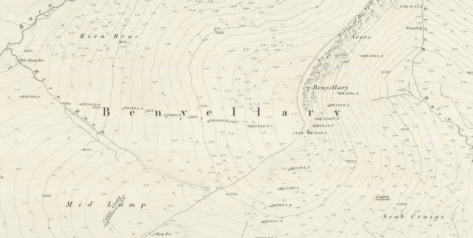
Benyellarie (N of Glentrool)
“A large lofty rocky heathy hill on the farms of Palgown… on its eastern side is a large precipice called “Scars of Benyellary.”
Benyellarie, from beinn iolaire, the eagle’s hill
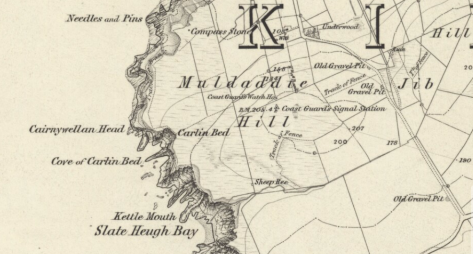
Cairnywellan Head (by Port Logan, S of Portpatrick)
“A head land which terminates Port Nessock Bay on the South side. It is a Conspicuous object & well known to mariners.”
Cairnywellan, from cárn na bhfaoileann, cairn of the seagulls
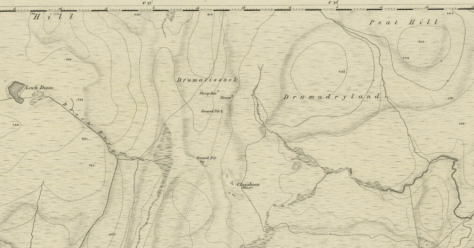
Drumadryland (E of Cairnryan)
“A Broad heathy hill on the North side of a large Moor or marsh, and on the farm of Delhabach”
Drumadryland, from druim na’ dreolan, ridge of the wrens
“I like the elements of ‘serious play’ in Arne’s work. ‘gingko leaf fairy tale’ links the Brothers Grimm and Hiroshima to suggest, touchingly, both a loss of innocence and a reconciliation with the past… ‘the forgotten dream’ makes succinct comedy from inarticulacy.”
“The conversation with Christine has been, like her readings, measured and occasional. Her work deals in nuance, glimpse, intuition, and part of its appeal for me is that I don’t always understand it entirely.”
Extending the Possibilities: Translation as Conversation is a piece I’ve written for the Year of Conversation website. It outlines my reflections on translating the work of Arne Rautenberg and Christine Marendon, over many years.
Arne Rautenberg & Ken Cockburn, St Andrews, 2019
I was lucky enough to read with Arne at this year’s StAnza festival, and to hear Christine read at the Portico Library in Manchester.
Christine Marendon, Portico Library, May 2019
“A Year of Conversation 2019 is about us all celebrating, initiating and exploring conversation in our lives. There will be some events involving many people at places you might expect – festivals for example. But there will be many conversation events that are smaller and more intimate too. What is a ‘conversation event’? It’s simply something that’s been planned – that you might have planned – in which conversation plays a significant part or which gives rise to conversation. So it may be a performance of some kind or it may be a group of people (you have) chosen for a special reason to share a meal. There will be information about events on the website, but there will also be space for you to reflect on your own experiences of conversation.” Tom Pow, Creative Director, A Year of Conversation 2019
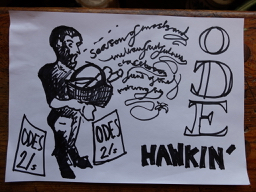
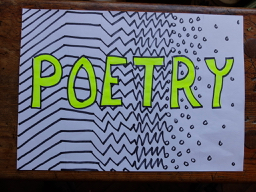
Thanks to Angus Reid for helping me make a 10-second video for the Edinburgh Fringe’s Inspiration Machine. It takes work to make something that short!We used an old poem of mine, POETRY, which is based loosely on a Pepsi ad from the 70s. These are Angus’s drawings that we used in the video, throwaway style, like Dylan in ‘Subterranean Homesick Blues’. (Nothing like showing your age…)
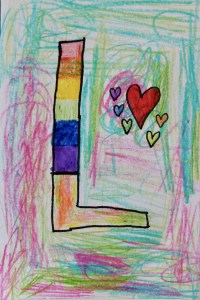
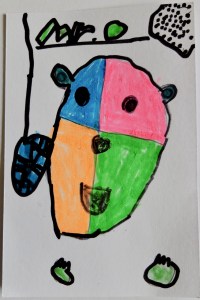
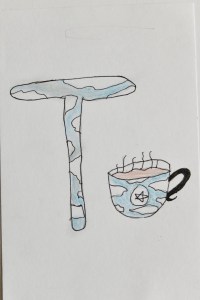
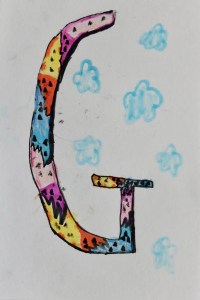
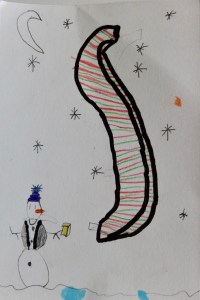
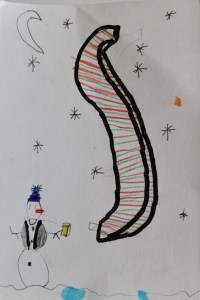
As last year, this spring I led another project at Leith Primary School with Lorna Irvine and Suzanne Butler, and supported by the church of St James the Less, Leith. We worked with the two P4 classes on poetry, drama and song, focussing on their impressions of Edinburgh, and keeping fit and healthy. My group wrote about the games and sports they play, visiting Holyrood Palace, and the food they like to eat, as well as saying hello and goodbye in several languages. They also created a series of individual letters, which I collaged together to create ‘headings’ which were projected during the performance.
My thanks to the school, and especially the class teachers, Mrs McDonald and Mrs Kinneil. Here are some extracts from the script.
Hi – sup – heya – yo –
Bonjour — Salaam aalekum – Nihau – Priviet –
In other words… Hello!
*
We’re going on the bus to Holyrood Palace.
Outside the palace we looked around and saw
a tower that was 500 years old,
shields that had a unicorn and an eagle,
a bath house and a flower garden,
the learning centre and Arthur’s Seat.
Inside the palace we saw
the room with all the jewelry,
the king’s gorgeous jewels and golden swords –
some swords had diamonds in the middle.
We went into the gallery with 96 paintings
but barely any furniture
and our challenge was
to find a sword slash in one of the paintings
and a secret door that leads to the kitchen
and to count all the paintings
and we had to do all of that in 2 minutes!
*
In the evening we go home,
We’re hungry and want some food.
My mum’s banana split and coffee –
That sounds really good!
And when we go to the café
What we want to eat
Is toast or macaroni cheese –
What a delicious treat!
*
We hope you have enjoyed
Spending the day with us
In our Edinburgh.
Au revoir – Gudafis – Zytien – Papa –
So long – See you later – Cheerio – Missing you already –
In other words… goodbye!
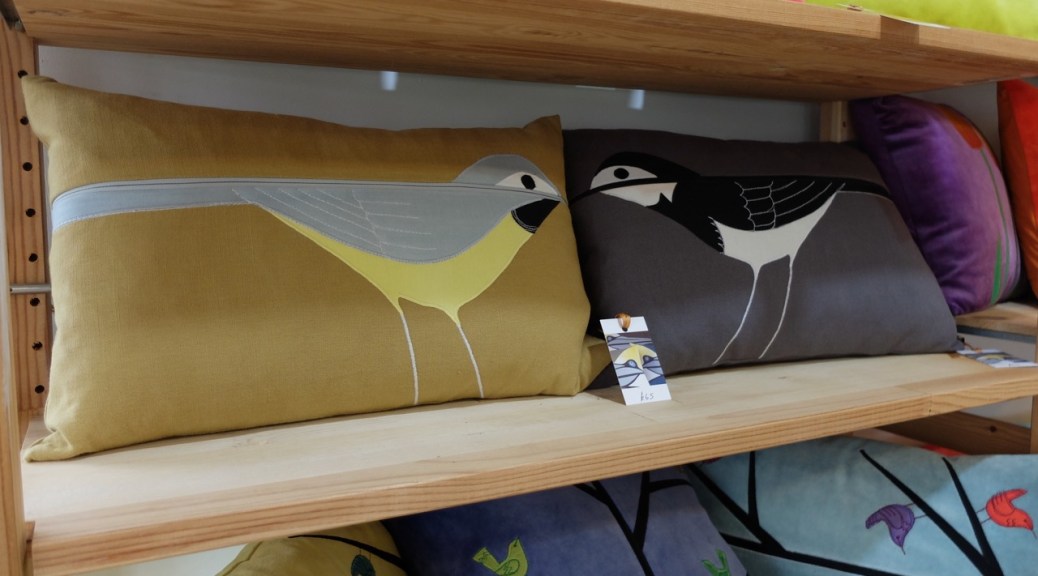
Over the Spring Fling weekend (25–27 May) I visited artist studios across Dumfries and Galloway, from Gatelawbridge to Port William, speaking to artists and visitors. As well as seeing a fantastic range of bird-themed artworks, I spoke to lots of folk who shared their sightings and memories of birds.
Lisa Hooper, Friends from the North
Over the next few weeks and I’ll be reflecting on my Spring Fling experiences, and writing a new piece of work to be presented at the Wigtown Book Festival in the autumn.
Amanda Simmons, Arctic Terns
In the meantime here’s a selection of birds from the weekend – some spotted during conversations and workshops, some glimpsed as I travelled, and some contemplated in studios and galleries. My thanks to everyone involved.
Sarah Stewart, origami birds
Conversations I heard of an oystercatcher nesting on a roundabout, a crow that kept banging into the window, and jays burying acorns. I was told there are no magpies around Kirkcudbright and Wigtown – some say they were exterminated, others that they can’t co-exist beside carrion crows. I heard of swallow fledglings standing in a line on a beam, sometimes for three or four days, before they launch themselves, of thrushes littering the garden with broken snail-shells, and of a buzzard swooping to lift a frog from a pond, like an osprey takes fish. I was told of stock doves nesting in owl-boxes, and that there are more egrets now, but fewer lapwings and swallows. I heard from a member of a rowing club who enjoys seeing gulls, sandpipers and herons up close, and a member of a golf club who sees mostly magpies. I was told of a sound like someone in distress, which turned out to be a barn owl, and of green woodpeckers, red kites, small owls and bittern in Cambridgeshire. I heard of a heron which stands in the pond that’s not full of newts, and of a raptor which, falling on chaffinches gathered at the bird-feeder, misjudged its flight and crashed into the fence, before picking itself up and flying away embarrassed. I was told of a thrush singing at Carstairs Station, of blackbirds flying out from the bay tree, and of a hen pheasant which planned to nest in the field behind a house until the neighbour’s cat disturbed it. I heard of the bell in the County Buildings remaining silent when the ospreys didn’t return, and of sedge warblers which sound like techno and hiphop.
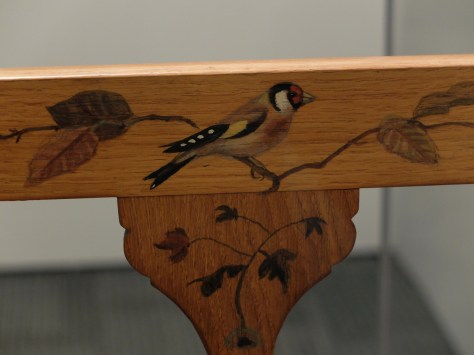
Goldfinch, on a chair by Bill Johnston (1893–1974), in Kirkcudbright Galleries
Observations
From the car I notice a woodpecker land on the verge, its distinctive black-and-white striped head, while a large puddle in a lay-by that loops off the road has attracted a duck and several ducklings. The looping flight of siskins around a flowering laburnum tree, oystercatchers heard through an open door, the songs of a Galloway hedgerow in late May. At the Cairnholy stones, a blackbird flies from the nearby house to the far side of the valley in seconds. From within an evergreen a thrush emerges, stands speckled on the threshold a moment as if deciding where to, then off. A buzzard circles above the green slope at Port Castle Bay, now seen, now hidden.
I’m delighted that Heroines from Abroad is one of 8 books on the shortlist for this year’s Oxford-Weidenfeld Prize. The prize is for book-length literary translations into English from any living European language. The winner will be announced at the prizegiving and dinner at St Anne’s College, Oxford on Saturday 15 June 2019.
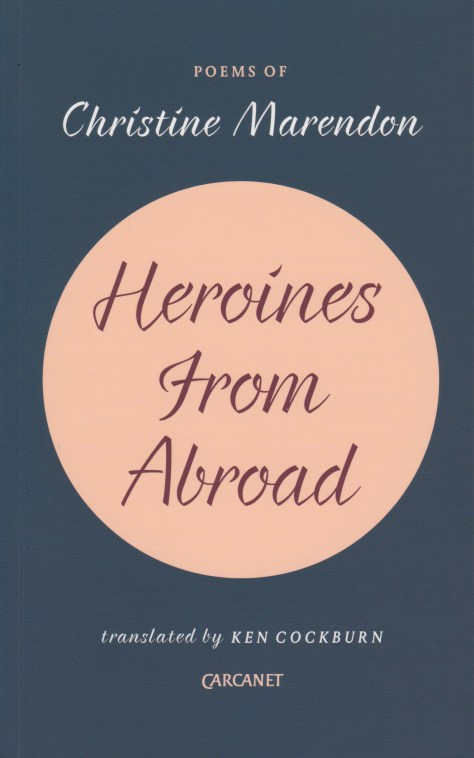
Heroines from Abroad was published last summer by Carcanet. It’s a first collection of poems by Christine Marendon, with her poems in the original German alongside my translations.
In February and March I ran schools workshops for StAnza, Scotland’s International Poetry Festival. I worked with lower secondary pupils at Madras Academy, Waid Academy and St Leonard’s School, as well as with a group of home-schooled pupils from Lothian and Borders.
St Leonards School 190402
St Leonards School 190402
We looked at three poems as starting points: Zbigniew Herbert’s ‘Journey to Kraków’ (which I’d used with Edinburgh secondary schools last autumn), and two poems about birds – Alastair Reid’s ‘Daedalus’ and Alexander Hutchison’s ‘Gavia Stellata’. ‘Journey to Krakow’, written in the 1950s, describes a scene on a train in which ‘a boy / with a book on his knees’ responds to a stranger’s interest in his reading with brief comments on books he’s read, expressing both ‘rapture and condemnation’. I asked the pupils to reflect on their own reading – and watching and listening – preferences, and to present their work as bookmarks. The voice of ‘Daedalus’ is a father describing his son who ‘has birds in his head’, while ‘Gavia Stellata’ describes the red-throated diver by way of elaborate questions and simple answers. I used both poems to suggest ways the pupils could write about birds using both knowledge and imagination.
The sessions with the Madras pupils took place before StAnza, which took place in St Andrews from 6 to 10 March. During the festival their poems were displayed inside and outside the Byre Theatre, as well as in the garden of the Preservation Trust Museum.
I worked with the home-schooled group in the Japanese garden at Lauriston Castle. We read some haiku and mesostics, went for a walk, wrote poems on labels and made a temporary anthology on a small pine.
My thanks to all the teachers and pupils involved, and to StAnza for making the sessions possible.
I’ll be leading poetry walks as part of the Edinburgh Festival Fringe again this year. Edina Europa looks at the Scottish capital’s links with Europe over the centuries. I’m still compiling poems and working out the itinerary, but the walks will start and end at the Scottish Poetry Library, just off the Canongate near the Scottish Parliament.
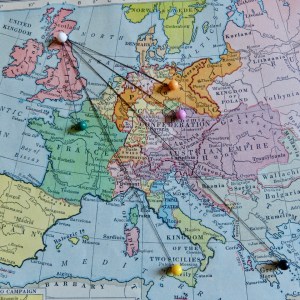
The map above (taken from an old historical atlas, and showing Europe after 1815) links Edinburgh with cities it’s been compared to: it’s well known as the ‘Athens of the North’, but it’s also been compared favourably, and alliteratively, with Paris, Palermo, Prague and Potsdam.
Today I’ve been looking at James Hogg’s portrayal in The Queen’s Wake of the Italian David Rizzio, the ill-fated favourite of Mary Queen of Scots. I also discovered that the well-known ballad ‘Mary Hamilton’ (‘Yestreen the queen had four Maries’) has its roots in Russia…
These are the twelve herms of Scottish poets, overlooking the grandly named Loch Ross just by the Edinburgh Park Central tram stop, to the west of the city. On the sides of the plinth you can find some information about, and a poem by, each poet, though only Edwin Morgan wrote a poem specifically for his herm.
A human head would never do
under the mists and rains or tugged
by ruthless winds or whipped with leaves
from raving trees. But who is he
in bronze, who is the moveless one?
The poet laughed, it isn’t me.
It’s nearly me, but I am free
to dodge the showers or revel in them,
to walk the alleys under the stars
or waken where the blackbirds are.
Some day my veins will turn to bronze
and I can’t hear, or make, a song.
Then indeed I shall be my head
staring ahead, or so it seems,
but you may find me watching you,
dear traveller, or wheeling round
into your dreams.





















 Poems on the page and in the world