Tag Archives: Edinburgh

Poems around Edinburgh

I’ve been out taking photos of lines and stanzas from poems I read on the poetry walks, at the places where I read them.

I’ve been posting these on my Facebook and instagram pages, but thought I’d gather a few of them here.

S.T. Coleridge at the Black Bull, Grassmarket

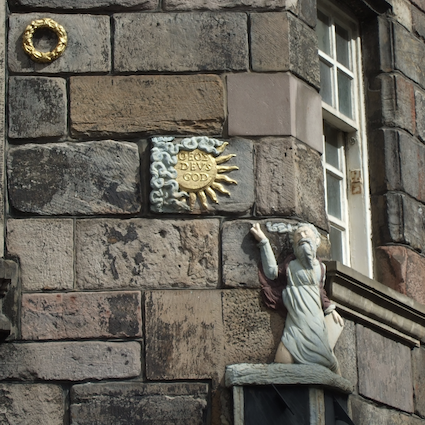
Gavin Douglas at Gladstone’s Land, Lawnmarket. The ‘soir gled’ is the red kite; the surname of the man after whom Gladstone’s Land refers to a ‘gled stane’, or kite’s stone, hence the golden raptor on the building’s front.

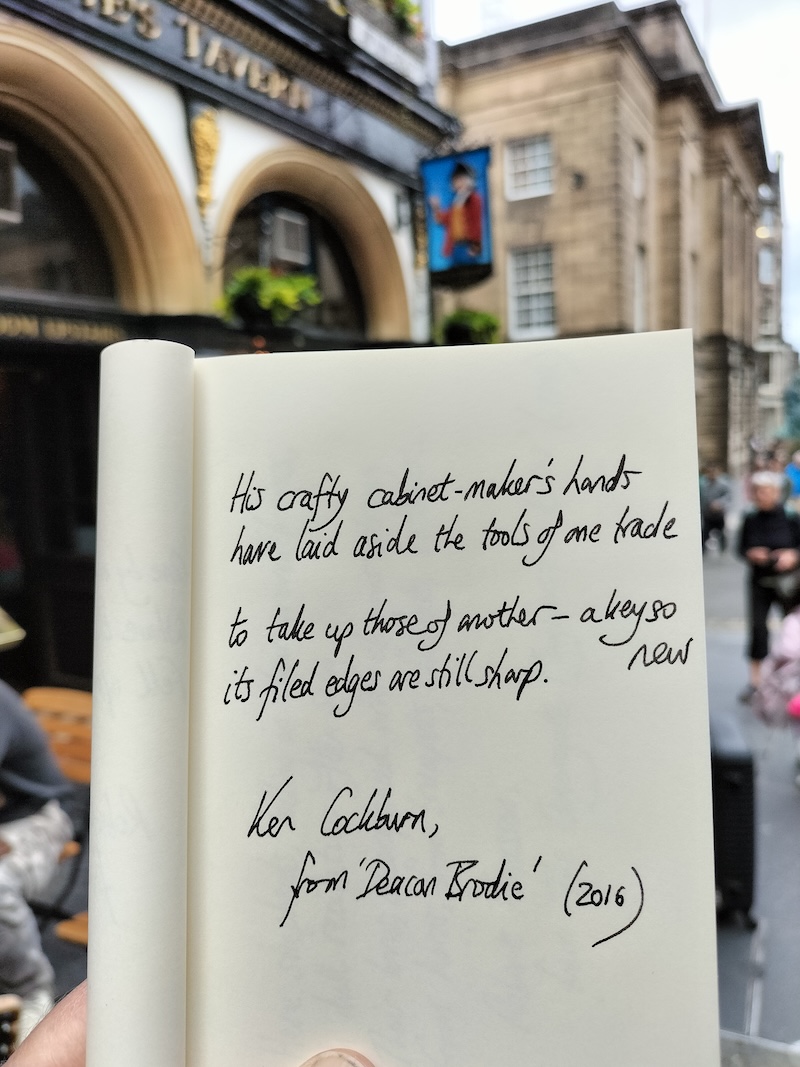
Ken Cockburn at Deacon Brodie’s pub, Lawnmarket

Angus Reid at The Scottish parliament building, Holyrood Road

Robert Fergusson at the Palace of Holyroodhouse

RLS at the High Kirk of St Giles, Parliament Square

John Taylor on Johnstone Terrace

More Instagram Posts 2024

I’ve been posting regularly on instagram this year, with a different theme each month.

The first three months are covered by this post; the themes since then have been Paris and Edinburgh…

the Hebrides and Gael Turnbull…

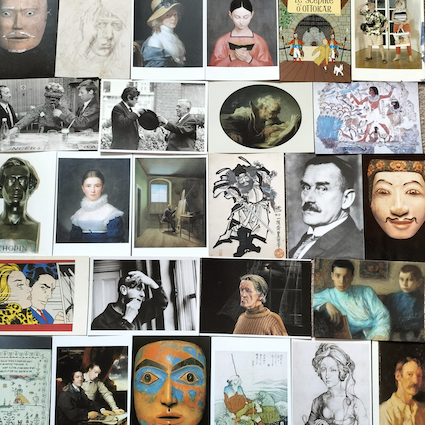
postcard portraits…

then London and poem postcards.

Still two months to come…

kencockburnedinburgh

Poetry walks, summer 2024

I’m running more poetry walks in Edinburgh over the next few months, from 21 June to 12 October.

The June, July, September and October walks start outside St Giles Cathedral; the August walks by the Robert Fergusson statue outside the Canongate Kirk.

Full details here.

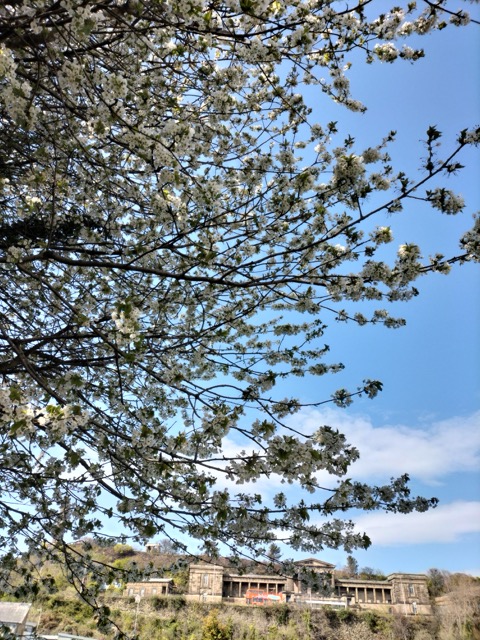
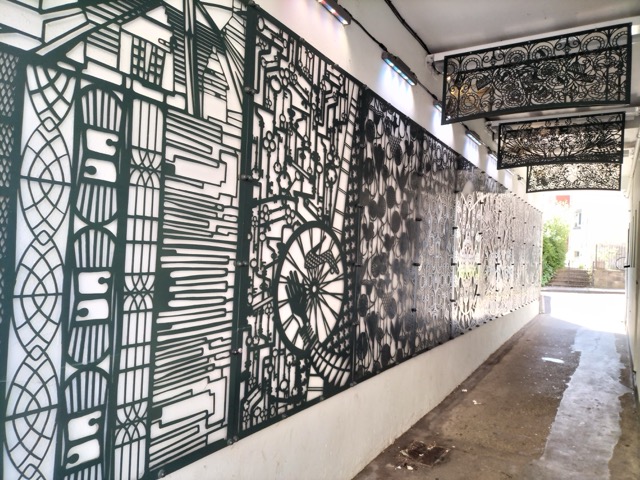
Column 1: St Anthony’s Chapel, Holyrood Park; The Scottish parliament building (staves and shadows); the old Royal High School, Calton Hill

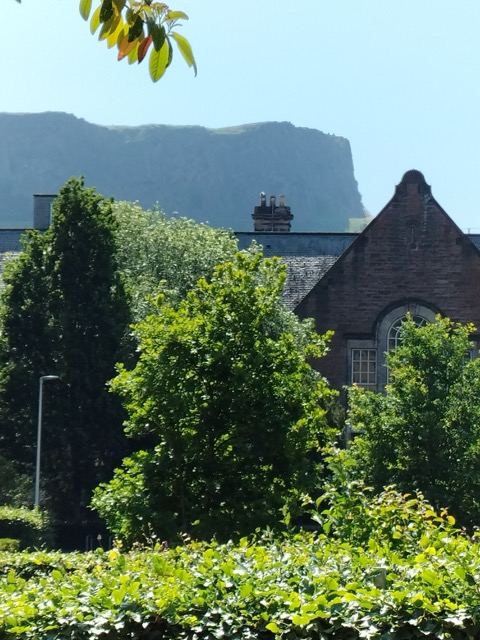
Column 2: Gullan’s Close, Canongate; Salisbury Crags, seen from Moray House gardens; 264 Canongate

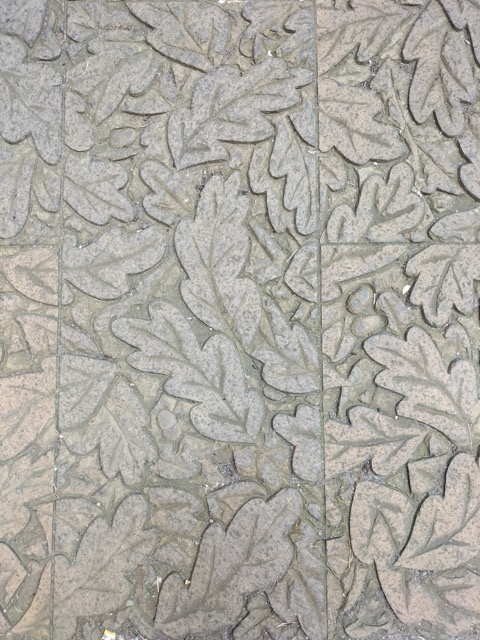
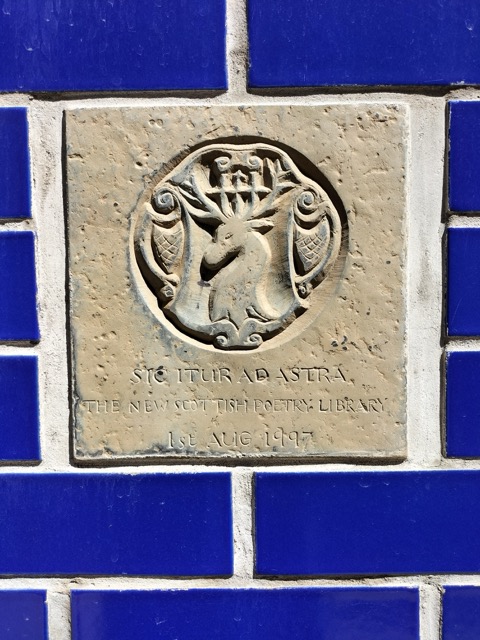
Colum 3: carved oak leaves, Riddle’s Court, Lawnmarket; Scottish Poetry Library; view from New Calton Burial Ground

New prints & books from The Caseroom Press

Some new publications from The Caseroom Press, designed and printed by Barrie Tullett.

There are two prints of individual poems, both published but uncollected.

I wrote ‘Hands’ in 2014, when I was working for the first time in care homes; it’s based partly on what residents told me they’d used their hands for, and partly on my own experiences and memories.

‘Close’ dates from 1996; it’s a poem I put aside, but I rediscovered it when I used it for a poetry walk a few years ago, and now I’m very fond of it. It’s a moment that’s long passed – my daughter has grown up, the ‘newspapermen’ have gone and buses no longer run along that stretch of the Mile – so in it’s way it’s become a historical document.

There are also two books – a single-poem artist’s book, and a little Edinburgh anthology.

Позже / Später / Later features a single poem by Wassily Kandinsky from his 1913 book Klänge. It’s the second in an ongoing series from The Caseroom Press – the first was Гимн / Hymnus / Hymn, published in 2022. This post from the time shows that book, and gives some background about Kandinsky’s book and the current project.

Wale comprises my selection of quotes about Edinburgh from over the centuries. The title is from Robert Fergusson – ‘Auld Reikie, wale o ika toun / That Scotland kens beneath the moon!’, ‘wale’ meaning the choice, the pick, the best. The cover image shows a detail from the paving outside the Scottish parliament building.

If you’d like copies of any of these, please get in touch via the Contact page.

‘Hands’, A3, £10
‘Close’, A4, £5
Wale, 107x107mm, £5
Позже / Später / Later, 220x220mm, £20
P&P will be added to the above prices.

Edinburgh Communities

On and off since spring of last year I’ve been running sessions in care homes and day centres for the Edinburgh International Book Festival’s Communities Programme. Sessions are themed, and I take in a selection of poems and songs on that theme, together with objects relating to them.

In recent weeks I’ve been visiting Corstorphine Dementia Project and Gilmerton Neurological Care Centre (both in Edinburgh). Themes so far include Scotland, Autumn and Hands, and in the coming weeks we’ll focus on Edinburgh itself as well as travelling Around the World.

The Book Festival came along to last week’s session at Corstorphine, and have since posted about it here. They also took the photos you can see here (in which I’m wearing my best autumnal shirt).

I’m pleased to say the sessions have been really well received – ““the feedback I’ve been getting from staff and our members has just been so positive. From what they tell me, it’s really multi-sensory, engaging and they love the way you deliver the poem and conversation prompts.”

I worked in theatre a long time ago, and it’s been good to explore a more performative approach to presenting poems.

I don’t think I’ve mentioned here the post I wrote for the Book Festival last year, about the sessions I ran at Eagle Lodge Care Home, which you can still read here.

My thanks to the Book Festival for enabling these sessions, to the organisers at the care homes and community centres, and to everyone who has listened, joined in, made suggestions and otherwise conversed.

Edinburgh (2nd edition)

Almost 18 months ago Barie Tullet’s Caseroom Press published the pamphlet Edinburgh: poems and translations. The first edition – hand-sewn, with covers in a wide range of colours – is now sold out, and last month a second edition appeared, with staples and a uniform cover. The contents remain the same – poems about the city written in 1996-97 and 2016, plus translations from Victor Hugo, Theodor Fontane and the 17th century Latin of Arthur Johnston.

The first sales were at last month’s Artists Book Fair at the Fruitmarket Gallery. Also on sale there were two new pamphlets, both featuring poems that would have made the cut for Edinburgh: poems and translations had they been written a little sooner.

They were commissioned by the first Push the Boat Out festival in autumn 2021, and again refer to sites in Edinburgh’s Old Town: ‘Jacob’s Ladder’ beneath the railways bridge at the junction of Calton Road and New Street, and ‘The Ballad of William Knox’ at the poet’s memorial stone in the New Calton Burial Ground, not far from the Stevenson vault, where Robert Louis’s grandfather, father, and uncle are all buried. (There are some photos of his memorial in an earlier blog, part of An Edinburgh Alphabet – scroll down to ‘K’.)

Edinburgh: poems & translations
ISBN 978-1-905821-35-8
210 x 125mm, 16 pages, soft covers

Jacob’s Ladder
No ISBN
282 x 99mm, 4pp, grey endpapers

The Ballad of William Knox
No ISBN
282 x 99mm, 4pp, blue endpapers

Now Listen

I’ve been reading poems into my phone and my laptop quite often over the past few months.

Earlier this year The Academy of American Poets published ‘Home’ as part of the poem-a-day series. It’s a portrait of my father in his last months of his life, and you can read and listen to it here.

Then there are three poems in edition #10 of iamb: poetry seen and heard – ‘Hands’, ‘Rodney’ and ‘Ward’. I’m in good company – Jay Whittaker, Penelope Shuttle and others.

Last year I was commissioned by Edinburgh’s Push the Boat Out poetry festival to write poems about central Edinburgh for A Poetry Mile. I wrote three new poems, and they also accepted a couple of older poems, ‘Close’ and ‘William ‘Deacon’ Brodie’.

You can find recordings of me reading them on the Poetry Map section of the website -again in good company, including Alan Spence and JL Williams – but you do have to hunt for the poems, as even if you know the city well they’re not quite where they should be.

To listen to ‘Jacob’s Ladder’, click the marker on Calton Road just west of the junction with New Street.

‘Close’ is the marker on the High Street by Filling Station.

The marker for ‘Greyfriars Bobby’ is inside Greyfriars Kirkyard.

Rather than inside his eponymous tavern, ‘William ‘Deacon’ Brodie’ can be found loitering at New College, between Mound Place and Castlehill.

‘The Ballad of William Knox’ should be in the New Calton Burial Ground, or New Calton Cemetery as it’s called on the map, which runs from Regent Road down to Calton Road. Knox’s needle stands roughly between Archibald Elliott and Robert Stevenson, but there’s no marker in the vicinity. If you manage to locate him, let me know.

Duncan Ban MacIntyre

duncan ban mcintyre memorial greyfriars 1

Described on his grave memorial as ‘the celebrated Celtic bard’, Donnachadh Mac An t-Saoir (1724–1812) spent much of his long life in Edinburgh. Known in English as Duncan Ban MacIntyre, he moved from Breadalbane to Edinburgh in 1767, and was employed, like many Highlanders in the city, as a member of the City Guard. His wife ran a pub in the Lawnmarket. They lived in Roxburgh Close, off the north side of the High Street, where this plaque remembers him.

512px-Plaque_to_Duncan_Ban_MacIntyre,_Roxburgh_Close,_Edinburgh

Illiterate, he nevertheless published three editions of his poems as Orain Ghaidhealach (Gaelic Songs) in 1768, 1790 and 1804, assisted by his friend the Rev. John Stewart, ministers being at the time often the only people fully literate in Gaelic. Each edition was funded by subscription, and MacIntyre travelled across Scotland to persuade, with some success, potential readers to sign up.

Additional poems were added to second and third editions. ‘Oran Dhùn Eideann’ (Song to Edinburgh) first appeared in the third edition, and sings the praises of the poet’s adopted city. Below is the poem’s penultimate stanza in Gaelic, then in English and French (translated by, respectively, Angus MacLeod and Donald James Macleod).

Tha Dun-éideann boidheach
Air iomadh seòl na dhà,
Gun bhaile anns an rioghachd so
Nach deanadh striochdadh dha ;
A liuthad fear a dh’innsinn ann
A bélreadh cis do chach,
Daoin-uaisle casg’ an iota
Ag òl air fion na Spàinnt’.

Edinburgh is beautiful
in many diverse ways;
there is no city in this realm
but would yield it precedence.
How many men I could tell of there,
who would give others fee,
while gentlemen slake their thirst
by drinking Spanish wine.

Edimbourg est belle
En bien des façons ;
Il n’y a point de ville dans ce royaume,
Qui ne doive reconnaître sa supériorité ;
Il y a beaucoup de personnes que je pourrais nommer
Qui donnaient des revenus à d’autres,
Des messieurs qui étanchent leur soif
En buvant le vin d’Espagne.

He is buried in Greyfriars Kirkyard.

duncan ban mcintyre memorial greyfriars 2

Photo credits:

“File:Plaque to Duncan Ban MacIntyre, Roxburgh Close, Edinburgh.jpg” by Stephencdickson is licensed under CC BY-SA 4.0

“duncan ban mcintyre memorial greyfriars” by Gary Thomson is licensed under CC BY-NC-ND 2.0

“duncan ban mcintyre memorial greyfriars” by Gary Thomson is licensed under CC BY-NC-ND 2.0

Norman MacCaig

Herms Norman MacCaig
Norman MacCaig by David Annand

It’s almost a quarter century since the death of Norman MacCaig, on 23 January 1996.

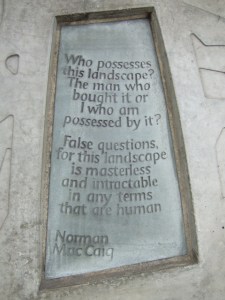
MacCaig is often thought of as a poet of remote places – Assynt and Harris, in particular – but he lived and worked most of his life in Edinburgh, and the city features in many of his poems, including these lines on the Scottish Parliament building’s Canongate wall:

Inscription_Parliament_MacCaig

You’ll also encounter him on Rose Street:

EPT Rose St MacCaig
MacCaig, from ‘November Night, Edinburgh’, Rose Street

I’ve just come across ‘Drop-out in Edinburgh’ from his collection The World’s Room (1974), in which the sounds of the city are neatly summed up as

… warpipes and genteel pianos
and the sawing voices of lawyers.

That poem articulates the city’s opposites as “caves of guilt… pinnacles of jubilation”. In an earlier poem, ‘Out from a Lecture’, having bemoaned the dullness of lectures and book-learning, he is heartened by an everyday epiphany:

The High Street sticks his elbows in my ribs,
Lifts up a dram of shopfronts; shuts that book.
– And I raise my little glass where like a cherry
The sun’s stuck on a chimney-stack, and drink.

Slàinte!