Tag Archives: Edinburgh

Now Listen

I’ve been reading poems into my phone and my laptop quite often over the past few months.

Earlier this year The Academy of American Poets published ‘Home’ as part of the poem-a-day series. It’s a portrait of my father in his last months of his life, and you can read and listen to it here.

Then there are three poems in edition #10 of iamb: poetry seen and heard – ‘Hands’, ‘Rodney’ and ‘Ward’. I’m in good company – Jay Whittaker, Penelope Shuttle and others.

Last year I was commissioned by Edinburgh’s Push the Boat Out poetry festival to write poems about central Edinburgh for A Poetry Mile. I wrote three new poems, and they also accepted a couple of older poems, ‘Close’ and ‘William ‘Deacon’ Brodie’.

You can find recordings of me reading them on the Poetry Map section of the website -again in good company, including Alan Spence and JL Williams – but you do have to hunt for the poems, as even if you know the city well they’re not quite where they should be.

To listen to ‘Jacob’s Ladder’, click the marker on Calton Road just west of the junction with New Street.

‘Close’ is the marker on the High Street by Filling Station.

The marker for ‘Greyfriars Bobby’ is inside Greyfriars Kirkyard.

Rather than inside his eponymous tavern, ‘William ‘Deacon’ Brodie’ can be found loitering at New College, between Mound Place and Castlehill.

‘The Ballad of William Knox’ should be in the New Calton Burial Ground, or New Calton Cemetery as it’s called on the map, which runs from Regent Road down to Calton Road. Knox’s needle stands roughly between Archibald Elliott and Robert Stevenson, but there’s no marker in the vicinity. If you manage to locate him, let me know.

Duncan Ban MacIntyre

duncan ban mcintyre memorial greyfriars 1

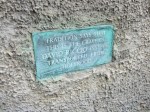
Described on his grave memorial as ‘the celebrated Celtic bard’, Donnachadh Mac An t-Saoir (1724–1812) spent much of his long life in Edinburgh. Known in English as Duncan Ban MacIntyre, he moved from Breadalbane to Edinburgh in 1767, and was employed, like many Highlanders in the city, as a member of the City Guard. His wife ran a pub in the Lawnmarket. They lived in Roxburgh Close, off the north side of the High Street, where this plaque remembers him.

512px-Plaque_to_Duncan_Ban_MacIntyre,_Roxburgh_Close,_Edinburgh

Illiterate, he nevertheless published three editions of his poems as Orain Ghaidhealach (Gaelic Songs) in 1768, 1790 and 1804, assisted by his friend the Rev. John Stewart, ministers being at the time often the only people fully literate in Gaelic. Each edition was funded by subscription, and MacIntyre travelled across Scotland to persuade, with some success, potential readers to sign up.

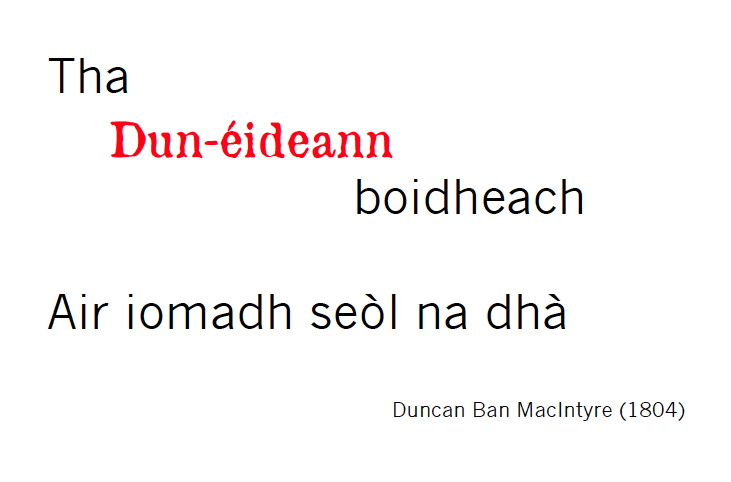
Additional poems were added to second and third editions. ‘Oran Dhùn Eideann’ (Song to Edinburgh) first appeared in the third edition, and sings the praises of the poet’s adopted city. Below is the poem’s penultimate stanza in Gaelic, then in English and French (translated by, respectively, Angus MacLeod and Donald James Macleod).

Tha Dun-éideann boidheach
Air iomadh seòl na dhà,
Gun bhaile anns an rioghachd so
Nach deanadh striochdadh dha ;
A liuthad fear a dh’innsinn ann
A bélreadh cis do chach,
Daoin-uaisle casg’ an iota
Ag òl air fion na Spàinnt’.

Edinburgh is beautiful
in many diverse ways;
there is no city in this realm
but would yield it precedence.
How many men I could tell of there,
who would give others fee,
while gentlemen slake their thirst
by drinking Spanish wine.

Edimbourg est belle
En bien des façons ;
Il n’y a point de ville dans ce royaume,
Qui ne doive reconnaître sa supériorité ;
Il y a beaucoup de personnes que je pourrais nommer
Qui donnaient des revenus à d’autres,
Des messieurs qui étanchent leur soif
En buvant le vin d’Espagne.

He is buried in Greyfriars Kirkyard.

duncan ban mcintyre memorial greyfriars 2

Photo credits:

“File:Plaque to Duncan Ban MacIntyre, Roxburgh Close, Edinburgh.jpg” by Stephencdickson is licensed under CC BY-SA 4.0

“duncan ban mcintyre memorial greyfriars” by Gary Thomson is licensed under CC BY-NC-ND 2.0

“duncan ban mcintyre memorial greyfriars” by Gary Thomson is licensed under CC BY-NC-ND 2.0

Norman MacCaig

Herms Norman MacCaig
Norman MacCaig by David Annand

It’s almost a quarter century since the death of Norman MacCaig, on 23 January 1996.

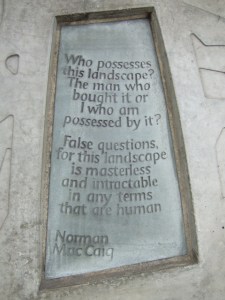
MacCaig is often thought of as a poet of remote places – Assynt and Harris, in particular – but he lived and worked most of his life in Edinburgh, and the city features in many of his poems, including these lines on the Scottish Parliament building’s Canongate wall:

Inscription_Parliament_MacCaig

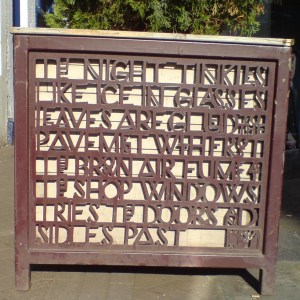
You’ll also encounter him on Rose Street:

EPT Rose St MacCaig
MacCaig, from ‘November Night, Edinburgh’, Rose Street

I’ve just come across ‘Drop-out in Edinburgh’ from his collection The World’s Room (1974), in which the sounds of the city are neatly summed up as

… warpipes and genteel pianos
and the sawing voices of lawyers.

That poem articulates the city’s opposites as “caves of guilt… pinnacles of jubilation”. In an earlier poem, ‘Out from a Lecture’, having bemoaned the dullness of lectures and book-learning, he is heartened by an everyday epiphany:

The High Street sticks his elbows in my ribs,
Lifts up a dram of shopfronts; shuts that book.
– And I raise my little glass where like a cherry
The sun’s stuck on a chimney-stack, and drink.

Slàinte!


Primary Four’s Edinburgh

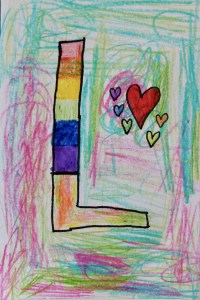
As last year, this spring I led another project at Leith Primary School with Lorna Irvine and Suzanne Butler, and supported by the church of St James the Less, Leith. We worked with the two P4 classes on poetry, drama and song, focussing on their impressions of Edinburgh, and keeping fit and healthy. My group wrote about the games and sports they play, visiting Holyrood Palace, and the food they like to eat, as well as saying hello and goodbye in several languages. They also created a series of individual letters, which I collaged together to create ‘headings’ which were projected during the performance.

My thanks to the school, and especially the class teachers, Mrs McDonald and Mrs Kinneil. Here are some extracts from the script.

Hi – sup – heya – yo –
Bonjour — Salaam aalekum – Nihau – Priviet –
In other words… Hello!

*

We’re going on the bus to Holyrood Palace.

Outside the palace we looked around and saw
a tower that was 500 years old,
shields that had a unicorn and an eagle,
a bath house and a flower garden,
the learning centre and Arthur’s Seat.

Inside the palace we saw
the room with all the jewelry,
the king’s gorgeous jewels and golden swords –
some swords had diamonds in the middle.

We went into the gallery with 96 paintings
but barely any furniture
and our challenge was
to find a sword slash in one of the paintings
and a secret door that leads to the kitchen
and to count all the paintings

and we had to do all of that in 2 minutes!

*

In the evening we go home,
We’re hungry and want some food.
My mum’s banana split and coffee –
That sounds really good!

And when we go to the café
What we want to eat
Is toast or macaroni cheese –
What a delicious treat!

*

We hope you have enjoyed
Spending the day with us
In our Edinburgh.

Au revoir – Gudafis – Zytien – Papa –
So long – See you later – Cheerio – Missing you already –
In other words… goodbye!

Zbigniew Herbert in Scotland, 1963

Herbert Collected Holy Iona

In Zbigniew Herbert’s Collected Poems 1956–1998 I came across a single reference to Scotland, in the poem ‘The Prayer of the Traveler Mr. Cogito’ or, to give it its Polish title, ‘Modlitwa Pana Cogito – podróżnika’. Here is the relevant section in the Polish original, followed by Alissa Valles’s translation from Collected Poems.

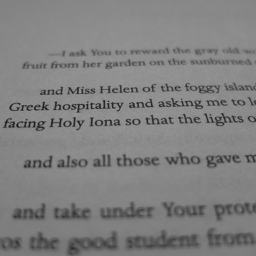
a także Miss Helen z mglistej wysepki Mull na Hebrydach za to że przyjęła mnie po grecku i prosiła żeby w nocy zostawić w oknie wychodzącym na Holy Iona zapaloną lampę aby światła ziemi pozdrawiały się

and Miss Helen of the foggy island of Mull in the Hebrides for offering Greek hospitality and asking me to leave a lamp lit at night in the window facing Holy Iona so that the lights of earth would greet each other

The poem is taken from Herbert’s 1983 collection Raport z oblężonego Miasta / Report from a Besieged City. I was curious to know more about the time he spent in Scotland, which was in fact twenty years before this collection appeared, in autumn 1963. According to Andrzej Franaszek’s 2018 biography of Herbert, using public transport Herbert travelled north from London, stopping in Leeds, York and Durham before arriving in Scotland, where he visited Edinburgh, Aberdeen, Inverness, Oban, Mull and Glasgow, before returning via Carlisle to London.

Franaszek quotes from a postcard Herbert sent from Edinburgh on 18 October:

Wdrapałem się na górę koło Edynburga i oczywiście spadłem trochę (niegroźnie). Tak trzeba. Ziemio ty moja szkocka ukochana! Jutro jadę, ale dobrze nie wiem dokąd. Dziś w nocy narada sztabu z mapą. Jestem bardzo szczęśliwy, żeście mnie wypchnęli w świat. (…) Przede mną góry i skały, kozice i georginie. Naprzód! Hej!!!

I scrambled my way onto a mountain near Edinburgh and I fell down a little (not dangerously). Maybe a good thing. My beloved Scottish earth! I am leaving tomorrow, even though I’m not sure where I’m going. Tonight there will be a conference of the High Command over the map. I’m very glad that you pushed me out into the world. (…) Ahead of me mountains and cliffs, mountain goats and dahlias. Onwards! Hey!!!

In another postcard, sent from Inverness, he described his mixed feelings about the country: he was ‘exhausted but happy, head over heels in love with Scotland; its beauty exhilarates the tourist. But life without sex… one has to go back.’

He returned via the west coast and, finding himself in Oban, decided to cross to the nearby Isle of Mull and from cross there to Iona or, as he consistently called it, using the English adjective, Holy Iona. ‘Holy Iona, czyli kartka z podróży’ (‘Holy Iona, or a page of travel’) was written in 1966 for the West German radio station WDR, and published posthumously in the collection Mistrz z Delft (2008). Of his perspective of islands, he wrote:

Wyspy nie należą do krajobrazu mego dzieciństwa. Urodziłem się w środkowej Europie, w połowie drogi między Morzem Bałtyckim a Czarnym. Pejzaż mojej młodości to podlwowskie okolice: jary i łagodne pagórki porośnięte sosną, na której najpiękniej kwitnie pierwszy sypki śnieg. Morze było tam czymś niewyobrażalnym, a wyspy miały posmak baśni.

Islands were not part of the landscape of my childhood. I was born in Central Europe, halfway between the Baltic and the Black Sea. The landscape of my youth was the area near Lwów, crevices and gentles hills covered in pine on which the first dry snow bloomed beautifully. The sea was something unimaginable there, and islands had a scent of fairytales.

The crossing to Iona had something otherwordly about it. It was 29 October, his birthday, and the ferry was no longer sailing. The landlady of his B&B at Fionnphort phoned a local fisherman, who agreed to take Herbert on the short crossing. In his radio talk he described their meeting-place:

Zimny, wilgotny, siwy ranek. Stoję w pobliżu jetty, która jest po prostu betonową ścieżką wchodzącą w morze. Ocean jest wzburzony, wysokie fale rozbijają się na skałach urwistego brzegu. Nagle z mgły wyłania się mała łódka rybacka płynąca w moim kierunku. Było to jak podanie ręki marzeniu.

A cold, damp, gray morning. I am standing near a jetty, which is just a concrete path going into the sea… which was stormy, high waves crashing against a rocky coast. A small open boat appeared from out of the mist; it was like extending your hand to a dream.

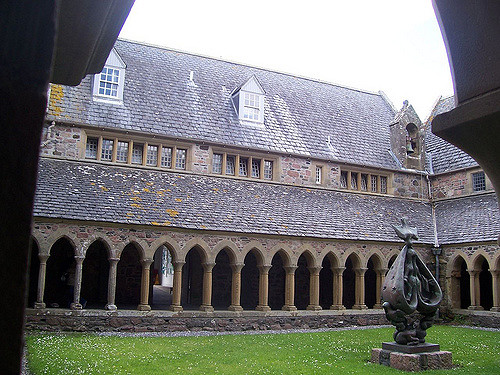
Once on Iona, Herbert explored the recently rebuilt abbey complex. He was particularly struck by his encounter with a sculpture, Descent of the Spirit’, by the Lithuanian-born Jewish sculptor Jacques (Jacob) Lipschitz (1891–1973), who fled France for the USA in 1940.

williammarnochionaabbey2008
Photo: William Marnoch, Iona Abbey, 2008

Its inscription, in French, reads:

Jacob Lipchitz juif fidéle à la fonde ses ancêtres a fait cette vierge pour la bonne entente des hommes sur la terre afin que l’esprit régne

Jacob Lipschitz a Jew faithful to the heritage of his ancestors made this virgin for the accord of men on earth so the spirit might reign

Herbert, who had witnessed the destruction of Polish Jewry during the Second World War, appreciated the paradox of recovering signs of community in this, to him, remote place. He expressed gratitude to ‘the Jewish artist who had heard so many words of hatred and responded by reaching for the words of reconciliation’.

Herbert returned to Mull, and the Fionnphort B&B, that same day. The evening brought him the image of light which he later incorporated into the ‘Prayer’:

Po kolacji gospodyni prosiła mnie, abym postawił małą lampkę w oknie wychodzącym na Holy Iona. Taki jest zwyczaj. Nocą światła obu wysp rozmawiają ze sobą. (…) Nie wiadomo, co przyniesie przyszłość i jak długo trwać będzie rozdarcie świata. Ale dopóki w jedną bodaj noc roku światła tej ziemi będą się pozdrawiały, niecała chyba nadzieja jest pogrzebana.

After supper the landlady asked me to put a small lamp in the window overlooking Holy Iona. That is the custom. At night the lights of both islands talk to each other. (…) It is not known what the future will bring and how long it might be until the world is torn apart, but as long as one night of the year, the lights of this land will offer greetings, hope is not buried.’


My thanks to Robin Connelly, Grażyna Fremi, Michał Kuźmiński, Basia Macmillan and Robert Macmillan for their help in sourcing and translating material on Herbert’s trip. As well as the books mentioned above, online there is, in Polish, a useful article from 2007 by Piotr Toczynski about Herbert and Iona, and a recording of Herbert talking about Scotland (scroll down to the heading ‘Szkocja’).

Reading the Streets: Edinburgh Festival Fringe 2018

Canongate SPL 4
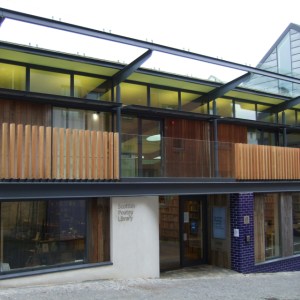
Scottish Poetry Library, Edinburgh

I’m presenting poetry walks on the Edinburgh Festival Fringe again this year, after doing so in 2016 and 2017.

Burns Monument
Burns Monument, Regent Road

As in previous years the walks start and end at the Scottish Poetry Library, off the Canongate near the foot of the Royal Mile. This year’s itinerary includes some sites visited in previous years, including the two nearby graveyards (havens of peace amid the roar of the festival!), while adding new locations, including the Burns Monument on Regent Road. I’ll read some poems I’ve read in previous years, while adding new pieces, including Coleridge’s ecstatic letter to Southey describing his visit in 1803.

Canongate Panmure House from Dunbar's Close garden 2
Panmure House seen from Dunbar’s Close garden

I’m grateful to Valerie Gillies and James Robertson for their permission to include poems they have written about the city. (You can read Valerie’s ‘To Edinburgh’ here.) As well as the linking script, I’ve written a new poem about the philosopher and economist Adam Smith, who lived in the area for the last 12 years of his life, and is buried in the Canongate Kirkyard. (Panmure House, where he lived, has just been renovated by Heriot-Watt University.)

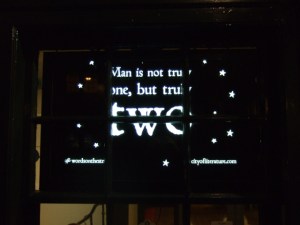
rls-two
Stevenson, from The Strange Case of Dr Jekyll and Mr Hyde (1886)

This year’s walk has the title Reading the Streets, and has as its focus some of the contrasts Edinburgh keeps throwing up. The Old Town / New Town divide is the most obvious and present one, and we’ll cross from one to the other. But there are many others, including at this time of year City / Festival, Residents / Visitors and Local / International. The poems are written in two languages, English / Scots, and since I  include some extracts from diaries and letters there’s a Poetry / Prose contrast too.

Palace Park Parliament
Palace and Paliament against Arthur’s Seat

The new cheek-by-jowl neighbours Palace / Parliament form a contemporary divide, though they’re on the same side in the Historic Time / Geological Time contrast as they look out onto Arthur’s Seat and Salisbury Crags.

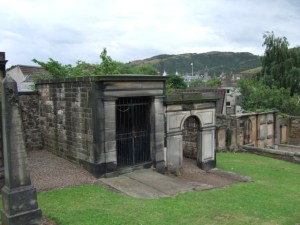
NCBG Stevenson vault 2
Stevenson family vault in the New Calton Burial Ground, Edinburgh

I’m also grateful to the Scottish Poetry Library for including the walks in its Fringe programme. They run from Saturday 4 – Monday 27 August, daily (not Thursdays, Fridays) starting at 11.00, and lasting 90 minutes.

Tickets are available from the Fringe box office, and from the SPL via Eventbrite.

Postcards from Edinburgh (1)

I’ve been tweeting some quotes from about Edinburgh, and here’s a wee collection of the first few.

EPT Wordsworth 02


EPT RLS 10


EPT DBM 02


EPT Garioch 02


EPT Piozzi 01

Dorothy Wordsworth recorded in her diary arriving in Edinburgh with her brother William on 15 September 1803. – Robert Louis Stevenson’s Edinburgh: Picturesque Notes (1878) still speaks to the city today.– Donnchadh Bàn Mac an t-Saoir, or in English Duncan Ban MacIntyre, was a Gaelic poet from Argyll who was a member of City Guard in the late 18th century; the lines, from his poem ‘Oran Dhun Eidann’ (‘Song of Edinburgh’), first published in 1804, translate as ‘Edinburgh is beautiful / in many diverse ways…’. – In ‘To Robert Fergusson’ Robert Garioch (1909–1981) imagines rattling the ‘rigg-bane’ or spine of the Old Town in the company of the energetic earlier poet. – Hester Piozzi, aka Dr Johnson’s confidante Mrs Thrale, visited the city in the summer of 1789, anxious she would encounter ‘a second hand London’, but found something quite different.


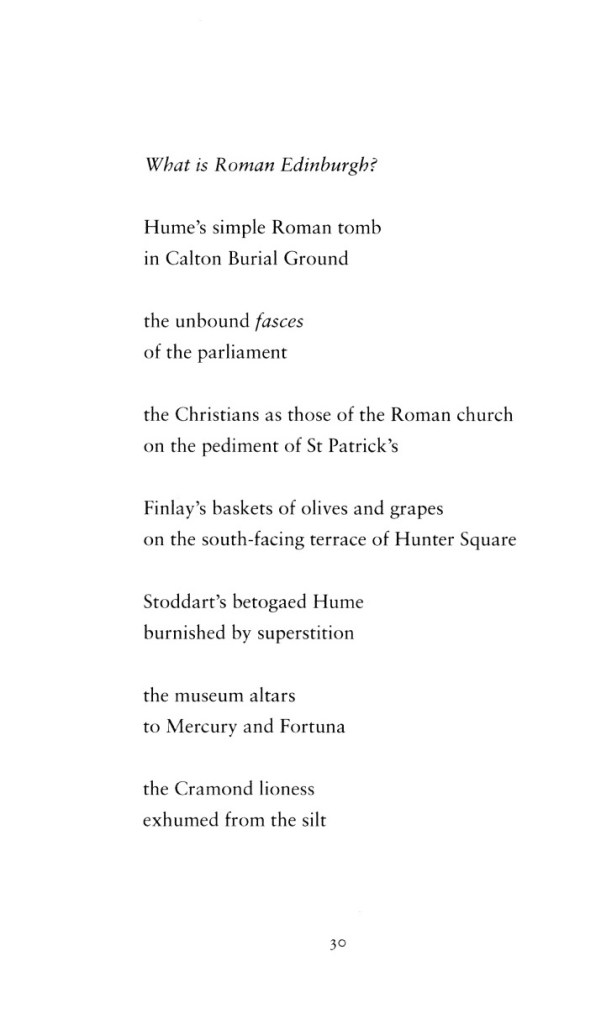
What is Roman Edinburgh?

EPT KC FtW Roman Edinburgh

Like Rome, Edinburgh is a city built on seven hills.

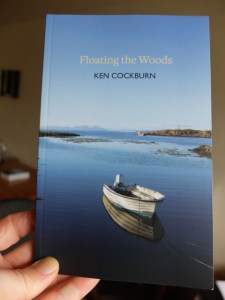
My new collection, Floating the Woods, published by Luath Press, includes ‘Seven Questions’, which considers Edinburgh’s links with Ancient Rome – there’s an extract above.

The book also includes ‘Pandora’s Light Box’, which describes the University of Edinburgh’s Talbot Rice Gallery, which today shows contemporary art but which began life as natural history museum.

Other poems move further afield, to Loch Ness, Orkney, Flanders and Rome itself, where in the 1750s a young Scottish architect, Robert Adam, is beginning to find his way.

Floating the Woods 03


An Edinburgh Alphabet, T–Z

T is for Triduana

Triduana_Chapel Triduana_Statue Triduana_KClabel

In the 19th century, and into the 20th, the main industry in the Canongate was brewing. There were a lots of springs and streams, now channeled underground, providing a good supply of water. Walking into Holyrood Park you soon come across St Margaret’s Well, a spring which has long existed, but whose well-house, as the sign says, was installed here in 1860s, after being moved from Restalrig, about a mile to the east. It’s a miniature copy of St Triduana’s Aisle, a 15th century chapel badly damaged at the Scottish Reformation in 1560, but restored in the early 1900s. I was very struck by it when I first visited 20 years ago, and wrote a poem about it, ‘Intercession’. In the extract below, the first verse gives Triduana’s story; the second describes the well-house.

The unusual hexagonal chapel was built for James III
above a spring, and the floor-slabs, laid below ground level,
would have been underwater: became, much later,
linked with Triduana, an ‘obscure Pictish saint’,
who gifted a princely suitor enamoured of her eyes
those eyes on thorns; was granted her desired seclusion.

*

… Where a well-house stands,
the chapel’s miniature double,
exact down to the floral bosses,
but pumpless: mosses thrive,
and a pipe dribbles water
into a pool of water.

U is for University

University_MesosticInterleaved University_MesosticInterleaved_COCKBURN University_MesosticInterleaved_MORGAN

University_MesosticInterleaved_AFcircle_credit University_MesosticInterleaved_AFcircle

Mesostic Interleaved was a project by Alec Finlay for the The University of Edinburgh Library when it was renovated in 2009. It features 100 mesostics by Alec, myself and other poets on the names of authors held in the library, which were was realised as a book, as a set of bookmarks, and as coloured shelf-ends within the library itself. The two shelf end mesostics pictured are:

rustiC gOds reloCated, craigcrooK’s Bucolic satUrdays inspiRe frieNdship

Man, gO Roam amonG An aNagram

The first is for Henry Cockburn (1779–1850) (no relation), whose friend Francis Jeffrey moved out of Edinburgh to then country district of Craigcrook; the second is for the poet Edwin Morgan (1920–2010), and nods towards Bob Cobbing’s extensive list of anagrams on EDWIN MORGAN, which begins:

AM WONDERING
NOW DREAMING
WORD MEANING
WANDERING ‘OM’

Alec also wrote a circle poem incorporating a mesostic, here shown in its printed form, which was installed as steel text in stone outside the entrance to the library. You can read his account of the project here.

V is for Vailima

Vailima_RLS_SNPG Vailima_RLS_NewCaltonBuryingGround_1 Vailima_RLS_NewCaltonBuryingGround_2

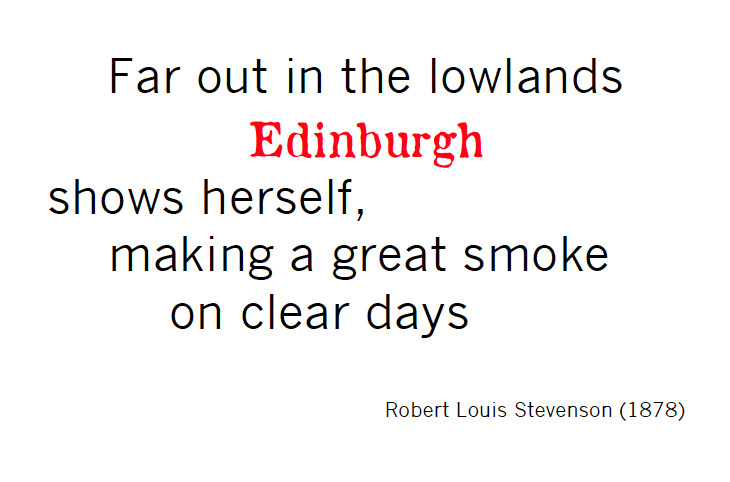
Robert Louis Stevenson (1850–94) bought the estate of Vailima in January 1890, having arrived in Samoa the previous month. He wrote the poem ‘The tropics vanish…’ about the same time. In it he imagines he is high on the Pentland Hills just south of Edinburgh, looking over on the city, before he zooms in on the family vault in the New Calton Burying Ground, where his grandfather and other relatives are buried. Many of them were engineers, and the family became known as ‘the Lighthouse Stevensons’, for all the lighthouses they built around the Scottish coasts. The poem was published posthumously in Songs of Travel (1895), a volume prepared by Stevenson before his death.

Far set in fields and woods, the town I see
Spring gallant from the shallows of her smoke,
Cragged, spired, and turreted, her virgin fort
Beflagged. About, on seaward-drooping hills,
New folds of city glitter…

There, on the sunny frontage of a hill,
Hard by the house of kings, repose the dead,
My dead, the ready and the strong of word.
Their works, the salt-encrusted, still survive;
The sea bombards their founded towers; the night
Thrills pierced with their strong lamps. The artificers,
One after one, here in this grated cell,
Where the rain erases, and the rust consumes,
Fell upon lasting silence…

There are photographs of RLS at Vailima at https://www.capitalcollections.org.uk (search for ‘Vailima’).

W is for Waverley

Waverley_Scott_04 Waverley_1814 Waverley_Scott_03

Waverley_Scott_05 Waverley_Scott_02 Waverley_Scott_01

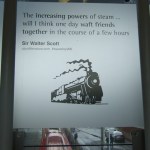
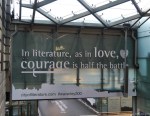
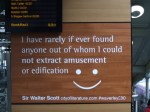
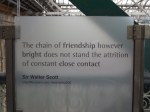
Walter Scott (1771–1832) published his first novel, Waverley; or, ‘Tis Sixty Years Since, in 1814. He was already famous for such poems as The Lay of the Last Minstrel (1805) and The Lady of the Lake (1810), but the novel was published anonymously, and Scott didn’t admit publicly to writing this and the many novels that followed until 1827. Waverley is set during the Jacobite Rebellion of 1745, and narrates the adventures of a young English nobleman who finds himself in Bonnie Prince Charlie’s army. But he’s never quite sure which side he wants to be on, hence his name. The railway station at the east end of Princes St which opened in 1846 was named after Scott’s work. In 2014, to celebrate the 200th annversary of the novel’s appearance, and the re-opening of the line between Edinburgh and the Scottish borders, quotations from Scott’s works were installed around the station by Edinburgh City of Literature.

X is for Charles X

X_HolyroodAbbey X_AFrenchKingAtHolyrood

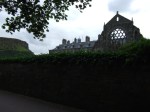
In the past the area around Holyrood Palace was a debtor’s sanctuary. One man who took advantage of that sanctuary was Charles Bourbon, Comte d’Artois (1757–1836), the youngest brother of Louis XVI, guillotined after the French revolution. Charles left France and raised an army to fight the revolutionaries, which lost the first battle it fought. The now heavily indebted Charles fled to Britain; to protect him from his creditors the government sent him north to Holyrood, where he lived from 1796 to 1803. He later returned to mainland Europe, and to France itself after Napoleon’s defeat at Waterloo. In 1824 he became king, but his unpopularity led to his overthrow in 1830 and, given those still outstanding earlier debts, his return to Holyrood.

A year before his fall, he had met the young poet and playwright Victor Hugo (1802–85). Hugo’s play Marion de Lorme had been banned by the censor; his appeal against the ban surprisingly led to a private audience with Charles. But the ban remained, and some years later Hugo wrote a poem about their meeting, contrasting the sumptuous surroundings of Saint Cloud, the palace to the west of Paris where they met, with Charles’ residence at Holyrood, which had suffered from decades of neglect. Hugo never visited Scotland, so he wrote from imagination. He titled the poem ‘Le Sept Août 1829’ (‘7th August 1829’), which was the date of their meeting.

Holyrood ! Holyrood ! la ronce est sur tes dalles.
Le chevreau broute au bas de tes tours féodales.
Ô fureur des rivaux ardents à se chercher !
Amours ! — Darnley ! Rizzio ! quel néant est le vôtre !
Tous deux sont là, — l’un près de l’autre ; —
L’un est une ombre, et l’autre une tâche au plancher !

Holyrood! Holyrood! The bramble is on your flagstones. / The goat grazes beneath your feudal towers. / O fury of the ardent rivals who seek each other! / Loves! — Darnley! Rizzio! what void is yours! / Both are there, — one next to the other; — / One is a shadow, the other a stain on the floor!

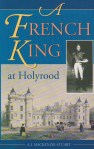
cf A.J. Mackenzie-Stewart’s book A French King at Holyrood (1997).

Y is for Chiang Yee

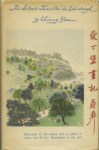
Yee_Silent_Traveller_in_Edinburgh

Chiang Yee (1903–1977) was a Chinese poet, author, painter and calligrapher who lived in Britain from 1933–1955, then spent 20 years in the USA (at Colombia University) before returning to China shortly before he died. He wrote a series of books as The Silent Traveller, including The Silent Traveller in Edinburgh, written during the war years and published in 1948. In it he pairs his own translations of classic Chinese poems with places and people he encounters in the city. In the New Calton Burying Ground he sees the Burns monument, and writes:

When I looked up at it from the lower level of the New Calton Burying Ground it seemed to me singularly beautiful and serene… My thoughts on Burns went further… I began to wonder about his nationality… Recently I read ‘Shakespeare’s Legacy’ by the late Sir James Barrie in which the wife asserts to her husband that Shakespeare was a Scot from Glen Drumly, so why should I not claim Robert Burns as a Chinese by birth, particularly as I can quote the following poem from a collection of Chinese love-songs from twenty-five centuries ago?

Bonnie is my quiet lassie, supposed to be
Waiting for me at the corner of the city wall.
I love her but know not where she is.
Scratching my head I pace to and fro.

Fair is my quiet lassie,
Who gave me a crimson reed.
This crimson reed glows
And reflects her beauty that I love.

From the pasture she brought back for me a tender blade,
So beautiful and rare.
It is not that you, the blade, are beautiful,
But you are the gift of my love.

I do not wish to start an argument, nor to claim that I know anything about Christianity, yet it seems to me that Robert Burns’ life and thoughts are more Confucian than Christian.

Z is for riZZio

Murder of David Rizzio in the presence of Mary Stuart Z_Rizzio

David Rizzio (to use the more common spelling, though the plaque in the Canongate kirkyard opts for Riccio), came to Scotland from his native Turin in 1561. A good musician, and a Catholic, he found favour with Mary Queen of Scots, lately returned from France. In 1565 Mary married a Protestant noble, Lord Darnley, who soon became jealous of Rizzio. On 9 March 1566 Darnley and other Protestant lords burst into her chamber at Holyrood Palace and murdered Rizzio in front of her. Within a year Darnley too was dead, and the country descended into civil war; Mary was forced to abdicate and fled to England. In Hogg’s The Queen’s Wake (1813), Rizzio is the first poet to recite his work to the court.

Short was the pause ; the stranger youth,
The gaudy minstrel of the south,
Whose glossy eye and lady form
Had never braved the northern storm
Stepped lightly forth, — kneeled three times low, —
And then, with many a smile and bow,
Mounted the form amid the ring,
And rung his harp’s responsive string.
Though true the chords, and mellow-toned,
Long, long he twisted, long he coned ;
Well pleased to hear his name they knew ;
‘Tis Rizzio!’ round in whispers flew.

And the beginning of that performance seems as good a place as any to end.

An Edinburgh Alphabet, N–S

N is for Netherbow

Netherbow_Port Netherbow_1606 Netherbow_bell Netherbow_mottoes

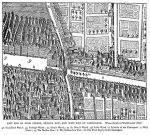
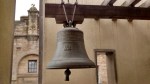
The Netherbow Port was one of six entrances to Edinburgh until it was demolished along with the old city walls in 1764. It was here the Jacobite Army under Bonnie Prince Charlie forced their way into the city in 1745. Today near where it stood is the Scottish Storytelling Centre; it incorporates an inscription from 1606 for James VI, BEATI PACIFICI (blessed are the peacemakers), and a bell commissioned by ‘the senate and people of Edinburgh’ from Holland in 1621. Near the bell is a modern rendering of the motto of James and the other Stuart monarchs, NEMO ME IMPUNE LACESSIT / wha daur meddle wi me.

In 1633, on the occasion of Charles I’s coronation at Holyrood, the whole city was turned into a vast theatre (why does that sound familiar?), with visuals by the painter George Jameson of Aberdeen, and texts by the poet William Drummond of Hawthornden. At the Netherbow Port, there was, according to Drummond’s biographer David Masson, an “arch, with stage, mottoes, canvasses and what not, representing Heaven itself, with stars of all magnitudes, the Earth beneath and the Titans prostrate on it, the Fates, and the Seven Planets, each sitting on a throne, and Endymion among them.”

O is for Ossian
Ossian_BlackfriarsSt Ossian_Fingal Ossian_Gérard_Hamburg Ossian_HughBlair

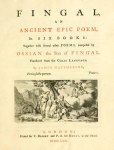
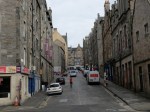
Blackfriars Street runs unassumingly between the Cowgate and the High Street. It was created in 1867 after the demolition of Blackfriars Wynd, where in 1507 the first printing press in Scotland had been set up by Chepman and Myllar. Here in 1762 James Macpherson translated – or wrote – Fingal, one of the most popular and influential works of early Romanticism.

The poems of Ossian were hugely popular in the late 18th and early 19th centuries, widely read in Britain and across Europe, influencing landscape design (especially Scottish follies), the early work of Goethe, and Napoleon, who carried a copy with him on campaign. Presented as prose translations of ancient Gaelic poetry made by James Macpherson, they contained more of the latter than the former.

Macpherson (1736–1796) was a Gaelic speaker from Ruthven in Inverness-shire. He began collecting oral poetry in Gaelic from his home area, popularly considered to be by the legendary bard Ossian, and continued collecting while employed as a tutor by Graham of Balgowan in Perthshire. Here he met the philosopher and historian Adam Ferguson (also a Gaelic speaker), and the minister and playwright John Home, who asked him to translate some Gaelic poems. Macpherson was at first reluctant, but his Fragments of Ancient Poetry (1760) was hugely successful, and he was then funded by the Edinburgh literati to look for what they hoped would be a Scottish epic to rival the Iliad.

Macpherson’s greatest champion was Hugh Blair (1718–1800), a Church of Scotland minister who in 1760 was appointed Professor of Rhetoric at Edinburgh University (and who spoke no Gaelic). In 1762 he invited Macpherson to Edinburgh, and there he composed much of his next book, Fingal, in Blackfriars Wynd, in an apartment directly below Blair’s lodgings. The following year Blair wrote ‘A Critical Dissertation on the Poems Of Ossian, the Son of Fingal’, included in every edition of Ossian after 1765: ‘We may,” he wrote, boldly assign Ossian a place among those whose works are to last for ages.’

Blair described Ossian as “the only poet who never relaxes”. While Macpherson’s language and imagery may have been revelatory and innovative at the time, his work is hard to read at any length now. Even at the time Macpherson had his detractors: Boswell records Samuel Johnson saying, ‘I look upon M’Pherson’s Fingal to be as gross an imposition as ever the world was troubled with. Had it been really an ancient work, a true specimen how men thought at that time, it would have been a curiosity of the first rate. As a modern production, it is nothing.’ (Journal of a Tour to the Hebrides, 22 September 1773)

Below is a brief extract from Fingal.

‘As the troubled noise of the ocean when roll the waves on high: as the last peal of the thunder of heaven, such is the noise of battle. Though Cormac’s hundred bards were there to give the war to song; feeble were the voices of a hundred bards to send the deaths to future times. For many were the falls of the heroes; and wide poured the blood of the valiant.’

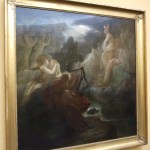
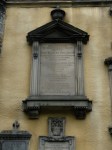
Blair’s memorial is in Greyfriars Kirkyard. François Gérard’s painting ‘Ossian Evoking the Spirits on the Banks of the Lora to the Sound of His Harp’ (c.1811) hangs in the Hamburger Kunsthalle.

P is for Parliament
Parliament_label_EM Parliament_exterior_MSPblock Parliament_exterior_2

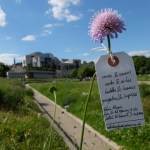
Scotland’s parliament – abolished with the Act of Union in 1707– was restablished in 1999. It met at the Assembly Hall on the Mound, while a new building was being constructed. Designed by the Catalan architect Enric Miralles, who died in 2000, it opened on 9 October 2004. On that day a poem was read, written by Edwin Morgan, the Scottish Makar, or national poet. He lived in Glasgow, was in his 80s, and not in good health, so he wasn’t able to visit the building. He wrote from photos, and plans, and people’s descriptions, but he gives a very accurate description of the building and its variety. The poem is in three parts: the first describes the building, the second describes its place in Edinburgh, and in Scottish history, and the third looks to what we might expect in the future from the new parliamentarians. This is from the first part.

‘Did you want classic columns and predictable pediments? A growl of old Gothic grandeur? A blissfully boring box?

‘Not here, no thanks! No icon, no IKEA, no iceberg, but curves and caverns, nooks and niches, huddles and heavens, syncopations and surprises. Leave symmetry to the cemetery. But bring together slate and stainless steel, black granite and grey granite, seasoned oak and sycamore, concrete blond and smooth as silk – the mix is almost alive – it breathes and beckons – imperial marble it is not!’

Features on the building’s exterior include the so-called ‘bamboos’, which in fact are staves of oak. Miralles grew up in the 1950s and 60s in Spain under facism; the facist emblem is a bundle of sticks bound tightly together, and my sense is that these are those sticks unbound. That’s the difference between facism and democracy – here each stick has its own individual space. The ‘trigger panels’ can be seen as the wrist and lower part of the palm – so the image of a clenched fist. again it’s a reminder to those inside the building of why they are there – as representatives of the people, and the land, outside the building.

Q is for Queen

QueensWake_Hogg QueensWake_HoggMemorial_Ettrick

The Queen’s Wake (1813) is a book-length poem by James Hogg (1770–1835). In it Hogg imagines Holyrood Palace at Christmas 1561. Mary Stuart has returned to Scotland from France, after the death of her husband, King François II, the previous year. She misses the entertainments of the French court, and so calls a ‘wake’ at Christmas – essentially a poetry competition, a 16th century equivalent of a spoken word slam. Just as performers have arrived from all over the world for this year’s Festival, Hogg imagines poets from all over Scotland coming to Edinburgh and performing at the palace over three nights. In this passage, they are newly arrived, and confidence in their abilities quickly turns to nerves.

‘Ah! when at home the songs they raised,
When gaping rustics stood and gazed,
Each bard believed, with ready will,
Unmatched his song, unmatched his skill!
But when the royal halls appeared,
Each aspect changed, each bosom feared;
And when in court of Holyrood
Filed harps and bards around him stood,
His eye emitted cheerless ray,
His hope, his spirit sunk away:
There stood the minstrel, but his mind
Seemed left in native glen behind.’

The second photo above was taken at the Hogg monument in the Ettrick Valley, with the edition of The Queen’s Wake published by Edinburgh University Press in 2005.

R is for Ransford

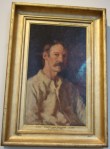
Ransford_portrait Ransford_MadeInEdinburgh

Tessa Ransford (1938–2015) was the founding Director of the Scottish Poetry Library from 1984 until 1999, when the library moved from what had become cramped premises in Tweeddale Court to new purpose-built premises at Crichton’s Close off the Canongate. She published many volumes of poems, including Shadows from the Greater Hill (1987), a year-long meditation on Edinburgh’s Holyrood Park, which her flat overlooked; and Made in Edinburgh (2014), a selection of her poems about the city.

The poem below is from Shadows from the Greater Hill.

August 20th

The Duke’s Fell ponies are out for exercise,
six in tandem pairs, with free-flowing tails:
Martin, Roy, Edward, Robin, Mark, Ebony.

They slow down beside me passing with my briefcase
in the prancing morning.

Each of them is power for ten times the buggy.
Six of them feel it not more than conscience
harnessed behind them,
but they know bit and blinkers, collar and straps.

Each of them is part of an all-black team,
moving with precision as one organism.

Their trainer speaks.
They hear his voice separately, but respond together.
The reins are in his fingers.


S is for St Anthony’s Chapel
StAnthonysChapel_DW_1 StAnthonysChapel_DW_3 StAnthonysChapel_DW_2

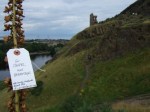
In her diary, Dorothy Wordsworth, visiting the city with her brother William, mentions St Anthony’s Chapel in Holyrood Park. The Wordsworths had made a journey from their home in the Lake District to Scotland, initially accompanied by Coleridge too, but he went his own way in the Highlands. Returning south, they reached Edinburgh on Thursday 15 September, 1803, and stayed at the White Hart Inn in the Grassmarket, which Dorothy described as “not noisy, and tolerably cheap”. The following morning they set out from the Grassmarket in the direction of Holyrood. She writes:

‘We set out upon our walk, and went through many streets to Holyrood House, and thence to the hill called Arthur’s Seat, a high hill, very rocky at the top, and below covered with smooth turf, on which sheep were feeding. We climbed up till we came to St. Anthony’s Well and Chapel, as it is called, but it is more like a hermitage than a chapel, – a small ruin, which from its situation is exceedingly interesting, though in itself not remarkable. We sat down on a stone not far from the chapel, overlooking a pastoral hollow as wild and solitary as any in the heart of the Highland mountains: there, instead of the roaring of torrents, we listened to the noises of the city, which were blended in one loud indistinct buzz, – a regular sound in the air, which in certain moods of feeling, and at certain times, might have a more tranquillizing effect upon the mind than those which we are accustomed to hear in such places.’