Category Archives: Publications

Orkney

we sail past Stroma’s empty fields
the Maidens grind the sea-gods’ salt
binoculars to scan the scene
the latent power the races hold

the Romans came and saw and left
Vikings named themselves in runes
a hoard of shards the dig unearthed
the sacred grove is made of stone

unfurl your banner to the breeze
starlings wheel across the sky
a spotted orchid in the verge
the wind is in the blades and flags

divers down among the wrecks
I don’t know what it is I’ve found
a haar drifts in across the rocks
the crab’s blue shell fades in the sun

Last autumn I took part in The Written Image, an exhibition organised by Edinburgh Printmakers Workshop and the Scottish Poetry Library. Poets and printmakers were paired, and I worked with Cat Outram. When we met she was just about to visit Orkney for the first time, and I’d visited the previous summer, so that became our theme. We came to settle on four of Cat’s images that seemed to give a good overview of Orkney: FERRY (geography), FARM (economy), BEACH (ecology), and BRODGAR (archaeology). I returned to a notebook I’d kept while there in 2012, and another relating to an unrealised project at John O’Groats; for each image I composed a 4-line stanza, guided by half-rhymes. The order in which the stanzas can be read is interchangeable. ‘The Maidens’ are one of the powerful tidal currents, or ‘races’, in the Pentland Firth.

Orkney print 2

Summer on the road north

Road sign

In the grey afternoons and long nights of January, it’s good to be reminded of The Road North, the summer Alec Finlay and I followed the Japanese poets Basho and Sora along the hosomichi, the back roads, of Perthshire, Argyll, the Hebrides and elsewhere.

The big blog is still available, but we’ve also written a long poem about the journey. There are four extracts from it in the new edition of Northwords Now (no. 25) – ‘Glen Lyon’, ‘Loch Etive’, ‘Schiehallion’ and ‘Berneray’– available here; other sections are online at Alec’s blog; more will appear in the spring edition of Shearsman.

23 wood sorrel

Composite Landscapes

‘Composite Landscapes’ is a paper on my work with artists ~in the fields, which I delivered at the conference Writing into Art held at the University of Strathclyde and Kelvingrove Museum and Art Gallery, Glasgow, on 18–19 June 2013.
01 ~in the fields

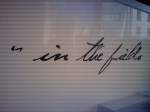
Since 2008, I have collaborated on several projects with the artist collective ~ in the fields, Nicole Heidtke and Stefan Baumberger. Their work, in their own words, “emphasizes natural phenomena and condenses poetic moments into inventions of closed systems”. Their visual art practice draws on archival material and often involves environmental topics.

Our collaborations include a publication, an exhibition and public art projects, and I would like to consider some of the approaches to writing these different projects suggested, in terms of our collaborative methods, as well as the ways in which the content, form and sequencing of the resultant texts developed.

In particular I’ll consider two works: ink, for which text, written in response to an extant sculptural work, features in and shapes a book publication; and yen to see distant places, an interactive work made for an exhibition last summer at New Media Scotland, Edinburgh.
02 soccer

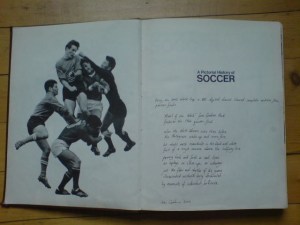
Our initial connection was a shared interest in the relationship of the handwritten inscription to the printed book – the individual to the mass-produced. I wrote a sequence of poems, On the flyleaf, notionally written in and relating to particular books, and I continue to have an interest in marginalia – readers writing in books. The image above features one of the ‘flyleaf’ poems.
03 parallel_view_on_programming_det

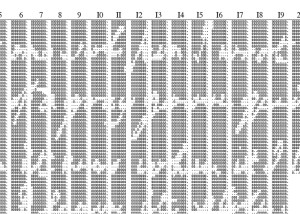
~ in the fields’ work incorporates new and old media, and their sculptural work ink used digitised versions of handwritten inscriptions found in five printed books from five centuries. This inscription – here represented in digital form – is taken from a 1634 edition of Pliny’s Natural History:

With one sole pen I wrote this book
Made of a grey goose quill;
A pen it was when I it tooke,
And a pen I leave it still.

04 ink_threespheres

Ink – the sculptural work – consists of five colourless clear glass bulbs – each partly filled with blue ink. When the visitor approaches, the bulbs begin to rotate, causing a layer of ink to coat the inside surface. Through the ink, illuminated handwritten inscriptions become visible on a spinning armature – a rotor with LEDs which pulse very quickly – and the inscriptions are given to the visitor individually. The visitor’s presence initiates the offering of the inscription once again.
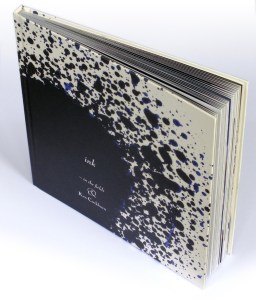
05 Ink upright

In the book Ink, images and texts relating to the sculptural work ink are augmented by texts by myself – original poems, found poems and reflective prose – which consider the sculptural work itself as well as the related topics of marginalia and the colour blue. An alphabet poem – on imaginary shades of blue – came to define the structure and extent of the book.

06 Ink French folds

The book is bound using French folds – the main text is all printed on one side of the paper – but between the pages, as it were, there is a background text – the alphabet poem – glimpsed out of the darkness. The book is 52 pages, so two pages for each letter of the alphabet.
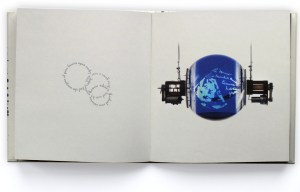
07 Ink Circles

The poems in the book move off in different directions from the sculptural work. As well as the blue alphabet, there are found poems using parts of the handwritten descriptions; these additionally reflect the globes of sculptural work by being presented as circle poems, a form I had previously attempted without much success, but which seemed to work for me in this context. There are also poems reflecting on the sculptural work directly – on movement – on the propriety, or otherwise, of writing in books – and on the happenstance of the collaboration occuring in the first place. Here are two short poems – original, rather than found – from the book.

A paradox – before
this or any other book
absorbs the library-
stamp of ownership.
marginalia’s
a proper response, a nod
to posterity; but afterwards
unwanted, wanton, an act
of desecration,
proper grounds for censure.

*

It felt like a gift, such an encounter, out of the blue.

*****

08 Myriorama

“Landscape is not seen as merely dramatic background but as a force which shapes and directs the minds of its inhabitants.” (James Reed)

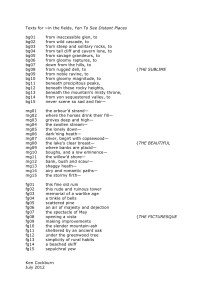
yen to see distant places from 2012 projects composite landscapes drawn from early 19th century etchings of Scottish landscapes, creating – perhaps somewhat in the manner of historical fiction – an image each of whose elements is based in reality, but which has never yet appeared in quite this context or combination.

Each composite image consists of three elements – background (The Sublime), middleground (The Beautiful) and foreground (The Picturesque).

~in the fields wrote to me: “[we are] working with the ‘Sublime’ as landscape elements which are rough and evoke respect. The ‘Beautiful’ (Edmund Burke) are the small elements, smooth, delicate. The ‘Picturesque’ (William Gilpin) element is something like a ruin of a castle… We decided also to have the introduction of the rhododendron, etc.”
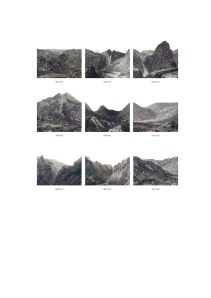
09 backgrounds 1-9

Here are some of the backgrounds. Individual elements are sourced from different books, mainly Walter Scott’s Provincial antiquities and picturesque scenery of Scotland: with descriptive illustrations, published in the 1820s. Other sources are books from the Botanic Garden Library, for example, Scottish trees with a history or a connection to a famous place. There are also some landscape drawings by Robert Kaye Greville (mainly for ‘the beautiful’) from the 1830s.
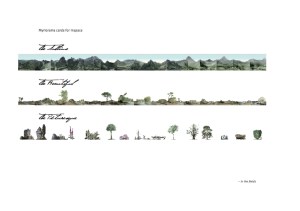
10 3 x 15

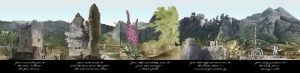
Fifteen images were selected, and individually coloured, for each element, and thus in total there are over three thousand possible combinations(15x15x15), or composite landscapes. The idea is also that the composite images can also connect horizontally to form a continuous landscape, or ‘myriorama’ – an idea taken from 19th century sets of cards featuring landscapes, which could be placed in any order and still produce a coherent image.
11 0001wG

I was originally asked to provide a short caption or title for each image, but in fact produced a short poetic line, mostly taken or adapted from the work of Sir Walter Scott and other Romantic writers. Like the images, these lines were adjusted so that when combined they form a composite three-line verse, or Romantic haiku. The first and second lines – background and middleground – are linked by prepositions ‘from x to y’ – with the third line following after a dash, thus precluding the need for more specific syntax, yet qualifying the previous couplet in some way.

12 2012-08-09 16.17.56

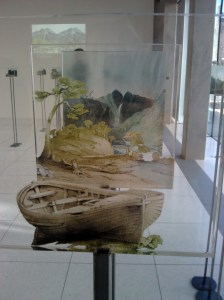
Here is a shot from the exhibition. You can see how each of the images is presented on a glass screen on a pole. When these are moved into a certain position, they are projected on to the screen at the back as a combined image, and the text appears with them.

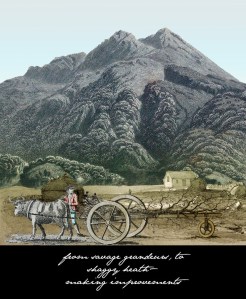
Here is the composite landscape, and poem, formed from the three elements in the bottom right of this image.
13 4_27_38

The text reads

from savage grandeurs, to
shaggy heath –
making improvements
14 2012-08-09 16.14.56

Another exhibition shot of the three elements – and the composite landscape which they form.

15 1_24_43

from wild cascade, to
boughs, and a low eminence –
a beached skiff

Here are a series of images, as presented on the screen during the exhibition, shifting from right to left.
16 panorama

In this case, the user experience is very different from that of ink, as they participate and create one image out of three parts, anticipating what the composite image will look like and seeing this as a part of an ongoing panorama, and then being surprised by the related poem they have also “composed”.

*****

To conclude: poetry is about structures, about form as well as content, and sometimes the most interesting way of producing content is to focus on the form, and let the content as it were come of its own accord. I enjoy the way ~in the fields focus on thinking through and making their highly conceptualised and technically ambitious works, and I hope the poems can work in similar ways, as intricate machines which fascinate in terms of both their engineering and their output.

Ken Cockburn, June2013

Autumn leaves

Autumn seems to be the time translations appear – a smaller crop than last year’s, but there are two publications to mention. No Man’s Land, the online journal for German writing in English, has published my translations of Arne Rautenberg – several haiku, and ‘gingko leaf fairy tale’, about coming across a pressed leaf in a copy of Grimm’s Fairy Tales. Those poems, and many more, are included in Snapdragon.

The recent issue (3:18) of Modern Poetry in Translation is on the theme of Transitions. It’s the last to be edited by David and Helen Constantine, who share this issue with their successor, Sasha Dugdale. I’ll be sad to see them go – they have consistently published work of interest from a generous range of poets and translators, and have been very supportive of my work, taking versions of Thomas Brasch, Thomas Rosenlöcher and Heiner Müller. This issue features translations of three poems by Heinz Czechowski (1935–2009), a writer I’ve just discovered this year, and who skillfully interweaves his private and public selves, the historical and the contemporary, the literary and the mundane. You can read one of the poems here.

Beside them are other translations of Czechowski by Ian Hilton, a former professor of Germany at Bangor University, who has known his work for much longer than I have, and who many years ago met the poet on the eastern side of the Berlin Wall.

Letterpress & Typewriters

I spent Saturday at the Scottish Poetry Library in Edinburgh. They were running their annual bookfair, By Leaves We Live, and it must have been one of the best attended ever. I was mostly at The Caseroom Press table with Barrie Tullett, who brought a small selection from his typewriter collection to display, and be used. They were joined by Edwin Morgan’s Blue Bell (part of his archive held by the SPL), and a red Olivetti Valentine, which Angus Reid had bought for his daughter in a Stockbridge charity shop for a tenner, but which drew admiring and even covetous looks from those that know about typewriters.

Barrie recently drew on the old Pepsi advert to write a text about LETTERPRESSIN’, which he letterpressed as a poster, and asked if I’d contribute something similar about POETRY. I obliged, and the result is above. It’s in an edition of 25, at £25.00 each, and copies are still available from the SPL.

A good day of conversations, rounded off with a party for Hamish Whyte’s Mariscat Press, now thirty years young and still going strong.

Snapdragon

Snapdragon is a newly published collection of my translations of poems by the German writer Arne Rautenberg, made over the past decade. Arne lives in Kiel, where I’ve visited him on several occasions, and he has been to Scotland twice, in 2003 and 2007.

As all books are, it is a collaborative effort. I was introduced to Arne by Alec Finlay, who has written the cover blurb above; Stewart Conn heard Arne and me read in Edinburgh and 2003, and his poem ‘Translations’ describing that occasion is included; the book is designed and laid out by Barrie Tullett, with whom I’ve worked on many projects over the years; and the cover was designed by Jantze Tullett, Barrie’s wife.

The ladybird
On the hibiscus flower
In the ashtray

(Haiku)

The poems are fomally varied: monologues, lists and fairy tales – haiku, double haiku and football haiku – one-word poems, nudges and inversions. They are presented as parallel text, German on the left and English on the right.

Between turbulence
And the monstrous rivets
A beckoning home.

His gaze deep in the
Rear wheel of a juggernaut
Thundering on by.

(from ‘Kiel After Rain’)

I mention my choice of title in the Afterword: “I settled on Snapdragon as it seemed to sum up much of Arne’s work: a flower-name, so a word that’s rooted in the real, something delicate and beautiful; yet also with outlandish and unsettling associations.”

The formal details are:
published by The Caseroom Press, 180 x 125 mm, 64 pages, ISBN 978-1-905821-21-1, cover price £5.00.

A review by Lesley Harrison has appeared in Northwords Now, no.22 (if you download the pdf, it’s on p.22). “I don’t speak German, but the English versions conjured very clearly a city-world still recovering from war, and Cockburn’s clipped, wry translations seem to be a perfect window to it, both clever and compelling.”

Arne Rautenberg, Glasgow, 2003
Alec Finlay & Arne Rautenberg, Newcastle-upon-Tyne, 2007
Ken Cockburn & Arne Rautenberg, Kiel, 2008 (photo by Birgit Rautenberg)

Les Citadelles


Alec Finlay and I have been working on a long poem about the journeys we made for The Road North, and two extracts have been translated into French, and published in the most recent edition of Les Citadelles. Philippe Démeron is the journal’s editor and also the translator, and he has chosen the poems ‘Loch na Tormalaich & Loch Duilleag-bhàite, Kilbride, Argyll’, and ‘The Groves of Isle Maree, Wester Ross’. Our swim among water-lilies,

shucking tangled legs
through greasy stems
I kick a lap
among the stars

becomes in Philippe’s French

pour dégager mes jambes empêtrées
dans des tiges gluantes
je donne un coup de genou
dans les étoiles

while this is our tree-list from Isle Maree and its French equivalent:

birch and chestnut
alder and beech
willow and dog-rose
sycamore and juniper

le bouleau et le châtaignier
l’aulne et le hêtre
le saule et l’églantier
le sycomore et le genévrier

We are in good company: elsewhere in the issue are poems by Kenneth White, Derek Mahon and John Montague, as well as an essay on the recent Nobel laureate Tomas Tranströmer, and poems by contemporary French poets including Armelle Leclerq and Roger Lecomte.

Armelle and Roger were my original connection to Les Citadelles. I met them in Bratislava in 2006, when we were all invited to read at the festival Ars Poetica. Roger is on the editorial board of Les Citadelles, and from that initial contact Philippe has translated and published several of poems in the magazine, for which I’m very grateful.

The magazine doesn’t have its own website, but click here for information about this issue, and here for more general information about the magazine. (Both pages are in French.)

The cover price is €10, and the ISSN is 1253-0557. (At time of writing, I have a spare copy, which I’m happy to send to the first person who requests it.)

The Fourth Wound in Fras 16


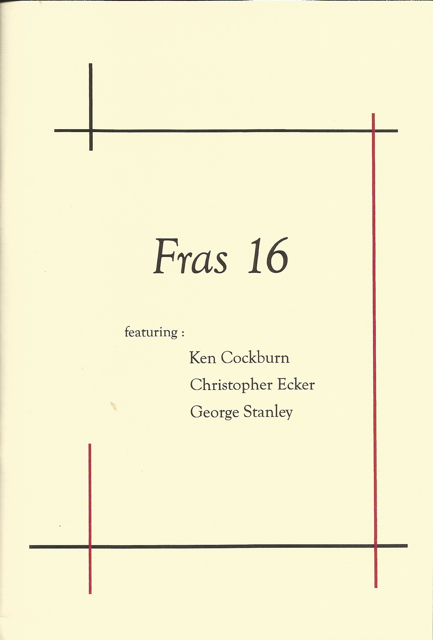
My translation of the opening of Christopher Ecker‘s compelling novella The Fourth Wound (Die vierte Kränkung is the original German title) has just appeared in the magazine Fras, no. 16.

Set in Brittany during World War Two, it tells the unsettling tale of a non-combattant German living there in a state of increasing uncertainty – emotional, psychological, social and moral – and of the shadowy local figures he must reluctantly engage with. Its thriller elements remind me of John Buchan, and it draws eloquently on Breton myth, history and landscape.

Christopher – who I met through the poet Arne Rautenberg, who I’ve also translated – lives in Kiel. His novel Madonna won the Book of the Year (Rheinland-Pflaz) in 2007, and his new novel, Fahlmann, has just been published.

Copies of Fras 16 are available for £4 each from FRAS Publications, 10 Croft Place, Dunning PH2 0SB, Scotland, UK.

From the German

I’ve had translations of German-language poems published in several magazines this autumn.


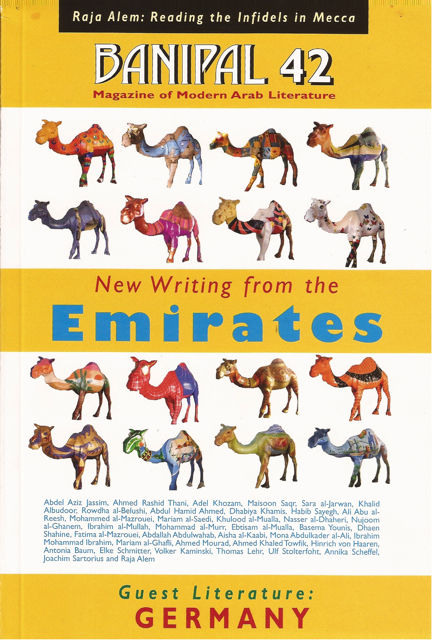
Banipal describes itself as a ‘magazine of modern Arabic literature’. Some years ago I translated for it poems by Adel Karasholi, a Syrian Kurd long exiled in Germany, who now writes in German. The magazine has now started to feature a ‘Guest Literature’ in each issue, and Banipal 42 features Germany. The editors asked me to translate six poems by Ulf Stolterfoht. He’s not an easy writer to translate – he himself has translated J.H. Prynne and Tom Raworth into German, and his work is similar to theirs in its slipperiness. I approached task with some trepidation, but was helped by Ulf’s patient responses to my questions, and I came to enjoy their unexpected twists and turns, their extravagant playfulness. There’s a good interview with him (in English) here.


Modern Poetry in Translation has published a poem each by Thomas Brasch, Thomas Rosenlöcher and Heiner Müller. It’s taken my translations of poems by Brasch and Rosenlöcher previously (issues 3/6 and 3/11 respectively). Heiner Müller I knew of as a playwright, until I discovered a volume of his poems when visiting Berlin in 2009. ’Napoleon at Wagram’ uses the dialectical method – like musical counterpoint – two very different narratives, about Napoleon and Lenin, are juxtaposed, and the reader is invited to make the connection.


Poems by Christine Marendon are in Feathers & Lime (2007); earlier this year I began working on her poems again, and four have just been published in Shearsman 89/90, and another two in the on-line journal no man’s land. I like the enigmatic imagery of her work: tantalising hints and glimpses of characters, situations and narratives.