Category Archives: Walks

Poems around Edinburgh

I’ve been out taking photos of lines and stanzas from poems I read on the poetry walks, at the places where I read them.

I’ve been posting these on my Facebook and instagram pages, but thought I’d gather a few of them here.

S.T. Coleridge at the Black Bull, Grassmarket

Gavin Douglas at Gladstone’s Land, Lawnmarket. The ‘soir gled’ is the red kite; the surname of the man after whom Gladstone’s Land refers to a ‘gled stane’, or kite’s stone, hence the golden raptor on the building’s front.

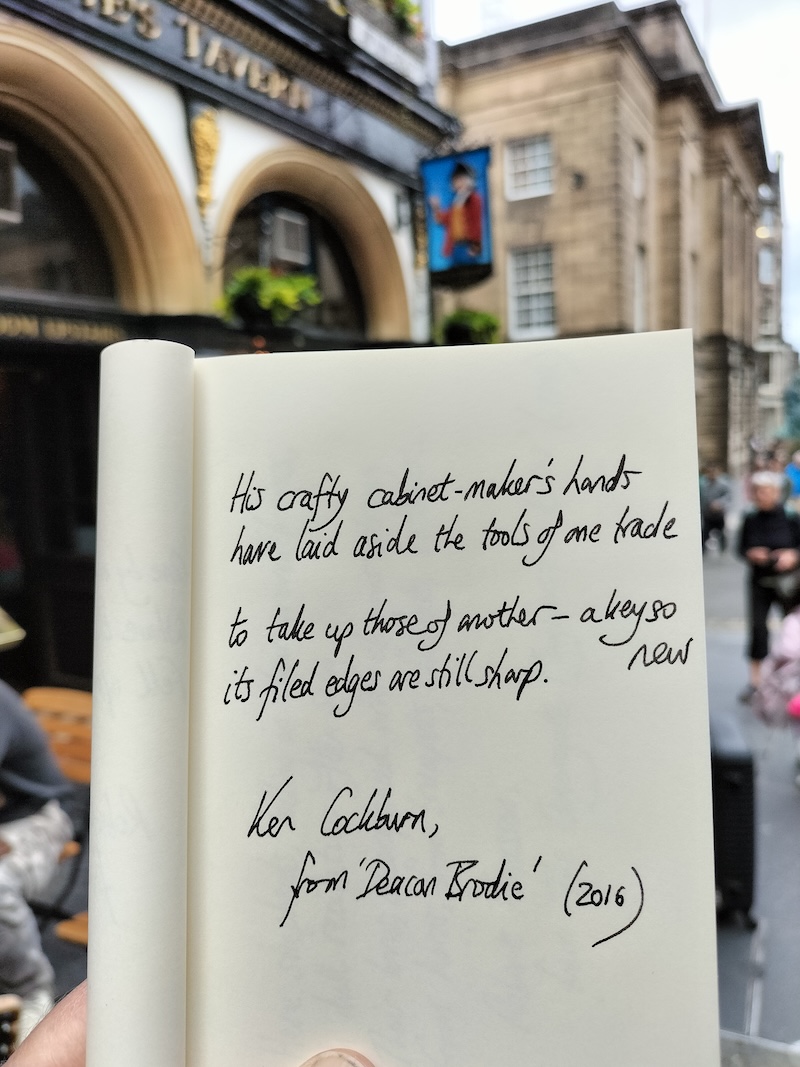
Ken Cockburn at Deacon Brodie’s pub, Lawnmarket

Angus Reid at The Scottish parliament building, Holyrood Road

Robert Fergusson at the Palace of Holyroodhouse

RLS at the High Kirk of St Giles, Parliament Square

John Taylor on Johnstone Terrace

News & updates, May 2025

I’m aware I haven’t posted here for quite a while, the main reason being that I’ve got into the habit of putting out my news in other ways, mainly regular posts on instagram, and an occasional newsletter sent out via Mailchimp.

You can find the last newsletter, which I sent out at the start of May, here. This is the introduction:

I’ll be leading poetry walks on the Edinburgh Fringe again this year, for the first time since 2019. – Along with Rod Burns and Becky Dwyer, I’ve become co-editor of Presence Haiku Journal, established by the late Martin Lucas and edited since 2014 by Ian Storr. – I have work in a forthcoming exhibition at MOCA Dunoon, paying tribute to Ian Hamilton Finlay whose centenary falls this year. – I’m leading a walking renga at Glasgow Botanic Gardens on Sunday 25th May, i.m Gerry Loose. – Plus a short poem published recently in Poetry Scotland.

If you want to read more about any of these, you can find the mailing here.

And if you want to sign up to receive future mailings, you can do so below.

If instagram is your thing, there I’m @kencockburnedinburgh Last year I took a different theme each month, which turned out to be a lot of work, and this year I’m posting on a more ad hoc basis.

Processing…
Success! You're on the list.

Poetry walks, summer 2024

I’m running more poetry walks in Edinburgh over the next few months, from 21 June to 12 October.

The June, July, September and October walks start outside St Giles Cathedral; the August walks by the Robert Fergusson statue outside the Canongate Kirk.

Full details here.

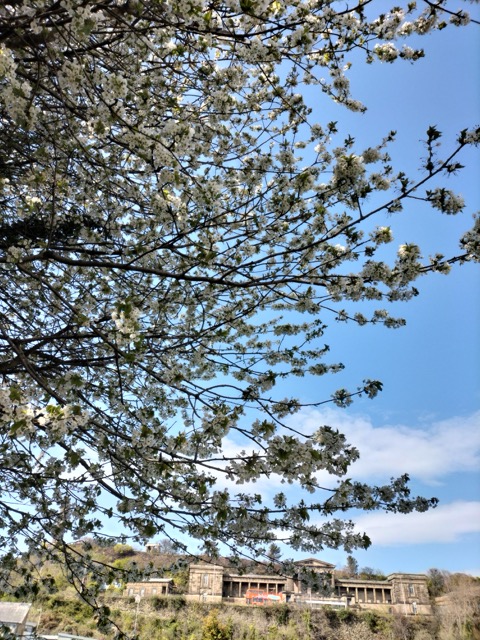
Column 1: St Anthony’s Chapel, Holyrood Park; The Scottish parliament building (staves and shadows); the old Royal High School, Calton Hill

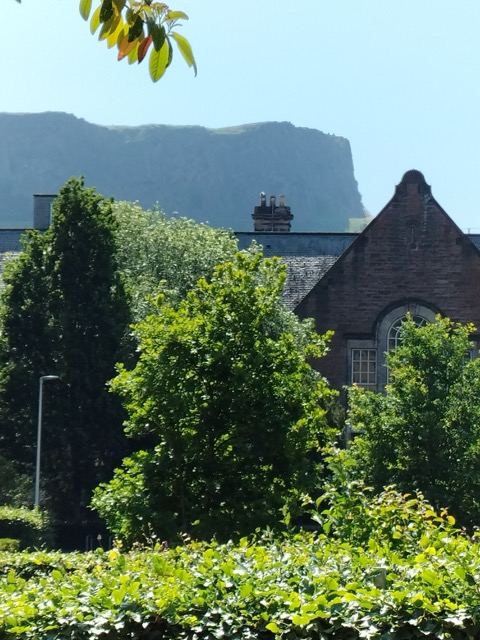
Column 2: Gullan’s Close, Canongate; Salisbury Crags, seen from Moray House gardens; 264 Canongate

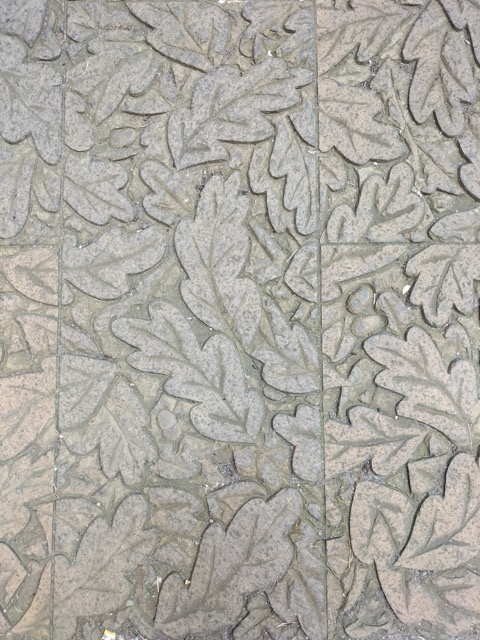
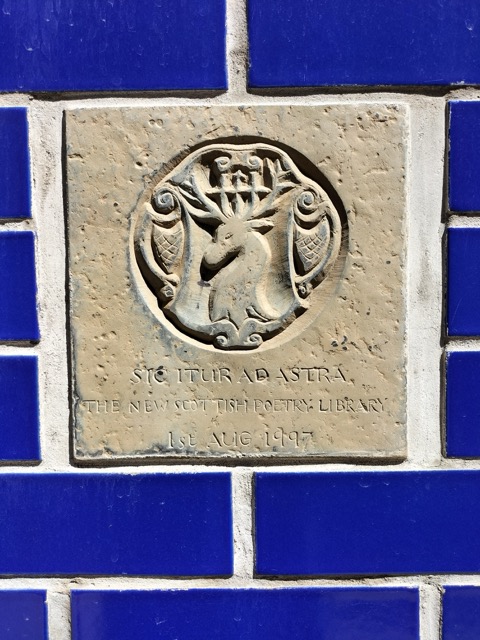
Colum 3: carved oak leaves, Riddle’s Court, Lawnmarket; Scottish Poetry Library; view from New Calton Burial Ground

Edinburgh (2nd edition)

Almost 18 months ago Barie Tullet’s Caseroom Press published the pamphlet Edinburgh: poems and translations. The first edition – hand-sewn, with covers in a wide range of colours – is now sold out, and last month a second edition appeared, with staples and a uniform cover. The contents remain the same – poems about the city written in 1996-97 and 2016, plus translations from Victor Hugo, Theodor Fontane and the 17th century Latin of Arthur Johnston.

The first sales were at last month’s Artists Book Fair at the Fruitmarket Gallery. Also on sale there were two new pamphlets, both featuring poems that would have made the cut for Edinburgh: poems and translations had they been written a little sooner.

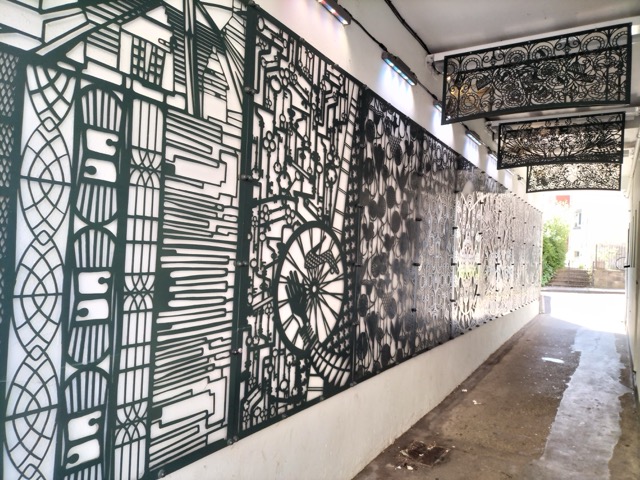
They were commissioned by the first Push the Boat Out festival in autumn 2021, and again refer to sites in Edinburgh’s Old Town: ‘Jacob’s Ladder’ beneath the railways bridge at the junction of Calton Road and New Street, and ‘The Ballad of William Knox’ at the poet’s memorial stone in the New Calton Burial Ground, not far from the Stevenson vault, where Robert Louis’s grandfather, father, and uncle are all buried. (There are some photos of his memorial in an earlier blog, part of An Edinburgh Alphabet – scroll down to ‘K’.)

Edinburgh: poems & translations
ISBN 978-1-905821-35-8
210 x 125mm, 16 pages, soft covers

Jacob’s Ladder
No ISBN
282 x 99mm, 4pp, grey endpapers

The Ballad of William Knox
No ISBN
282 x 99mm, 4pp, blue endpapers

Now Listen

I’ve been reading poems into my phone and my laptop quite often over the past few months.

Earlier this year The Academy of American Poets published ‘Home’ as part of the poem-a-day series. It’s a portrait of my father in his last months of his life, and you can read and listen to it here.

Then there are three poems in edition #10 of iamb: poetry seen and heard – ‘Hands’, ‘Rodney’ and ‘Ward’. I’m in good company – Jay Whittaker, Penelope Shuttle and others.

Last year I was commissioned by Edinburgh’s Push the Boat Out poetry festival to write poems about central Edinburgh for A Poetry Mile. I wrote three new poems, and they also accepted a couple of older poems, ‘Close’ and ‘William ‘Deacon’ Brodie’.

You can find recordings of me reading them on the Poetry Map section of the website -again in good company, including Alan Spence and JL Williams – but you do have to hunt for the poems, as even if you know the city well they’re not quite where they should be.

To listen to ‘Jacob’s Ladder’, click the marker on Calton Road just west of the junction with New Street.

‘Close’ is the marker on the High Street by Filling Station.

The marker for ‘Greyfriars Bobby’ is inside Greyfriars Kirkyard.

Rather than inside his eponymous tavern, ‘William ‘Deacon’ Brodie’ can be found loitering at New College, between Mound Place and Castlehill.

‘The Ballad of William Knox’ should be in the New Calton Burial Ground, or New Calton Cemetery as it’s called on the map, which runs from Regent Road down to Calton Road. Knox’s needle stands roughly between Archibald Elliott and Robert Stevenson, but there’s no marker in the vicinity. If you manage to locate him, let me know.

Edinburgh: poems & translations

It’s been a long time since I offered a poetry walk in the Old Town – almost two years. I gave some illustrated talks to U3A groups before the first lockdown, and since then have done a couple of online presentations.

In early 2020 I had a pamphlet of poems ready to publish with The Caseroom Press in early summer, with a view to promoting it during that year’s Edinburgh Fringe… but things didn’t go according to plan. For a while it seemed possible I could do something for the 2021 Fringe, but deadlines came and went.

It’s now ready, and I’m launching it in the days following National Poetry Day. First there’s a walk through the Old Town, from St Giles down the High Street and Canongate and into Holyrood Park, and then I’m also doing an online launch a few days later, for those unable (or unwilling) to venture into central Edinburgh and brave the autumn weather.

The walk is on Saturday 9 October at 11.00; the online launch on Tuesday 12 October at 19.00. For the latter I’ll be joined by Barrie Tullett, who designed and published the pamphlet for The Caseroom Press. You can book both the walk and the online launch via Eventbrite, and when booking you also have the option to buy a copy of the pamphlet.

Edinburgh: poems and translations includes original poems about Register House (and specifically the magnificent central dome designed by Robert Adam), the Scottish parliament building, and my then four-year old daughter running up and down Fleshmarket Close. There’s also a poem about Deacon Brodie who, despite being a legendary Edinburgh character, has been neglected by poets. The translations are of poems by Arthur Johnston, the 17th century Latin poet much admired by his near-namesake Samuel Johnson, by Victor Hugo, who conjures a romantically ruined Holyrood despite never visiting the city, and by Theodor Fontane, who did visit but whose ‘John Knox’s Death’ is full of anachronisms, all intentional no doubt

Edinburgh: Book Launch & Poetry Walk
Sat, 9 October 2021, 11:00 – 12:15 BST
Meet outside St Giles’ Cathedral, High Street, Edinburgh EH1 1RE

Edinburgh: online book launch
Tue, 12 Oct 2021 19:00-20.00
With Ken Cockburn & Barrie Tullett

Otherwise, if you’d like to buy a copy of the book get in touch! Until 12th October they cost £5.00 + P&P (thereafter £7.00 + P&P). As the photo above shows, the books are available in a variety of cover colours. If you have a preference, let me know.

Edinburgh: poems & translations
ISBN 978-1-905821-35-8
210 x 130mm, 16 pages, soft covers, saddle stitch binding

Gaelic Birdsong (1)

As Spring Fling x Wigtown Book Festival Writer-in-Residence for 2019, I’ve been creating new work exploring the links between birds, art and the landscape, inspired by my experiences during Spring Fling. The new work will be revealed at Wigtown Book Festival (27 September – 6 October) but in the meantime here are some insights and sneak peeks…

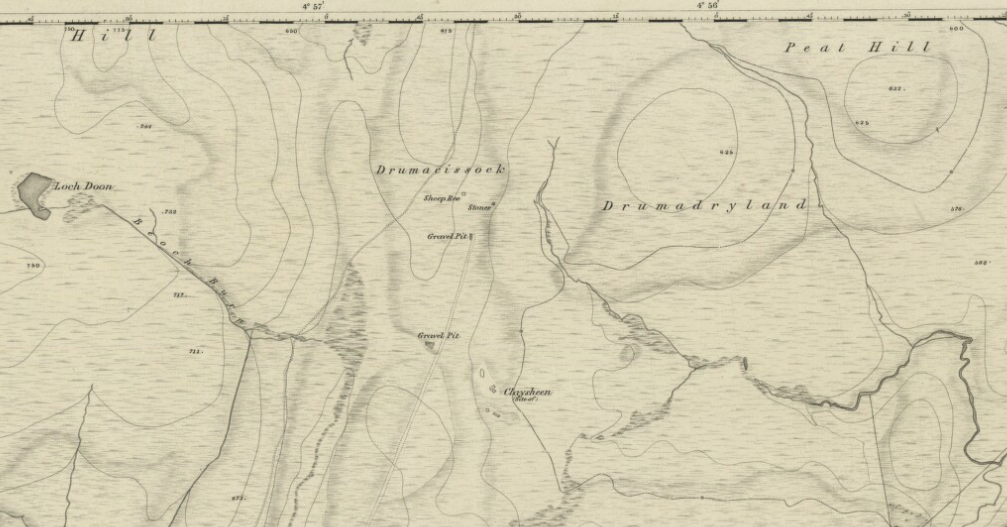
I’ve been researching place-names in Dumfries and Galloway which relate to birds. There are many, covering all sorts of ground, from coastal rocks to inland moors and up into the high hills. Many of these place-names are derived from Gaelic, spoken in Galloway until the 18th century.

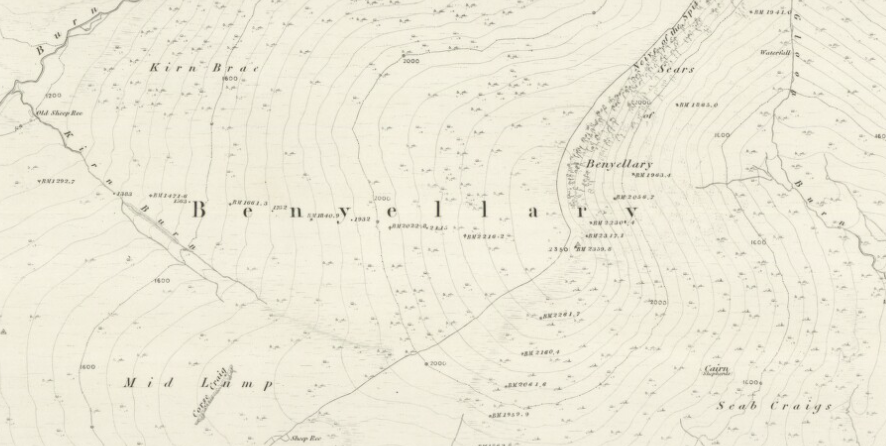
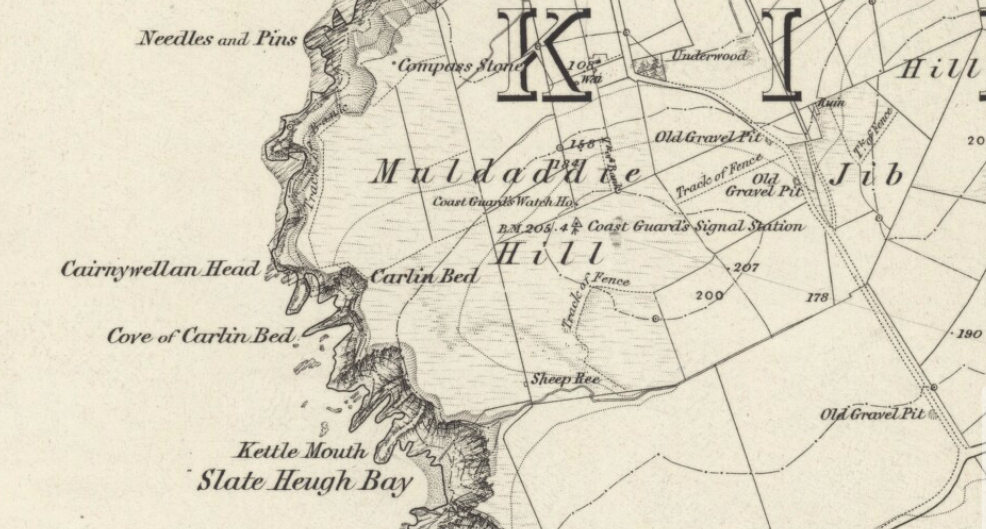
Here are three, given with their English meanings, together with a description of the place taken from the Ordnance Survey place-name books compiled in the 1840s and 1850s. The map extracts are taken from OS maps published around the same time.

Benyellary OS Sheet 13

Benyellarie (N of Glentrool)

“A large lofty rocky heathy hill on the farms of Palgown… on its eastern side is a large precipice called “Scars of Benyellary.”
Benyellarie, from beinn iolaire, the eagle’s hill

Cairnywellan Head OS Sheet 31

Cairnywellan Head (by Port Logan, S of Portpatrick)
“A head land which terminates Port Nessock Bay on the South side. It is a Conspicuous object & well known to mariners.”
Cairnywellan, from cárn na bhfaoileann, cairn of the seagulls

Drumadryland OS Sheet 11

Drumadryland (E of Cairnryan)
“A Broad heathy hill on the North side of a large Moor or marsh, and on the farm of Delhabach”
Drumadryland, from druim na’ dreolan, ridge of the wrens

The OS information can be found at https://scotlandsplaces.gov.uk

Trees for Life at Dundreggan

Dundreggan Jack Heath

Meet me,
On the slopes of Binnlidh Mhor.
Meet me,
Where the shielings were before.

Meet me,
By the bushy juniper.
Meet me,
Where the pinewoods once were.

Hamish Read, after Robin Robertson’s poem ‘Trysts’

DSC08216

The landscapes we see around us today are simply a snapshot in time; they were, and will be, different from this. As part of the Trees for Life project Rewilding the Highlands, in June 2017 I ran walking and writing sessions for two groups of S3 pupils from Glen Urquhart High School in Drumnadrochit. We spent one day at the TfL estate at Dundreggan, and the following day at school. The aim was to teach pupils something about local habitats, especially in terms of flora and place-names, and to give them opportunities to respond to these landscapes.

At Dundreggan we followed the route of the Juniper Walk, stopping by the waterfall (loud and midgey); the drystone walls (lichen and wildflowers), and the burn (gorse, thistles, nettles and raspberry). After a break for lunch at the Lodge, we climbed the track towards Binnlidh Beag as far as the lazybeds, again stopping to reflect on what we noticed (sounds, creatures, vegetation) as we progressed. There were some complaints as we climbed, but they were soon overcome by a general euphoria when we reached our destination, beyond the current edge of the forest, as views south and west over Glenmoriston opened up.

The next day at school I led the pupils in a series of writing exercises drawing on their experiences of the previous day, extending that by looking at a selection of Gaelic place-names from across the Highlands (drawn from a larger collection made by Alec Finlay).

Gaelic Couplets Alistair Nicholson

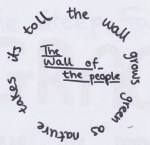
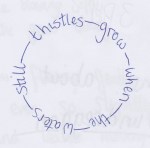
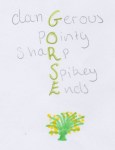
The names referred to flora and fauna, once there, now absent, but which might return: rustling leaves at Leitir Beithe, Birch Face; or rooting trotters at Sgùrr an Tuirc, Boar Peak. Pupils wrote circle poems, acrostics and mesostics, simple walking narratives (comprising short verses about each stop we made on the hill-climb), and poems drawing on real and made-up place names.

From their feedback, what they most enjoyed was walking up the hill, and seeing the creatures we came across, especially a couple of slow-worms.

They appreciated how walking helped them write: “it gave us a lot more ideas and a varied vocabulary… it helped me describe what was there better.”

Through the place-names they glimpsed something of the history of the place: “Gaelic place-names tell us about what was there before and things that aren’t there any more.”

And they were pleased to discover that the name Drumnadrochit comes from Druim na Drochaid, meaning ridge of the bridge.

When asked if they’d like to return to Dundreggan, most said yes, and several had a specific aim in mind: “to climb up the higher hill”.

Teachers also saw benefits for the pupils: “the workshop was really effective in inspiring the majority of the pupils and they really enjoyed learning outdoors for a change.  It made many of them much more aware of what we have on our door step.”


Art in Aden

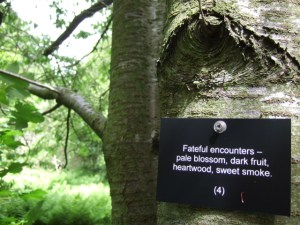
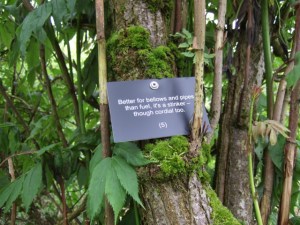
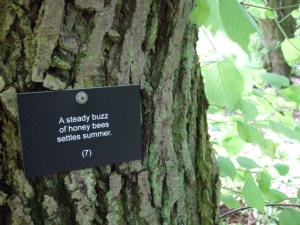
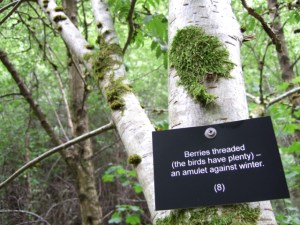
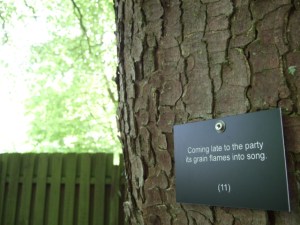
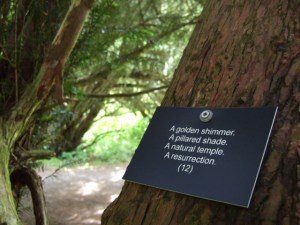
I made What is a tree? for the Midsummer Arts Festival at Aden Country Park, near Mintlaw, Aberdeenshire, on Sunday 19 June. It’s a set of poems on botanical labels attached to trees around the park. The poems aim, as in a riddle, to provide an initially puzzling, but also recognisably accurate, description of the tree in question.

Below are some notes about the ideas behind the poems.

(1) Recognisable by its black buds, the ash is one of the last trees to leaf in spring.

(2) The beech’s smooth bark has made it a favourite for inscriptions over the centuries; these expand as the tree grows.

(3) Their branches used for besoms in the past, birches create an environment favoured by many plants, fungi, moths and birds.

(4) To encounter a cherry was considered auspicious and fateful.

(5) The elder’s branches don’t burn well; its flowers don’t have a very pleasant smell, but make a fine drink.

(6) The horse-chestnut is easily recognisable at different times of year.

(7) Lime flowers attract bees in numbers.

(8) Planted outside houses to fend off evil spirits, the rowan’s red berries worn as a necklace were considered protective.

(9) The water-resistant resin in the wood of the Scots pine makes it good for boat-building; rosin (a residue from pine wood) is used for treating the bows of stringed instruments.

(10) Spruce wood was used in early aircraft construction, including the Wright Brother’s Kitty Hawk.

(11) A non-native tree, it’s unclear when the sycamore first arrived in Scotland. Its wood produces much heat when burned, while trees that show a ‘flame’ patterning in the wood are favoured by violin makers.

(12) Yews are often found in churchyards. The middle two lines are taken from Wordsworth’s poem ‘Yew Trees’.

With thanks to the Friends of Aden Country Park for commissioning this work.


Curved Stream at Traquair House

Curved Stream

Curved Stream is an exhibition by seven artists and one writer (myself) at Traquair House, near Innerleithen in the Scottish Borders. Each of the artists has a work in one of the garden pavilions to the rear of the house, and a related work in the main house and / or in the gardens and grounds.

Pavilion painting D&A

One of the pavilions has, as its centre-piece, an anonymous ceiling-painting depicting an episode in the story of Diana and Actaeon (told by Ovid in his Metamorphoses), just before the transformation of Actaeon into a stag. The survival, intact, of this beautiful artefact, embedded in the fabric of the building, exemplifies many of the special qualities of the site as a whole.

The work I’ve made is called DEA SILVARUM (Goddess of the Woods), as Ovid describes Diana, and is a walk with poems on the theme of hunting in the gardens and grounds of Traquair House. The poems include Ted Hughes’ version of Ovid, plus works by Robert Burns, Edna St Vincent Millay and the great Anon, among others. I led a first walk at the exhibition opening on 5 September, and will lead a second on Saturday 10 October at 2.30pm.

In the pavilion is a printed sheet listing the poems I selected for the walk, typeset by Barrie Tullett, with handwritten annotations featuring extracts from and reflections on the poems, as well as notes as to where I’d planned to read them. The sheet is in a drawer, so you have to open it to read the text – the idea for that was taken from a Victorian Game Book which was (but is not longer) on display in the house, in a glass below a window with a sheet of dark fabric draped over it to protect it from the light. I liked that ‘reveal’, and it seemed to echo the events in Actaeon’s story as well, so the text is hidden in the drawer, until its own ‘reveal’.

If you don’t know the story: Actaeon has been hunting deer with his friends in the woods. After a successful, bloody morning, they pause; Actaeon wanders off alone and stumbles upon a cavern where the goddess Diana, is bathing. Angry that he has seen her naked, she turns him into a stag, and he is hunted down and killed by his own dogs.)

The artists involved are Gordon Brennan, Mark Haddon, Jane Hyslop, Paul Keir, Deirdre Macleod, Andrew Mackenzie and Mary Morrison. There is more information about the exhibition and their work at the Curved Stream website and Facebook page.