All posts by Ken Cockburn

Ken Cockburn is an Edinburgh-based poet, translator, editor and writing tutor.

Primary Four’s Doors


Over the past few years I’ve been involved with a performance project with Leith Primary School.
Organised by the church of St James the Less, Leith, this year Suzanne Butler, Lorna Irvine and I worked on the theme of ‘building’ with three classes.

Suzanne (of Fischy Music) wrote a song with P4/3, Lorna and P4B made a drama piece, ‘The Three Wee Leithers’ (based on the fable of ‘The Three Little Pigs’), while I helped P4A to write about life in Leith, and also in a realm of the imagination which they named ‘Minecraft Pugs’.
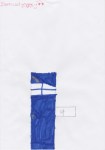
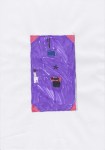
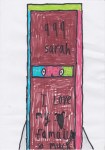
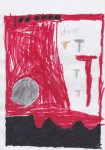
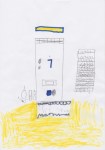
One of the poems I’d read to kick the project off was Holub’s ‘The Door’. During one of our sessions, I asked the pupils to imagine and draw their own door.

The plan was to show these during today’s performance, but we were in the brand new school hall, and no-one knew how to get the brand new projector to talk to a laptop.

I thought the doors deserved some sort of public display, so here they are, in ascending numerical order, from 3 to 1,000,000.
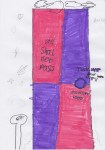
Thanks again to all the pupils for their imagination and enthusiasm!

The Stuarts’ Memorial in Rome


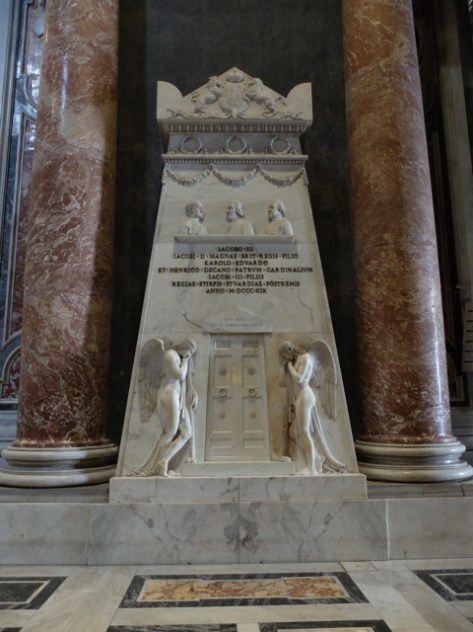
As a follow-up to two earlier posts about the Jacobites in Edinburgh (here and here), these photos from St Peter’s Basilica in Rome show the memorial created in 1819 to three Stuarts: James, and his sons Charles (aka Bonnie Prince Charlie, the only one of the three who set foot in Edinburgh) and Henry.

St Peter's Stuarts 06

On it James is styled James III (of Great Britain), and while he was recognised as such by many European states he never actually sat on the throne. After his death in 1766 some contemporary Jacobite diehards liked to refer his sons as Charles III and, following Charles’ death, Henry IX, but diplomatically and realistically the Roman memorial foregoes such  numerical aspirations.

St Peter's Stuarts 01

The text above the door between the angels attempts to offer some consolation for their exile and failure to ascend a throne they believed was rightly theirs: it translates roughly as ‘blessed are the dead who die in the Lord’.St Peter's Stuarts 04

Immediately opposite it, above a doorway, sits an elaborate memorial to Maria Clementina Sobieska, daughter of the Polish king Jan III, who was unhappily married to James, was the mother of Charles and Henry. She died aged 32 in 1735.

St Peter's Maria Clementina


New from The Caseroom Press

The Caseroom Press recently published two books which I had a hand in.

O | O 3: Word Disco is the third in an unintended trilogy of found poems, and follows Overheard Overlooked (2011) and Overlooked Overheard (2015). Visually it departs from the previous books, with the texts being typeset, distorted on photocopiers and then edited and composed in Photoshop. Barrie Tullett again designed it, and as with Overlooked Overheard his students at the University of Lincoln found the poems it contains. It’s available via The Caseroom Press website.

Woodland Orienteering presents six six-letter word-pairs composed in 2011 for an orienteering circuit in Dufftown, Moray, but never used (a seventh word-pair was, and remains in situ). If you’d like to buy a copy please contact me directly.

DSCF3484DSCF3487


DSCF3496DSCF3500


Postcards from Edinburgh (1)

I’ve been tweeting some quotes from about Edinburgh, and here’s a wee collection of the first few.

EPT Wordsworth 02


EPT RLS 10


EPT DBM 02


EPT Garioch 02


EPT Piozzi 01

Dorothy Wordsworth recorded in her diary arriving in Edinburgh with her brother William on 15 September 1803. – Robert Louis Stevenson’s Edinburgh: Picturesque Notes (1878) still speaks to the city today.– Donnchadh Bàn Mac an t-Saoir, or in English Duncan Ban MacIntyre, was a Gaelic poet from Argyll who was a member of City Guard in the late 18th century; the lines, from his poem ‘Oran Dhun Eidann’ (‘Song of Edinburgh’), first published in 1804, translate as ‘Edinburgh is beautiful / in many diverse ways…’. – In ‘To Robert Fergusson’ Robert Garioch (1909–1981) imagines rattling the ‘rigg-bane’ or spine of the Old Town in the company of the energetic earlier poet. – Hester Piozzi, aka Dr Johnson’s confidante Mrs Thrale, visited the city in the summer of 1789, anxious she would encounter ‘a second hand London’, but found something quite different.


TradFest 2018: Jacobite Edinburgh

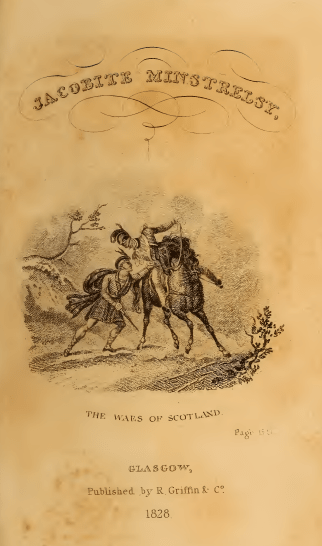
Jacobite Minstrelsy 1829 title page

I’m running two walks for Tradfest 2018 on a Jacobite theme. Dates and times are Thursday 3 May at 2.30pm, and Saturday 5 May at 11.00am, each lasting about 90 minutes. The starting point is the Scottish Storytelling Centre on the High Street, and we’ll walk down the Royal Mile to Holyrood Palace, pausing on the way to look at sites associated with the Jacobites and those who wrote about them.

Hogg Jacobite Relics 1819

I’ll read extracts from works by writers including James Hogg, Tobias Smollet and Walter Scott, describing the drama of Edinburgh’s occupation by the Jacobite army in autumn 1745, the decisive Battle of Culloden, and the long, painful aftermath which gradually gave way to the romantic myth of Bonnie Prince Charlie.

Hogg Jacobite Relics Song 81

For more details, and to book a ticket, click here.

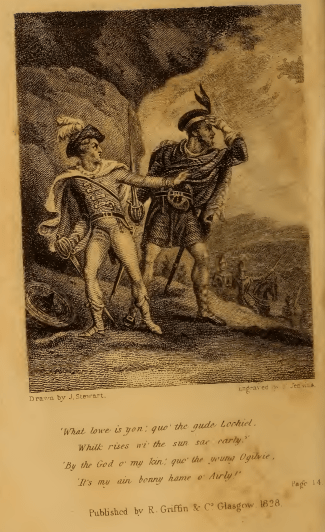
Jacobite Minstrelsy 1829 frontispiece

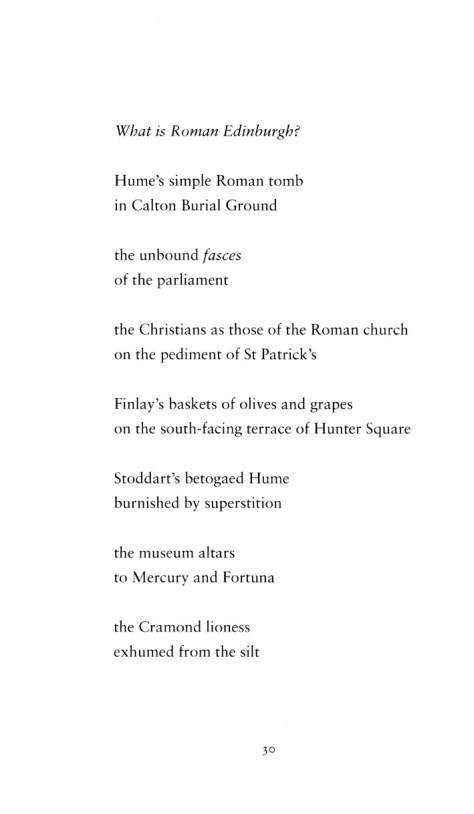
What is Roman Edinburgh?

EPT KC FtW Roman Edinburgh

Like Rome, Edinburgh is a city built on seven hills.

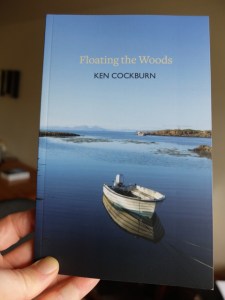
My new collection, Floating the Woods, published by Luath Press, includes ‘Seven Questions’, which considers Edinburgh’s links with Ancient Rome – there’s an extract above.

The book also includes ‘Pandora’s Light Box’, which describes the University of Edinburgh’s Talbot Rice Gallery, which today shows contemporary art but which began life as natural history museum.

Other poems move further afield, to Loch Ness, Orkney, Flanders and Rome itself, where in the 1750s a young Scottish architect, Robert Adam, is beginning to find his way.

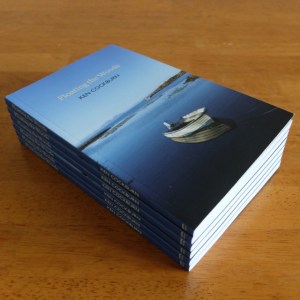
Floating the Woods 03


Floating the Woods

Floating the Woods 02

Last week I had my first sighting of Floating the Woods, a new collection of poems published by and available from Luath Press, and launched on Thursday 29 March at the Scottish Poetry Library.

The cover blurb reads, “the places in Floating the Woods are mainly Scottish, stretching from the Borders to Orkney, taking in Edinburgh, the Tay estuary and the River Ness. Through these landscapes move figures from the past – real, legendary and imagined – as the routes of Romans, Vikings and Celtic saints are followed by later figures such as Wordsworth, James Hogg and John Muir. Further afield the First World War casts a long, dark shadow over otherwise idyllic English and Belgian scenes. There are alphabet, calendar, list and found poems, dealing with imaginary shades of blue and the imponderables of etiquette.”

Floating the Woods 03

I am grateful to Jen Webb, editor of the Australian journal Meniscus, for her text which also appears on the cover. “List the things that matter, and what is likely to appear are stories, and buildings, the birds that fly between them, the hills and streams and skies that surround them, the ordinary stuff of everyday life lived alongside the felt presence of ancient recent history. Ken Cockburn’s new collection captures all this, in the lyrical lists, shape poems and sound poems filled with sharp yet tender observations of the world through which he moves. In a gloriously demotic voice that remains deeply immersed in the long traditions of poetry, he paints space, and place; and in his hands, language finds a mouth.”

Cockburn FtW 2018 2

Daughters of Penelope

These photos were taken at Edinburgh’s Dovecot Studios on 24 October 2017, during an event I created with Juliana Capes for the exhibition Daughters of Penelope (which runs till 20 January).

You dropped a purple ravelling in,
You dropped an amber thread;
And now you’ve littered all the East
With duds of emerald!

We focused on works by Julie Brook, Caroline Dear, Linder and Sonia Delauney. Juliana read an original text written in response to the artworks, while I read a selection of poems on weaving and colour, including works by Emily Dickinson (above) and verses from the Carmina Gadelica.

Photographs courtesy of Dovecot Studios.

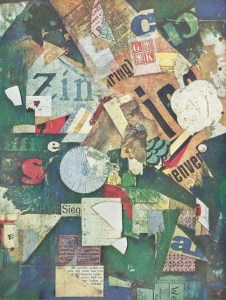
Kurt Schwitters

Schwitters_Collage

A Hanover bourgeois, Kurt Schwitters,
Grew tired of painting his sitters.
In sentences terse
He declared all art Merz
And made poems from sneezes and titters.

A limerick for Kurt Schwitters on 8 January 2018, the 70th anniversary of his death.

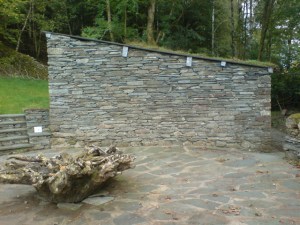
Below are some photos from a visit in 2014 to Cylinders in the Lake District, where Schwitters made his last Merzbau in the 1940s (the barn he made it was recently in the news again), and there is a bench with extracts from his ‘Ursonate’ (to hear an extract performed by Florian Kaplick click here).

Cylinders_Merzbarn