All posts by Ken Cockburn

Ken Cockburn is an Edinburgh-based poet, translator, editor and writing tutor.

Walking Poets: the books

Earlier this year I mentioned that I was taking part in the exhibition Wordsworth and Basho: Walking Poets at Dove Cottage, Grasmere. That exhibition is now up and running – it closes on 2 November – and this post is about three books connected with it.

While yet we may coverA-ga coverWalking Poets cover

While yet we may is my contribution to the exhibition. It exists as a boxed set of 68 cards, and as a book. “While yet we may is composed of 17 words from Basho’s Oku no hosomichi (best known in English as The Narrow Road to the Deep North, though I worked mainly from the English translation by Cid Corman and Kamaike Susumu published as Back Roads to Far Towns) and 51 extracts from The Prelude, The Recluse and ‘Lines Composed a Few Miles Above Tintern Abbey’ by William Wordsworth. The idea for While yet we may came from a ‘variable construction’ by the poet Gael Turnbull (1928–2004), which consisted of two sets of cards : one of 28 cards, each featuring a noun, the other of 112 cards, each featuring a qualifying phrase. As Turnbull explained, “any one of the one-hundred-and-twelve phrases may relate to any of the twenty-eight nouns”. Of a published version in which each phrase was paired with a noun he wrote, “this version is no less final than any other”. The same applies to the version of While yet we may printed here.”
While yet we may spread
While yet we may cards
Copies of While yet we may (book and cards) are available from the bookshop at Dove Cottage, at £8.00 and £25.00; alternatively, you can buy them online at Big Cartel.

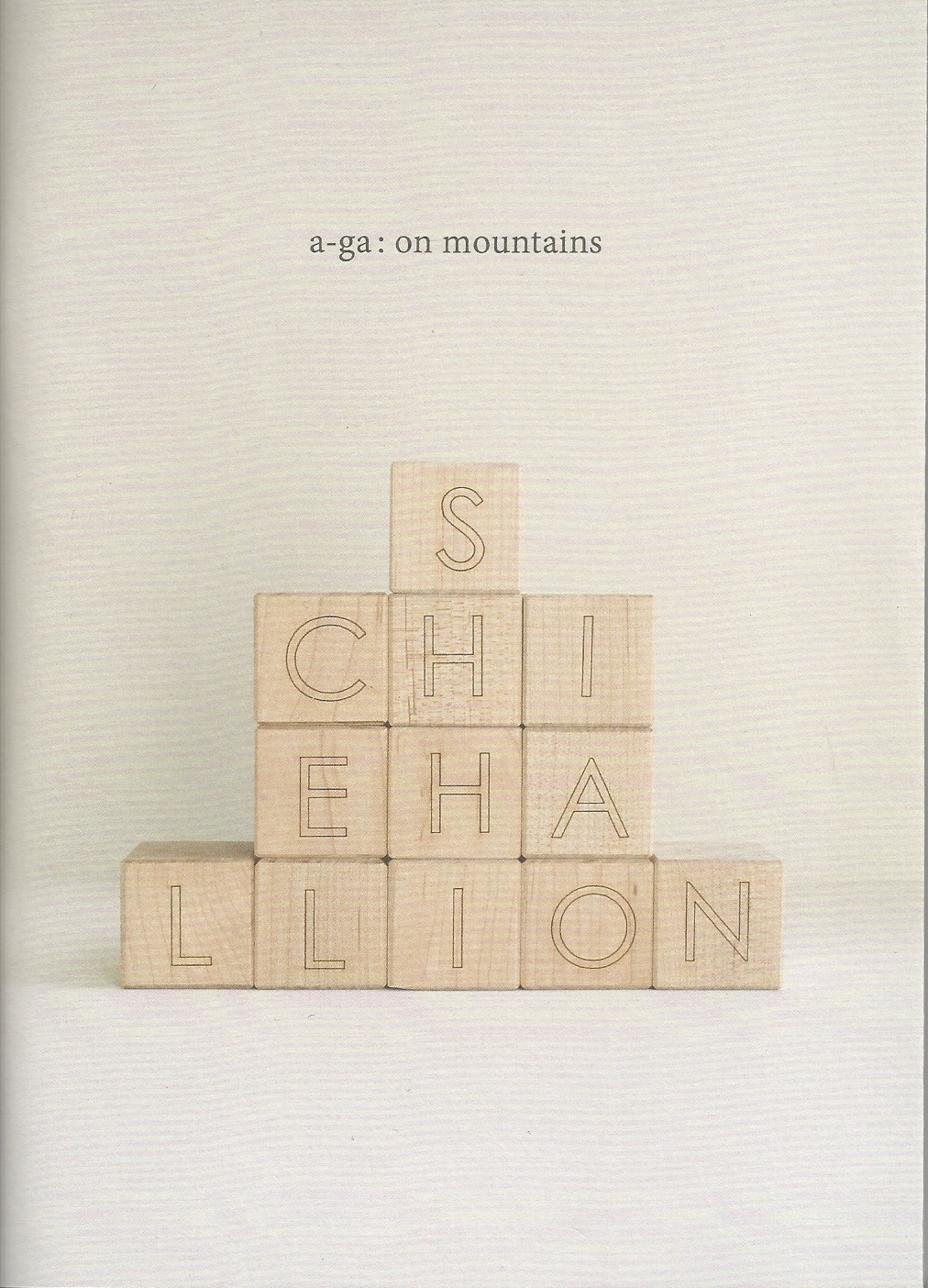
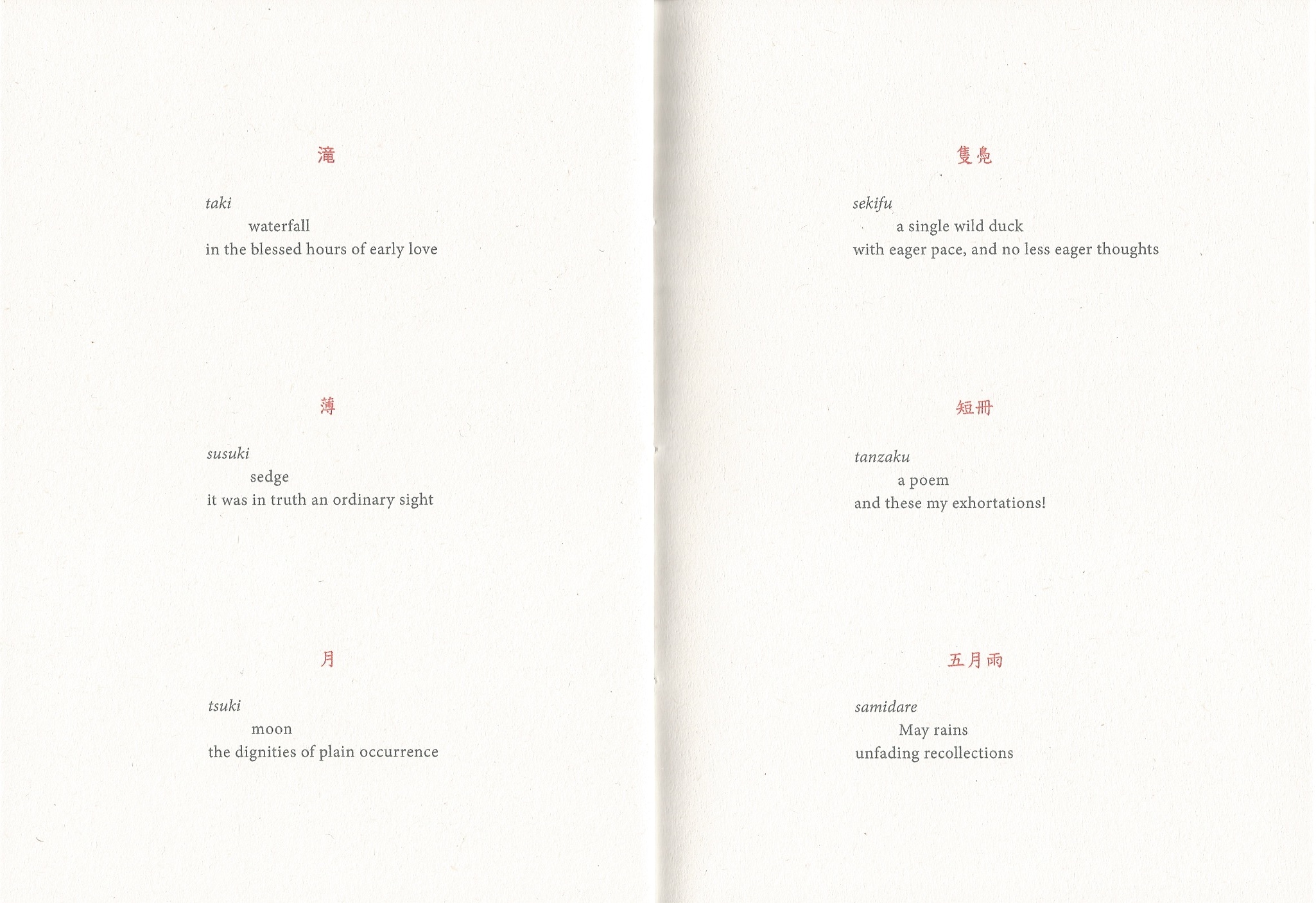
Alec Finlay’s contribution to Walking Poets is the booklet a-ga : on mountains, which includes pieces composed for the road north.

A-ga spread

The exhibition catalogue has now been published, a fine full-colour publication edited by Mike Collier, and featuring work by, among others, Autumn Richardson, Richard Skelton. Ayako Tani and Brian Thompson. You can buy a copy here for only £9.99. One of the photos I took on the walk up Easdale Tarn in January has made its way onto the front cover.

Walking Poets cover
Walking Poets back cover

Library Promenade

Earlier this year with the help of Artlink I devised a performance at the National Library of Scotland for visually impaired and sighted visitors. ‘Some Bat-squeak Echo of Other Time’ took its title from a phrase in Audrey Niffenegger’s novel The Time Traveller’s Wife, and the performance connected various spaces within the library building on George IV Bridge with extracts from fiction – so the grand staircase became the setting for a scene from James Joyce’s Dubliners story ‘The Dead’, while the reading rooms hosted the “stout, middled-aged man with enormous owl-eyed spectacles” (described as being “somewhat drunk”) from The Great Gatsby. I read the extracts along with Jenny Hulse and Lorna Irvine, and we were accompanied by Laure Paterson on fiddle and Sally Thomas on flute – before a four-strong choir closed proceedings with a wonderful rendition of ‘Let’s Do It’ on the staircase.

You can listen to a podcast which features extracts from the performance, and interviews with some of those involved, and there’s more information on the project on the Artlink website.

Husum

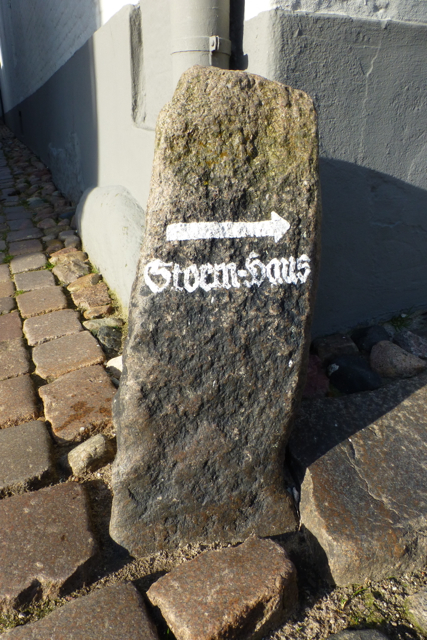
Storm sign 1
I was in Germany in March, visiting friends in Kiel, and had the chance to visit Husum, on the west coast of Holstein. It was here that the 19th century writer Theodor Storm lived for many years, and I happened to be reading his novella Der Schimmelreiter (The Rider on the White Horse), so I looked into his old house, now a museum.

The copy of Der Schimmelreiter which I was reading had been given to me by a friend, who’d meant to buy an English translation but had got a German edition instead. I thought I should take some photos of the book in situ, having as it were found its way home.

Later I enjoyed a reading by the poets Arne Rautenberg and Hendrik Rost at Der Speicher, an old warehouse on the quay. I spoke to Hendrik afterwards. He has three children, and said he wrote a whole book of poems on the commute between Lübeck and Hamburg, and could even quantify the time thus spent – 560 hours.

Storm’s heavy wooden writing desk – a gift for this 70th birthday – offers a rather different writing environment.

Ettrick Valley

I visited the Ettrick Valley with painter Andrew MacKenzie on Easter Monday, April 21 – a field-trip of sorts, as Andrew and I have been talking about a collaboration, and this is a first step.

We drove along the B7009 which runs alongside (more or less) Ettrick Water, through Ettrickbridge, then turned off at Wardlaw / Hopehouse. Leaving the car we follow a path above the river, which snakes between the spruce woods on the hillside and the ‘Ettrick Marshes’ next to the river, as far as a (slightly dilapidated) bird-hide. From there, in the shadow of the spruce-wood, we look down over the pale sunlit marshland and over to the pale spring hillsides opposite.

Back in the car, we stop at the Hogg Memorial, or ‘Monument on Birthplace of James Hogg’, as the OS has it, with its image of Hogg in profile surmounting four well-horned sheep-heads. There’s a dog barking either side: it must be those sheep… While there’s no line from Hogg on the memorial, behind it runs a semi-circular stone bench, where visitors can read lines of their own choosing; perhaps these from The Queen’s Wake, said to be a self-portrait:

The Bard on Ettrick’s mountains green
In Nature’s bosom nursed had been,
And oft had marked in forest lone
Her beauties on her mountain throne;
Had seen her deck the wild-wood tree,
And star with snowy gems the lea;
In loveliest colours paint the plain.
And sow the moor with purple grain;
By golden mead and mountain sheer,
Had viewed the Ettrick waving clear,
Where shadowy flocks of purest snow
Seemed grazing in a world below.

Further on, the road’s mainly used for taking timber from the surrounding hillsides. We park at a locked gate, and walk towards the last house, Potburn, where the Borders historian Walter Elliot grew up, and where the painter William Johnstone lived in the 1960s. It’s been empty for some years now, and while the roof is more or less intact, it is gradually decaying, especially the outhouses.

We continue along the track past a caravan, presumably the residence of a forestry worker – perhaps the one who just passed us on a quad-bike – and make for Over Phawhope Bothy. Andrew made a wall-drawing here a year or two ago, which is still intact, though with a few additions, which he doesn’t seem to mind.

Our last stop is at Ettrick Kirk, where Hogg is buried. It’s an neat little church, the wooden pews inside admitting no disorder; outside I enjoy the combination of spring sunshine and still leafless trees. The graveyard is dominated by the remarkably well-maintained monument of Thomas Boston (1676–1732), an uncompromising but popular minister from the Covenanting tradition. Hogg’s stone is more modest, but has been cleared of the springy green moss spreading over its neighbours.

Orkney

we sail past Stroma’s empty fields
the Maidens grind the sea-gods’ salt
binoculars to scan the scene
the latent power the races hold

the Romans came and saw and left
Vikings named themselves in runes
a hoard of shards the dig unearthed
the sacred grove is made of stone

unfurl your banner to the breeze
starlings wheel across the sky
a spotted orchid in the verge
the wind is in the blades and flags

divers down among the wrecks
I don’t know what it is I’ve found
a haar drifts in across the rocks
the crab’s blue shell fades in the sun

Last autumn I took part in The Written Image, an exhibition organised by Edinburgh Printmakers Workshop and the Scottish Poetry Library. Poets and printmakers were paired, and I worked with Cat Outram. When we met she was just about to visit Orkney for the first time, and I’d visited the previous summer, so that became our theme. We came to settle on four of Cat’s images that seemed to give a good overview of Orkney: FERRY (geography), FARM (economy), BEACH (ecology), and BRODGAR (archaeology). I returned to a notebook I’d kept while there in 2012, and another relating to an unrealised project at John O’Groats; for each image I composed a 4-line stanza, guided by half-rhymes. The order in which the stanzas can be read is interchangeable. ‘The Maidens’ are one of the powerful tidal currents, or ‘races’, in the Pentland Firth.

Orkney print 2

Wordsworth & Basho: Walking Poets

Sill Stone

I was in the Lake District last week for a symposium on ‘Wordsworth and Basho: Walking Poets’. A group of us were there to meet and discuss what we might make for a forthcoming exhibition at Dove Cottage, Grasmere, home to the Wordsworths from 1799 to 1808, now a museum and home of the Wordsworth Trust.

The Prelude mss

Curator Jeff Cawton shared his enthusiasm for ‘The Prelude’ and its various manuscripts. Most are written in the hand either of Mary, the poet’s wife, or Dorothy, his sister, with amendments by William; apparently he found writing physically painful, so composed in his mind while out walking, dictating the results when he came home.

Wordsworth ms

The pages above show a draft of Book 10, with William’s revisions on the left hand page:

… As a light
And pliant harebell, swinging in the breeze
On some grey rock, its birth-place, so had I
Wantoned, fast rooted on the ancient tower
Of my beloved country, wishing not
A happier fortune than to wither there
And now was from that pleasant station plucked
And tossed about in whirlwind. I rejoiced…

Wayfinder

A group of us managed a walk in Easedale, up Sour Milk Gill (a fast-flowing stream) to Easedale Tarn (a placid lake). At the foot I read ‘Emma’s Dell’, one of the ‘Poems on the Naming of Places’ – right place, wrong season, as the poem is set on “an April morning, fresh and clear”, whereas we had damp January.

Easedale Sour Milk Gill

Though with all the recent rain, it was still true that

The Rivulet, delighting in its strength,
Ran with a young man’s speed…

The white waters reminded me the Inverianvie, of one of our stations on The Road North, so I adapted a line from Basho to fit the new location.

Poem-label gillEasedale label rapidsEasdale 1

Summer on the road north

Road sign

In the grey afternoons and long nights of January, it’s good to be reminded of The Road North, the summer Alec Finlay and I followed the Japanese poets Basho and Sora along the hosomichi, the back roads, of Perthshire, Argyll, the Hebrides and elsewhere.

The big blog is still available, but we’ve also written a long poem about the journey. There are four extracts from it in the new edition of Northwords Now (no. 25) – ‘Glen Lyon’, ‘Loch Etive’, ‘Schiehallion’ and ‘Berneray’– available here; other sections are online at Alec’s blog; more will appear in the spring edition of Shearsman.

23 wood sorrel

Meeting Thomas Rosenlöcher

I met the poet Thomas Rosenlöcher in 2005, when he read at the Goethe Institut Glasgow, and have kept in touch intermittently since. But over the years I have translated a number of his poems – those published in the journal Modern Poetry in Translation can be read here.

Hirngefunkel

He got in touch at the end of last year to let me know of a new collection, Hirngefunkel (Mindspark).

2013-07-13 15.29

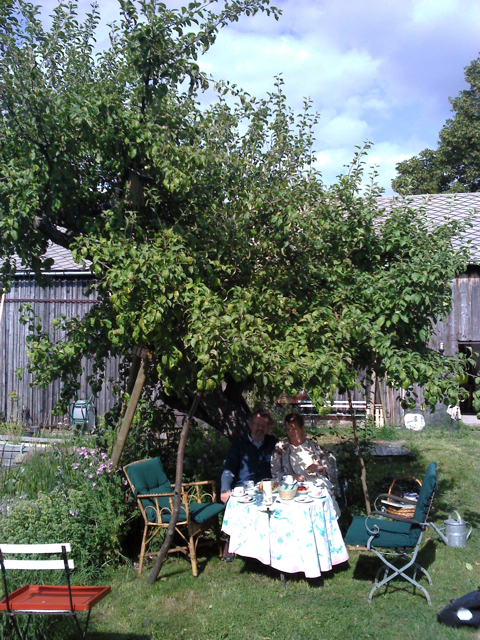
He also invited me to visit him, and I travelled to Dresden earlier this summer. I met him and his wife Birgit at their house in the countryside nearby.
2013-07-13 22.28

I also had a chance to hear him give a reading of his work, in the odd but fitting setting of the Stasi-Behörde, that is, the building where all the Stasi files are kept and where they can be consulted by members of the public. – Fitting in the sense that he had his own problems with the Stasi in the old GDR; at the reading he joked that, at readings back then, he always tried to work out which member of the audience was the informer.

I came away with new insights into his work, and with an appetite to translate more of his work.
With thanks to Creative Scotland for their financial support towards the trip.

2013-07-13 16.28