All posts by Ken Cockburn

Ken Cockburn is an Edinburgh-based poet, translator, editor and writing tutor.

Buson 2016 : Jedburgh

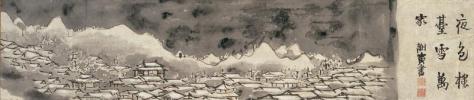
Snowclad_houses_in_the_nightI’m running several events this year under the heading ‘Buson 2016’, celebrating the birth 300 years ago of the great Japanese painter and haiku master Yosa Buson (1716–1783).

This week Andrew Mackenzie and I visited Jedburgh Grammar School, where we worked with S5 and S6 pupils. Andrew and I collaborated on Into Ettrick a couple of years ago, but this is the first time we’ve worked together with a school group. The idea was to create a piece which integrated image and text, as Buson did in many of his works.

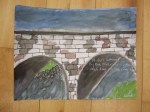
We sketched and took notes at two spots by the Jed Water, near the Abbey Bridge opposite the abbey, and by the Canongate Bridge. Andrew showed them how to sketch with pencil and charcoal, while I encouraged them to be attentive to what has happening as we were there, using Norman MacCaig’s poem ‘Notations of Ten Summer Minutes’ as a model.

Back in school I guided the pupils into writing haiku based on their notes – snapshots capturing when, where and what happened – while Andrew led them in working with watercolour and pen-and-ink to develop sketches made earlier. Then we put the two together – some of the results are below.
David Blake, PT English who organised the school’s side of the session, commented:

Blank space! If there is one thing which I will always remember from the Yosa Buson workshop which I took part in, along with 35 Higher and Advanced Higher English pupils, it is the importance of blank space. As both artist and poet Buson would have instinctively understood the relationship between the visual and the written – something that we often forget.

Our day began somewhat greyer than I had hoped and the pupils’ initial enthusiasm reflected that sombre sky but as the first part of the day proceeded they quickly began to respond to what they saw in both visual and written mediums. Pupils who claimed that they could not draw were working hard to create images of what they saw, within minutes of being given a writing task they were enthusiastically coming up with ideas that I would struggle to draw out of them in the classroom. By the afternoon, armed with the sketchbooks in which we had drawn what we had seen and written down our thoughts, we were ready to embark on the production of ink illustrations and haiku poems. The quality of some of the work that the pupils produced was well beyond their expectations and despite their many claims that their work was rubbish you could see they were secretly pleased with how well their paintings and poems had turned out; one or two even confided that they had gone home that night and made further use of their sketchbooks!

This was one of the most enjoyable workshops that I have experienced in my teaching career and one which I believe that, as well as the wonderful creative experience of producing the visual art, the pupils got a lot out of in terms of their understanding of how to write effectively: in writing, as in art, it is as much about what you leave out as that which you put in – blank space.

With thanks to Jedburgh Grammar School, and to the GB Sasakawa Foundation for funding the work.

Walks on National Poetry Day

KC reading
I ran two walks on National Poetry Day 2015 – Thursday 8 October – starting at the Scottish Storytelling Centre and walking down to the Scottish Parliament. The weather was kind, with some gentle autumn sun, and on the way I read poems by Christine De Luca and Ingrid Murray, Tessa Ransford, Muriel Spark, Norman MacCaig, Roberts Burns, Fergusson and Garioch, Bert Brecht, Stewart Conn, Angus Reid and Edwin Morgan, as well as the great Anon, and one of my own.

I’m grateful to Elaine Erb (from Alberta, Canada), for the photographs here, taken during the morning walk. The large-scale poem on the the printed scaffolding sheet (a huge new development is being put up behind it) is ‘Spiral’ by Elizabeth Burns, installed earlier that morning. At 25 by 12 metres, it’s reputedly the largest poem in the UK, and will stay up on the building until summer 2016.

River Connections, Inverness

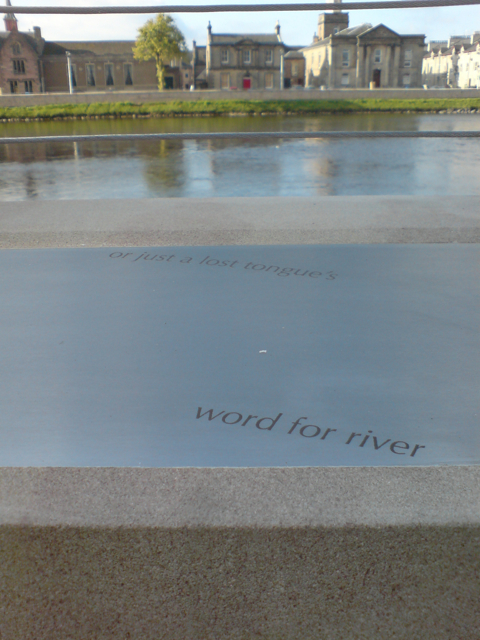
lost tongue

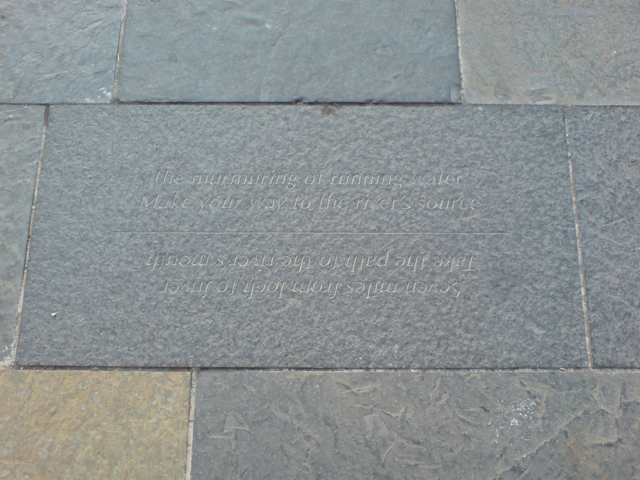
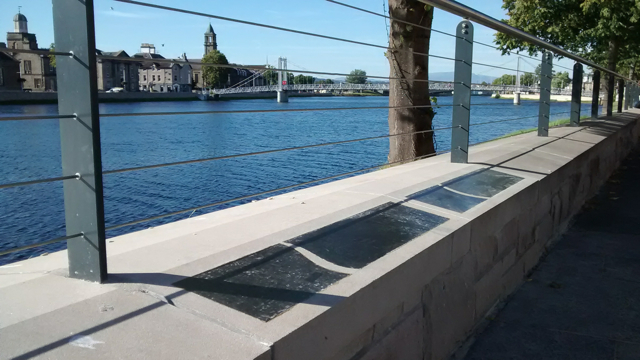
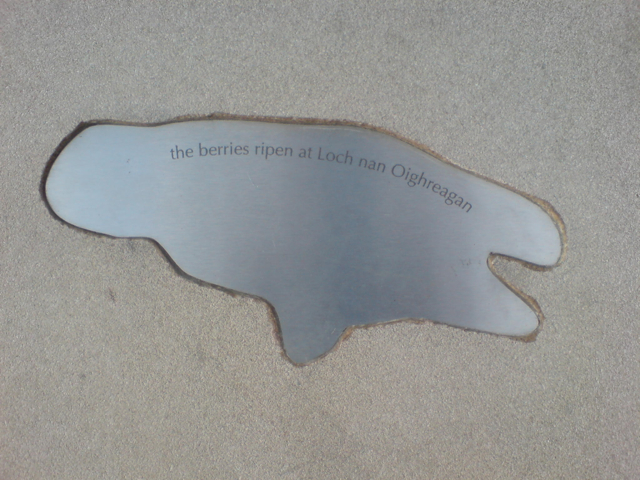
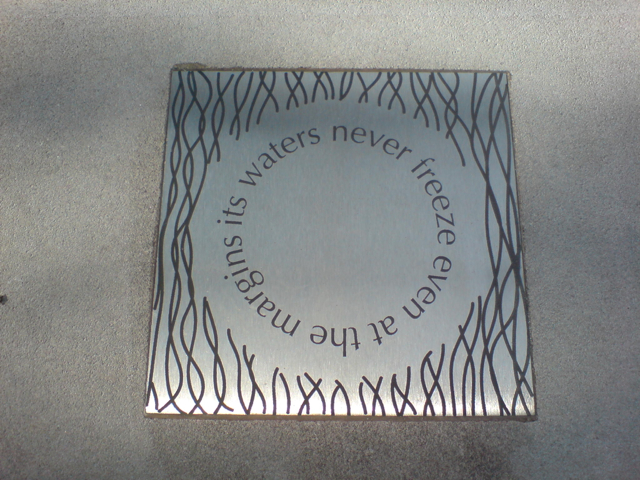
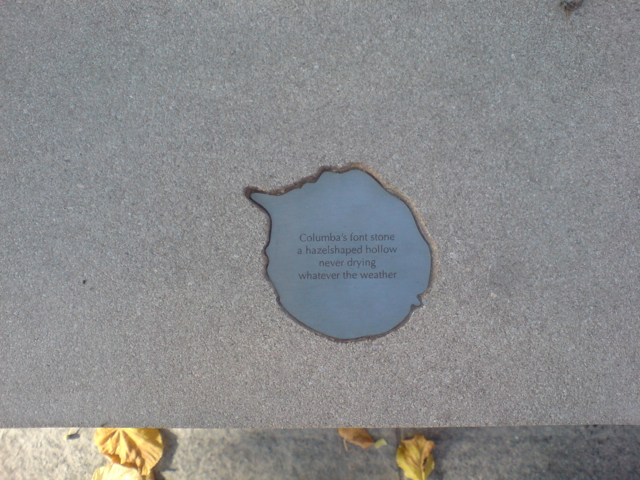
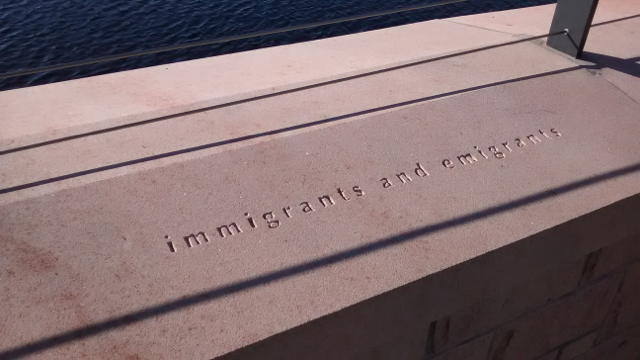
At the end of September I was in Inverness, where I saw a batch of poems I wrote last year about the River Ness and its vast catchment area being installed on the new flood wall. I’d been asked by Mary Bourne to produce the work, which she intended to carve directly onto the wall, but it turned out the stone wasn’t good for carving (a soft sandstone, with hard bits of quartz spread erratically through it), so she had most of the poems etched onto steel and set into the wall. The masons were at work setting them into the coping as we walked along the riverbank in unseasonably warm sunshine.

The poems are mostly on Bank Street, between the Young Street Bridge and the pedestrian bridge, though there are a few beyond that, along Douglas Row towards the Friars Bridge. A further group of texts will be installed on the west bank of the river in the new year, and stones featuring circle poems written by local writers are to be installed at Kessock Road near the mouth of the river shortly.

Seven Miles
Uillte
Loch nan Oighreagan
never freeze
Loch Ness, Columba
immigrants and emigrants

Library Mesostics

Mesostic Interleaved

I visited Edinburgh University Main Library today, open to the public on Doors Open Day. I wanted to see again the mesostic poems, by myself, Alec Finlay and others, that were installed on the bay ends as part of the library refurbishment in 2009. Each is about a particular author whose work is in the collection; an earlier post gives more background.

Curved Stream at Traquair House

Curved Stream

Curved Stream is an exhibition by seven artists and one writer (myself) at Traquair House, near Innerleithen in the Scottish Borders. Each of the artists has a work in one of the garden pavilions to the rear of the house, and a related work in the main house and / or in the gardens and grounds.

Pavilion painting D&A

One of the pavilions has, as its centre-piece, an anonymous ceiling-painting depicting an episode in the story of Diana and Actaeon (told by Ovid in his Metamorphoses), just before the transformation of Actaeon into a stag. The survival, intact, of this beautiful artefact, embedded in the fabric of the building, exemplifies many of the special qualities of the site as a whole.

The work I’ve made is called DEA SILVARUM (Goddess of the Woods), as Ovid describes Diana, and is a walk with poems on the theme of hunting in the gardens and grounds of Traquair House. The poems include Ted Hughes’ version of Ovid, plus works by Robert Burns, Edna St Vincent Millay and the great Anon, among others. I led a first walk at the exhibition opening on 5 September, and will lead a second on Saturday 10 October at 2.30pm.

In the pavilion is a printed sheet listing the poems I selected for the walk, typeset by Barrie Tullett, with handwritten annotations featuring extracts from and reflections on the poems, as well as notes as to where I’d planned to read them. The sheet is in a drawer, so you have to open it to read the text – the idea for that was taken from a Victorian Game Book which was (but is not longer) on display in the house, in a glass below a window with a sheet of dark fabric draped over it to protect it from the light. I liked that ‘reveal’, and it seemed to echo the events in Actaeon’s story as well, so the text is hidden in the drawer, until its own ‘reveal’.

If you don’t know the story: Actaeon has been hunting deer with his friends in the woods. After a successful, bloody morning, they pause; Actaeon wanders off alone and stumbles upon a cavern where the goddess Diana, is bathing. Angry that he has seen her naked, she turns him into a stag, and he is hunted down and killed by his own dogs.)

The artists involved are Gordon Brennan, Mark Haddon, Jane Hyslop, Paul Keir, Deirdre Macleod, Andrew Mackenzie and Mary Morrison. There is more information about the exhibition and their work at the Curved Stream website and Facebook page.

Falkland Labyrinth

Labyrinth symbol

In 2014 I was asked to write a poem for the orchard at Falkland Palace in Fife. Sonia, the palace’s head gardener, had just planted a willow labyrinth, with a circular area at its centre. There she planned to install a circular bench, with on it a poem.

Over the summer I ran various events in and around the palace, working with local residents, pupils from the village primary school and from Falkland School, as well as kids from the nursery just up the road. We explored the orchard in blossom time, and again when the branches were heavy with fruit; and a group of us did a circuit up Maspie Den, following the “Yad’s single thread” upstream. I climbed East Lomond, or Falkland Hill, which I’d last done as a teenager, and also West Lomond, a bit further out from the village, which I’d last done more recently as part of The Road North.

Pictish bull stone NMS

I read about the village’s history: the obscure origin of the name ‘Falkland’; the Pictish stone featuring the image of a bull, “spirited and naturalistically rendered”; the development of the palace as a hunting lodge with an enclosed park around it for the ‘sport’ of the Scottish royals; the locally grown flax which was woven into linen; the now ruined Temple of Decision; and the local flora and fauna, from white ramping fumitory to the soprano pipistrelle.

I was also thinking about the ‘release – receive – return’ principle of the labyrinth: you release what’s you’re carrying with you on the way in; at the centre, the point of stillness, you receive what’s there for you to receive; and as you return, you think how what you’ve received will impact on your life in the future. I knew readers would encounter the poem at the mid-point of their experience of the labyrinth, and at what feels like a central point within Falkland, from that part of the orchard you can see the palace, the town hall, the church and East Lomond.

And I’d to fit all that into a poem which, given the dimensions of the bench and the need to have legible letters, was limited to 185 characters – slightly longer than a single tweet.

Now your steps to here have led
sit within the woven shade

Just outside this pliant wall
crowstep clocktower steeple hill

In the future bear in mind
the twists of labyrinthine time

Willow leaves

On Raasay

11401101_920675431288859_1939139233689863194_n

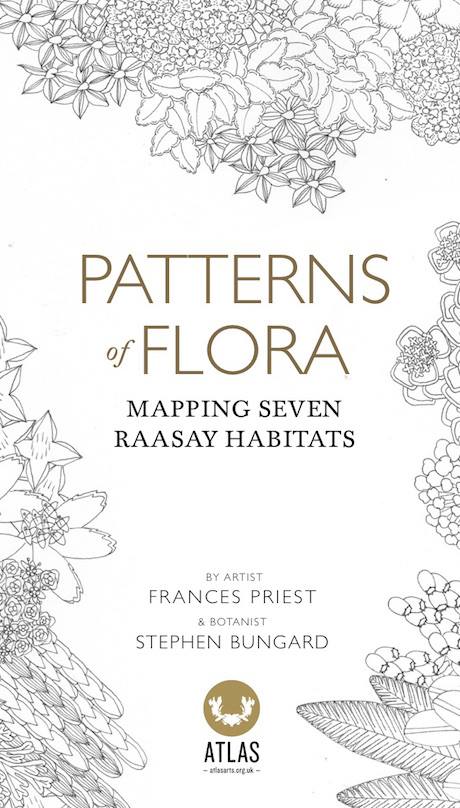
I was on the Isle of Raasay in early June, for the launch of Patterns of Flora | Mapping Seven Raasay Habitats. ATLAS Arts, based on nearby Skye, had commissioned Edinburgh-based ceramicist, Frances Priest to develop a series of handmade, ceramic artworks for permanent installation in Raasay House.

The form and design of the artworks – vases, door knobs, door pushes and pieces for sills – are based on Raasay’s plant life, and in particular seven different habitats that host unique and varying plant species: Bog, Coast, Fresh Water, Limestone, Moor, Mountains and Woodland. Alongside these Frances designed a map, featuring the habitats with associated walks. She collaborated with Raasay-based botanist Stephen Bungard.

(I had worked with Frances several years ago, on Pandora’s Light Box at the Talbot Rice Gallery in Edinburgh, and it was good to catch up with her work in a very different setting.)

10676329_921396287883440_1629111481114513217_n

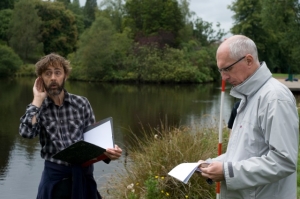
I was there to lead a ‘haiku walk’ on the Saturday afternoon, again working with Stephen. We went to the salt marsh at Oskaig, arriving at a particularly wind- and rain-swept moment, but the weather cleared and there was much to enjoy immediately around us, and looking across the sound to Skye and the Cuillins. I was struck by Stephen’s remark that the four aspen trees we saw were in fact all one, the trunks all sharing a single root.

Back at Raasay House all was notebooks and concentration.

On Sunday, once the morning rain had cleared, I managed a walk with Frances and others on the east coast from Fearns to Hallaig, below the cliffs and into the birchwood the burn runs through. In his poem ‘Hallaig’ Sorley Maclean repeoples the now empty places:

na h-igheanan ’nan coille bheithe, / dìreach an druim, crom an ceann.

the girls a wood of birches, / straight their backs, bent their heads.

Some flowers among the ruins

Callendar House
Callendar House

In summer 2013 the Park Gallery in Callendar House, Falkirk, exhibited Ian Hamilton Finlay’s Nature Over Again (After Poussin), part of the Artist Rooms collection.

The gallery asked Alec Finlay to make a new work for Callendar Park, and invited him to work with the gallery’s Youth Ambassadors (YAs), teenagers drawn from local secondary schools who are involved in different ways with the gallery’s programme. Alec asked me, along with other poets and artists, to work with the YAs over the summer to develop his ideas, centered on creating viewpoints within the park, and linking these to plants brought here by the Romans (the line of the Antonine Wall runs just to the north of Callendar House).

WALLFLOWERS | FLORES MURI – a series of plantings in Callendar Park marked by archaeological poles – was finalised and installed by Alec in spring 2014.

Sadly it was vandalised immediately and thoroughly.

Some flowers among the ruins is a new booklet published by Callendar Park, Falkirk. It invites the reader to walk in their imagination through the park, and to view the plantings that were once there, albeit briefly, rather like the Antonine Wall itself.

If you’d like a copy, send an SAE to Studio Alec Finlay, 53 Prince Regent Street, Edinburgh EH6 4AR. (It measures c.14x11cm, so you don’t need a large envelope.)

You can read the YAs blogs about the project here, and Alec has written a blog about it here. Below are some notes I made about my involvement in the project in 2013.

Alec Finlay & Ken Cockburn

Alec and I had made a couple of preliminary visits in the spring, looking for views. As the gallery is showing Nature Over Again (After Poussin), his initial idea was to set up viewfinders to ‘frame’ certain landscapes in a painterly way; but given the woodland we found too few. What we did find were the golf-course with its flags, the Antonine Wall still casting its Roman shadow, and what we called the ‘declension tree’ (a red maple), whose trunk divided close to the ground.

Come summer the tall limes are flowering and abuzz with bees. Between showers I explore the grounds with the Youth Ambassadors, looking for sites that will work as viewpoints and a views; like a golf flag which draws you towards itself, then points you towards what comes next. Nine in all (like the golf-course); each marked by an flag-topped archaeological pole, and a plant first brought here by the Romans (some of which already grow here, others we’ll plant specially). We write about and sketch the views, compare one with another, contrast different views from the same viewpoint.

After researching our Roman flora, we write very short poems about them, playing with their features, their uses and the meaning of their Latin names. Then we plot a route through the grounds, from one pole to the next, realising they’ll be more visible in winter; the landscape now is like a series of discreet rooms. We finalise the pole locations by photographing them in situ, each with a poem-label for its matched flora. It’s a good way of seeing how the poles link up, and considering the work as a whole.

The last day is spent with photographer Robin Gillanders. At each location Robin takes three photos of each person in a t-shirt (happily there are nine of us, so no-one is left out) – head & torso, facing forwards; full length, ditto; full length, looking away at the view. And at each location Alec and I discuss the poems, already revised, revising some further on the spot (most interestingly the Whitmanesque ‘daffodil’).

Robin speaks about photographing other gardens –Ian Hamilton Finlay’s Little Sparta, and Ermenonville where Rousseau is buried. Later, walking round Nature Over Again (After Poussin), Alec talks us through the images, and his personal memories of their creation; there’s some discussion of why the photos are ‘folded’.

2013-06-12 12.54.48

About Face

These are some images from the recent opening of the exhibition About Face at Hillhead Library, Glasgow, featuring large-scale polaroid photographs of ten Scottish poets made by Maud Sulter in 2002.

The poets are myself, Stewart Conn, Valerie Gillies, Brian Johnstone, Gerry Loose, Edwin Morgan, Liz Niven, Janet Paisley, Don Paterson, and Maud Sulter. Robyn Marsack, Director of the Scottish Poetry Library, spoke at the opening; the exhibition runs till 28 June 2015.

Maud Sulter was an artist and writer, whose poems featured in Donny O’Rourke’s seminal Dream State anthology. She died in 2008.

I had slightly hazy memories of the photograph being taken, but found the following diary entry.

Tuesday 29 August 2002: I stood for Maud Sulter this morning, just before Jennie Renton. I thought dreamy, Jennie said enquiring. A flicker of a smile. Smart flat by the parliament. Big camera, flash and it’s done.

She used a large-format camera, which came from Prague with a technician; waited for the right moment, pressed the button, then we watched and waited as the paper emerged and the image formed. Later I wrote, “What strikes me about my own portrait is the asymmetry of the face, the light / dark contrast, what seems to be a mixture of curiosity and reticence, alertness and sleepiness”.

The portraits toured to several venues in 2003 and 2004, but this is the first time they’ve been seen since. The exhibition coincides with Passion, a larger show of Sulter’s work, at Street Level Photoworks in Glasgow.

ECLIPSE: Enlightenment

DF Lunar Eclipse Solar Eclipse

Coinciding with the lunar eclipse on 4 April, and following the recent solar eclipse, David Faithfull’s ‘Moon draws Sun / Earth draws Moon’ has been projected onto the side of Castle Mill Works in Fountainbridge. As part of the Dark Matters project, we discussed in situ the installation and its connections with Enlightenment Edinburgh. (Thanks to Judith Liddle for the photos below.)

The Encyclopaedia Britannica was founded in Edinburgh in the 1760s, and early editions were printed in in Fountainbridge. The city at the time was just beginning to expand from the old town huddled for protection beneath the castle; and of its home city the EB states approvingly that “a plan of a new town to the north is fixed upon, and is actually carrying into execution with surprising rapidity, and with an elegance and taste that does honour to this country.”

I read parts of the ASTRONOMY ‘treatise’ from the first edition of the EB from 1768. While telescopes had given us a sense of the size of the universe, we had as yet no sense of geological time – that had to wait until James Hutton’s Theory of the Earth, elaborated in the 1780s and published in book form in 1795. And the author’s belief in a benevolent deity led him to this, to our minds certainly, surprising conclusion:

[There is] no room to doubt, but that all the planets and moons in the [solar] system are designed as commodious habitations for creatures endued with capacities of knowing and adoring their beneficent Creator. (…) From what we know of our own system, it may be reasonably concluded, that all the rest are with equal wisdom contrived, situated and provided with accommodations for rational inhabitants.

This, the author contends, extends even to comets:

The extreme heat, the dense atmosphere, the gross vapours, the chaotic state of the comets seem at first sight to indicate them altogether unfit for the purposes of animal life, and a most miserable habitation for rational beings ; and therefore some are of the opinion that they are so many hells for tormenting the dammed with perpetual vicissitudes of heat and cold. But when we consider, on the other hand, the infinite power and goodness of the Deity, the latter inclining, and the former enabling him to make creatures suited to all states and circumstances ; that matter exists only for the sake of intelligent beings ; and that where-ever we find it, we always find it pregnant with life, or necessarily subservient thereto ; the numberless species, the astonishing diversity of animals in earth, air, water, and even on other animals ; every blade of grass, every leaf, every fluid swarming with life ; and every one of these enjoying such gratifications as the nature and state of each requires ; When we reflect moreover, that some centuries ago, till experience undeceived us, a great part of the earth was judged uninhabitable, the torrid zone by reason of excessive heat, and the frigid zones because of their intolerable cold ; it seems highly probable, that such numerous and large masses of durable matter as the comets are, however unlikely they be to our earth, are not destitute of beings capable of contemplating with wonder, and acknowledging with gratitude, the wisdom, symmetry, and beauty of the creation ; which is more plainly to be observed in their extensive tour through the heavens, than in our more confined circuit. If further conjecture is permitted, may we not suppose them instrumental in recruiting the expanded fuel of the sun, and supplying the exhausted moisture of the planets? However difficult it may be, circumstanced as we are, to find out their particular destination, this is an undoubted truth, that wherever the Deity exerts his power, there he also manifests his wisdom and goodness.

Reading this, I am surprised Edinburgh was not also the founding city of science fiction literature.

DF Eclipse

Come dusk, the generator was switched on, and David’s installation played over the wall of the Castle Mill Works, a former rubber factory, earmarked to become the new home of Edinburgh Printmakers Workshop in a few years time.

And come dusk, we were all feeling the cold, and were glad of a chance to warm ourselves around the bonfire.

Bonfire