Postcards from Edinburgh (1)

I’ve been tweeting some quotes from about Edinburgh, and here’s a wee collection of the first few.

EPT Wordsworth 02


EPT RLS 10


EPT DBM 02


EPT Garioch 02


EPT Piozzi 01

Dorothy Wordsworth recorded in her diary arriving in Edinburgh with her brother William on 15 September 1803. – Robert Louis Stevenson’s Edinburgh: Picturesque Notes (1878) still speaks to the city today.– Donnchadh Bàn Mac an t-Saoir, or in English Duncan Ban MacIntyre, was a Gaelic poet from Argyll who was a member of City Guard in the late 18th century; the lines, from his poem ‘Oran Dhun Eidann’ (‘Song of Edinburgh’), first published in 1804, translate as ‘Edinburgh is beautiful / in many diverse ways…’. – In ‘To Robert Fergusson’ Robert Garioch (1909–1981) imagines rattling the ‘rigg-bane’ or spine of the Old Town in the company of the energetic earlier poet. – Hester Piozzi, aka Dr Johnson’s confidante Mrs Thrale, visited the city in the summer of 1789, anxious she would encounter ‘a second hand London’, but found something quite different.


TradFest 2018: Jacobite Edinburgh

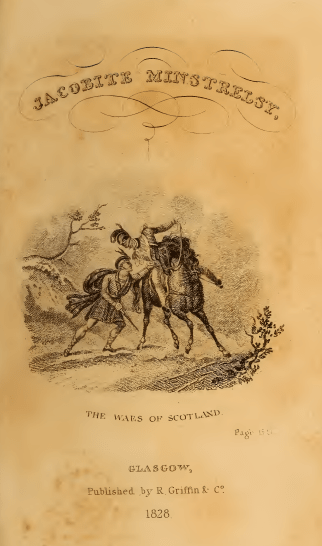
Jacobite Minstrelsy 1829 title page

I’m running two walks for Tradfest 2018 on a Jacobite theme. Dates and times are Thursday 3 May at 2.30pm, and Saturday 5 May at 11.00am, each lasting about 90 minutes. The starting point is the Scottish Storytelling Centre on the High Street, and we’ll walk down the Royal Mile to Holyrood Palace, pausing on the way to look at sites associated with the Jacobites and those who wrote about them.

Hogg Jacobite Relics 1819

I’ll read extracts from works by writers including James Hogg, Tobias Smollet and Walter Scott, describing the drama of Edinburgh’s occupation by the Jacobite army in autumn 1745, the decisive Battle of Culloden, and the long, painful aftermath which gradually gave way to the romantic myth of Bonnie Prince Charlie.

Hogg Jacobite Relics Song 81

For more details, and to book a ticket, click here.

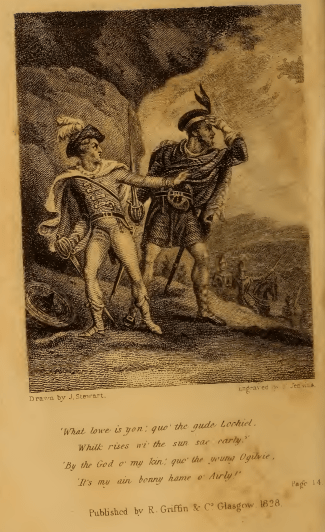
Jacobite Minstrelsy 1829 frontispiece

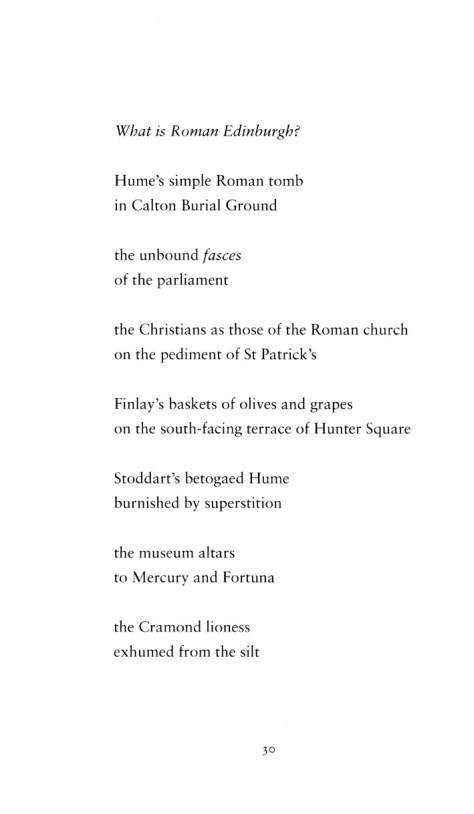
What is Roman Edinburgh?

EPT KC FtW Roman Edinburgh

Like Rome, Edinburgh is a city built on seven hills.

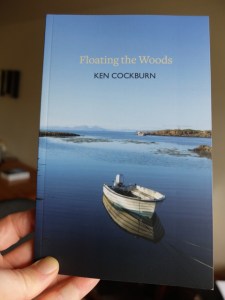
My new collection, Floating the Woods, published by Luath Press, includes ‘Seven Questions’, which considers Edinburgh’s links with Ancient Rome – there’s an extract above.

The book also includes ‘Pandora’s Light Box’, which describes the University of Edinburgh’s Talbot Rice Gallery, which today shows contemporary art but which began life as natural history museum.

Other poems move further afield, to Loch Ness, Orkney, Flanders and Rome itself, where in the 1750s a young Scottish architect, Robert Adam, is beginning to find his way.

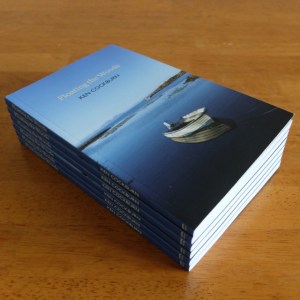
Floating the Woods 03


Floating the Woods

Floating the Woods 02

Last week I had my first sighting of Floating the Woods, a new collection of poems published by and available from Luath Press, and launched on Thursday 29 March at the Scottish Poetry Library.

The cover blurb reads, “the places in Floating the Woods are mainly Scottish, stretching from the Borders to Orkney, taking in Edinburgh, the Tay estuary and the River Ness. Through these landscapes move figures from the past – real, legendary and imagined – as the routes of Romans, Vikings and Celtic saints are followed by later figures such as Wordsworth, James Hogg and John Muir. Further afield the First World War casts a long, dark shadow over otherwise idyllic English and Belgian scenes. There are alphabet, calendar, list and found poems, dealing with imaginary shades of blue and the imponderables of etiquette.”

Floating the Woods 03

I am grateful to Jen Webb, editor of the Australian journal Meniscus, for her text which also appears on the cover. “List the things that matter, and what is likely to appear are stories, and buildings, the birds that fly between them, the hills and streams and skies that surround them, the ordinary stuff of everyday life lived alongside the felt presence of ancient recent history. Ken Cockburn’s new collection captures all this, in the lyrical lists, shape poems and sound poems filled with sharp yet tender observations of the world through which he moves. In a gloriously demotic voice that remains deeply immersed in the long traditions of poetry, he paints space, and place; and in his hands, language finds a mouth.”

Cockburn FtW 2018 2

Daughters of Penelope

These photos were taken at Edinburgh’s Dovecot Studios on 24 October 2017, during an event I created with Juliana Capes for the exhibition Daughters of Penelope (which runs till 20 January).

You dropped a purple ravelling in,
You dropped an amber thread;
And now you’ve littered all the East
With duds of emerald!

We focused on works by Julie Brook, Caroline Dear, Linder and Sonia Delauney. Juliana read an original text written in response to the artworks, while I read a selection of poems on weaving and colour, including works by Emily Dickinson (above) and verses from the Carmina Gadelica.

Photographs courtesy of Dovecot Studios.

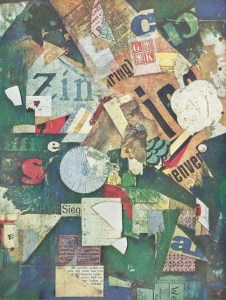
Kurt Schwitters

Schwitters_Collage

A Hanover bourgeois, Kurt Schwitters,
Grew tired of painting his sitters.
In sentences terse
He declared all art Merz
And made poems from sneezes and titters.

A limerick for Kurt Schwitters on 8 January 2018, the 70th anniversary of his death.

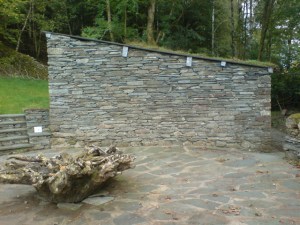
Below are some photos from a visit in 2014 to Cylinders in the Lake District, where Schwitters made his last Merzbau in the 1940s (the barn he made it was recently in the news again), and there is a bench with extracts from his ‘Ursonate’ (to hear an extract performed by Florian Kaplick click here).

Cylinders_Merzbarn

Apples and Pears (reprise)

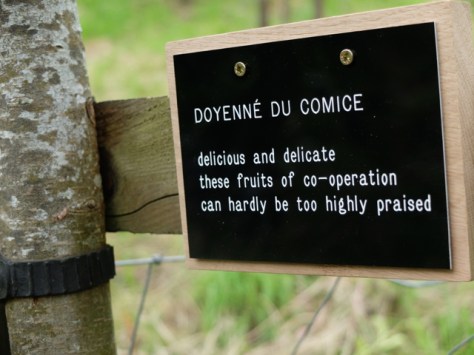
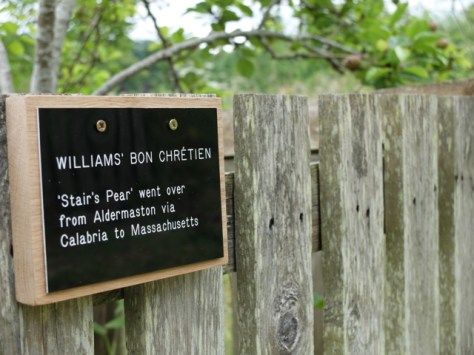
A brief follow-up to last year’s post about Crailing Community Orchard. I wrote short poems about the apple and pear varieties growing there, which were printed onto botanical labels. Earlier this year these were installed by the respective trees in the orchard. Here is a selection. Happy eating!


ASHMEADS KERNEL 2Ashmead’s Kernel

BEURRE HARDY 2
Beurré Hardy, raised c.1820, was named after a M. Hardy, then director of the Luxembourg Gardens in Paris.

CATILLAC 2Catillac is an old pear variety which has been given many different names, including Monstreuse de Landes, Grand Monarque and Grand Mogol, though its current English name derives from the place-name Cadillac in the Gironde area of France. CONCORDE 1
The Concorde pear combines the Conference and Comice pear varieties, the former popular in Europe, the latter in the USA. DOYENNE DU COMICE 3Doyenné du Comice

EARLY JULYAN 1
Early Julyan

JARGONELLE 4
Jargonelle

LOUISE BONNE 2
Louise Bonne of Jersey was raised c.1780 in Normandy, and was later introduced to England via the Channel Islands. PEASGOOD 2
Peasgood NonesuchWHITE MELROSE 4White Melrose was probably introduced to Scotland by the monks of Melrose Abbey, who as Cistercians wore white robes, to distinguish themselves from the black-robed Benedictines.

WILLIAMS BC 2
Williams Bon ChrétienYELLOW INGESTRIE 2Yellow Ingestrie


Festival International de la Poésie, Trois-Rivières, Québec

I recently attended the 33rd Festival International de la Poésie at Trois-Rivières, Québec, Canada – my first time in that country. There were poets from countries around the world, including Mexico, Argentina, USA, France, Belgium, Russia, Morocco, Mauritania and China, as well as from Québec and other parts of Canada. Below are just a few of those I met and heard read; I felt a real sense of community among us.

As for myself, I read in restaurants, cafés, bars, a cinema, a church, a museum and the Maison de la Culture. All the readings were limited to 3 minutes for French-language poems, and 5 minutes for  poem in French translation plus the original; then another poet would do the same, either right away or after a pause of 5 or 10 minutes for conversation and eating. A new format for me, but one I came to appreciate – no-one outstayed their welcome, and there was time to talk and think about what you’d just heard. I liked the equality of the festival too; each reading featured several poets (between three and seven), who’d each read for the same amount of time (usually two ‘rounds’, with sometimes a quick-fire third one at the end, without pauses between the poems).

Trois-Rivières itself is a town about the size of Dundee on the banks of the St Lawrence and St Maurice Rivers, and lies about half-way between Montreal and Québec City. (There are in fact only two rivers; the three rivers of the town’s name come from the ways islands in the St Maurice River mean it has three mouths as it joins the St Lawrence.) It was pleasantly warm throughout the festival – unusually so, I was told – but by the time we left autumn was colouring the trees.

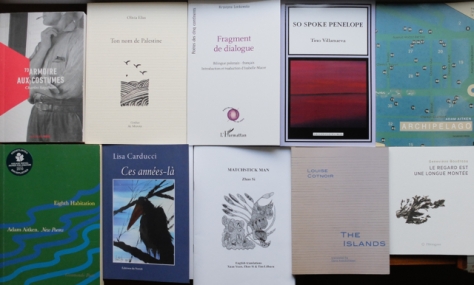
I came back with a selection of books, so this is what I’ll be reading over the next few weeks.

FIPTR_Books

My thanks to Philippe Démeron making French translations of my poems; to the Festival organisers Gaston Bellemare and Maryse Baribeau for the invitation and hospitality, and to them and everyone involved in the festival for making my stay such a pleasant and rewarding one.

Haiku in Hamburg

I visited planten un blomen, Hamburg’s botanic gardens, in mid-September, and ran a haiku workshop in the Japanese garden, which has a teahouse beside a pond lined with maples, pines and bamboo.

I’d visited the garden before, in late spring, but it seemed to be more itself in autumn – leaves reddening, a few of which had dropped visible in the clear water; pine needles fallen onto rocks; a more muted light suggesting both distance and enclosure.

For the workshop I selected some lines from German versions of Japanese haiku, and we used these as starting points for our own work. Here are some the poems written on the day, with my English translations.
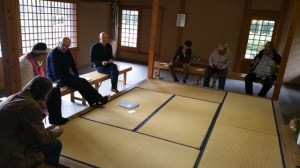
Teehaus_Gruppe

Bauschen die Wolken
lausche ich dem Herbstwind und
halte die Luft an.
[Christine]

Clouds pile up
I listen to the autumn wind and
hold my breath

*

Der Herbst beginnt schon
noch blühen die Sonnenblumen
welch ein schönes Gelb.
[Petra]

*

Autumn has begun
still the sunflowers bloom
a wonderful yellow

*

Plötzlich donnert es –
das Geräusch des Wassers bleibt
ununterbrochen
[KC]

Sudden thunder –
the sound of water continues
uninterrupted

*

Geräusch des Wassers
taube Ohren des Herbstes
nach dem Sonnenklang
[Simon]

The sound of water
autumn’s deaf ears
after sunchords

*

Zwei Ameisen sah’n
Altona Amerika
Erlangen Weisheit.
[Sidney]

Two ants saw
Altona America
Gained wisdom.

This is a playful take on an already playful poem, ‘Die Ameisen’ (’The Ants’) by Joachim Ringelnatz (1883-1934) known to anyone who lives in or grew up in Hamburg. I append a literal translation below. The district of Altona lies immediately west of central Hamburg.

In Hamburg lebten zwei Ameisen,
die wollten nach Australien reisen.
Bei Altona, auf der Chaussee,
da taten ihnen die Beine weh,
und da verzichteten sie weise
dann auf den letzten Teil der Reise.

In Hamburg there lived two ants,
who wanted to travel to Australia.
In Altona, on the street,
their legs started hurting,
so wisely they gave up
the last part of their journey.
JapaneseGarden13


Ken Cockburn's website & blog