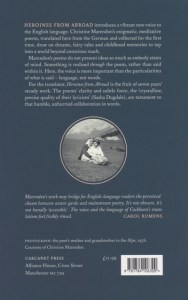
Heroines from Abroad, newly published by Carcanet, is a bilingual (German / English) edition of poems by Christine Marendon, alongside my translations.
Christine will be in Scotland this summer, and we are launching the book on 13 July at 8pm at Lighthouse in Edinburgh.
I discovered Christine’s poems via a mutual friend, the poet Arne Rautenberg. Christine had been invited to a festival in Slovenia, and needed English versions of six poems – could I make the translations? I enjoyed their enigmatic imagery and shifts in tone, and made the translations, helped by a correspondence with her.
Several years elapsed, when I always had in the back of my mind that I’d like to return to her work. I came across poems online, and have been translating her slowly but steadily since 2011; translations have appeared in Shearsman, Modern Poetry in Translation, New Books in German, and online at www.no-mans-land.org.
We met for the first time in March 2014, in Hamburg where she lives; shortly afterwards we were invited to read together in London by Sasha Dugdale, then the editor of Modern Poetry in Translation, and it was a pleasure to hear her measured reading voice.
From Bavaria, she grew up speaking both German and Italian, and only began writing in her poetry in her thirties, after attending a reading by the poet Hilde Domin (1909–2006). In Germany her work is published online, and in magazines and anthologies, but she still awaits a first collection. As a translator, she has made German versions of poems by James Wright.
‘Marendon’s work may bridge for English-language readers the perceived chasm between avant-garde and mainstream poetry. It’s not obscure, it’s not banally ‘accessible’. The voice and the language of Cockburn’s translations feel freshly rinsed.’ Carol Rumens
The Caseroom Press recently published two books which I had a hand in.
O | O 3: Word Disco is the third in an unintended trilogy of found poems, and follows Overheard Overlooked (2011) and Overlooked Overheard (2015). Visually it departs from the previous books, with the texts being typeset, distorted on photocopiers and then edited and composed in Photoshop. Barrie Tullett again designed it, and as with Overlooked Overheard his students at the University of Lincoln found the poems it contains. It’s available via The Caseroom Press website.
Woodland Orienteering presents six six-letter word-pairs composed in 2011 for an orienteering circuit in Dufftown, Moray, but never used (a seventh word-pair was, and remains in situ). If you’d like to buy a copy please contact me directly.
Like Rome, Edinburgh is a city built on seven hills.
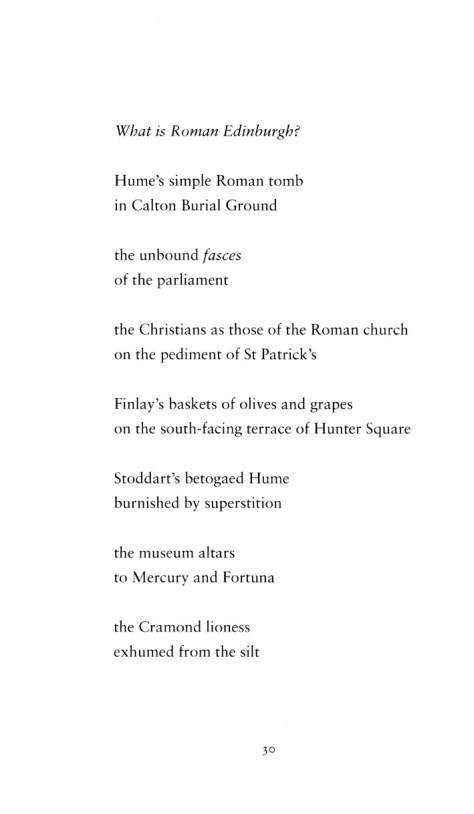
My new collection, Floating the Woods, published by Luath Press, includes ‘Seven Questions’, which considers Edinburgh’s links with Ancient Rome – there’s an extract above.
Hume’s statue
Hume’s tomb
St Patrick’s Church
The book also includes ‘Pandora’s Light Box’, which describes the University of Edinburgh’s Talbot Rice Gallery, which today shows contemporary art but which began life as natural history museum.
Other poems move further afield, to Loch Ness, Orkney, Flanders and Rome itself, where in the 1750s a young Scottish architect, Robert Adam, is beginning to find his way.
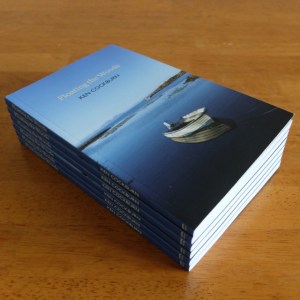
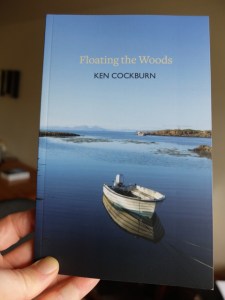
Last week I had my first sighting of Floating the Woods, a new collection of poems published by and available from Luath Press, and launched on Thursday 29 March at the Scottish Poetry Library.
The cover blurb reads, “the places in Floating the Woods are mainly Scottish, stretching from the Borders to Orkney, taking in Edinburgh, the Tay estuary and the River Ness. Through these landscapes move figures from the past – real, legendary and imagined – as the routes of Romans, Vikings and Celtic saints are followed by later figures such as Wordsworth, James Hogg and John Muir. Further afield the First World War casts a long, dark shadow over otherwise idyllic English and Belgian scenes. There are alphabet, calendar, list and found poems, dealing with imaginary shades of blue and the imponderables of etiquette.”
I am grateful to Jen Webb, editor of the Australian journal Meniscus, for her text which also appears on the cover. “List the things that matter, and what is likely to appear are stories, and buildings, the birds that fly between them, the hills and streams and skies that surround them, the ordinary stuff of everyday life lived alongside the felt presence of ancient recent history. Ken Cockburn’s new collection captures all this, in the lyrical lists, shape poems and sound poems filled with sharp yet tender observations of the world through which he moves. In a gloriously demotic voice that remains deeply immersed in the long traditions of poetry, he paints space, and place; and in his hands, language finds a mouth.”
I contributed a sequence of seven short poems, taking as my starting point Wordsworth’s ‘The Solitary Reaper’. They were presented as prints, and as a booklet in the display case.
The photographs on the wall are by Tomohiko Ogawa, and show postcards of Scotland ‘matched’ with landscapes in Japan. Tomohiko also took these exhibition photographs.
Some of Alec Finlay’s word-mountains were also shown. There is a fine, informative catalogue; below is a page with Tomohiko’s photographs, including one we used on the cover of The Road North (middle left; on the book cover it’s reversed), and a page with background to my take on ‘The Solitary Reaper’.
Silence before Speech is a new publication in memory of Neil Christie, a friend who died on Christmas eve three years ago. It’s a boxed set of 16 poem-cards, each featuring a poem by myself or Jane MacKie, and a painting by Dina Campbell. The portfolio was designed by Mary Asiedu.
We all knew Neil; he had a gift for friendship, and for bringing people together. One of his favourite tricks was to arrange a meeting to which he invited people from different parts of his life, and then cry off at the last moment, leaving us to get to know each other.
He worked as a graphic designer, and occasional publisher; Reading the Streets was made for his Duende Press, when he linked myself and illustrator Libby Walker. Latterly he lived down by the river at Cramond, and I’ve fond memories of eating fish soup in his small cottage there, packed with books and CDs, before emerging for a riverside stroll.
Jane and I both wrote to Dina’s images, and their titles. My poems all came out as unpunctuated six-liners; Jane allowed herself more scope, in length and stanza form.
The cards measure 195 x 94 mm. A set costs £15 – please contact me if you’d like to buy a set.
The gallery asked Alec Finlay to make a new work for Callendar Park, and invited him to work with the gallery’s Youth Ambassadors (YAs), teenagers drawn from local secondary schools who are involved in different ways with the gallery’s programme. Alec asked me, along with other poets and artists, to work with the YAs over the summer to develop his ideas, centered on creating viewpoints within the park, and linking these to plants brought here by the Romans (the line of the Antonine Wall runs just to the north of Callendar House).
WALLFLOWERS | FLORES MURI – a series of plantings in Callendar Park marked by archaeological poles – was finalised and installed by Alec in spring 2014.
Sadly it was vandalised immediately and thoroughly.
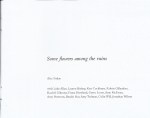
Some flowers among the ruins is a new booklet published by Callendar Park, Falkirk. It invites the reader to walk in their imagination through the park, and to view the plantings that were once there, albeit briefly, rather like the Antonine Wall itself.
If you’d like a copy, send an SAE to Studio Alec Finlay, 53 Prince Regent Street, Edinburgh EH6 4AR. (It measures c.14x11cm, so you don’t need a large envelope.)
You can read the YAs blogs about the project here, and Alec has written a blog about it here. Below are some notes I made about my involvement in the project in 2013.
Alec Finlay & Ken Cockburn
Alec and I had made a couple of preliminary visits in the spring, looking for views. As the gallery is showing Nature Over Again (After Poussin), his initial idea was to set up viewfinders to ‘frame’ certain landscapes in a painterly way; but given the woodland we found too few. What we did find were the golf-course with its flags, the Antonine Wall still casting its Roman shadow, and what we called the ‘declension tree’ (a red maple), whose trunk divided close to the ground.
Come summer the tall limes are flowering and abuzz with bees. Between showers I explore the grounds with the Youth Ambassadors, looking for sites that will work as viewpoints and a views; like a golf flag which draws you towards itself, then points you towards what comes next. Nine in all (like the golf-course); each marked by an flag-topped archaeological pole, and a plant first brought here by the Romans (some of which already grow here, others we’ll plant specially). We write about and sketch the views, compare one with another, contrast different views from the same viewpoint.
After researching our Roman flora, we write very short poems about them, playing with their features, their uses and the meaning of their Latin names. Then we plot a route through the grounds, from one pole to the next, realising they’ll be more visible in winter; the landscape now is like a series of discreet rooms. We finalise the pole locations by photographing them in situ, each with a poem-label for its matched flora. It’s a good way of seeing how the poles link up, and considering the work as a whole.
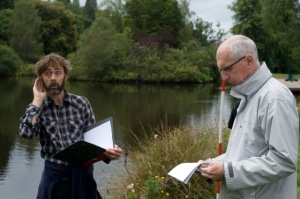
The last day is spent with photographer Robin Gillanders. At each location Robin takes three photos of each person in a t-shirt (happily there are nine of us, so no-one is left out) – head & torso, facing forwards; full length, ditto; full length, looking away at the view. And at each location Alec and I discuss the poems, already revised, revising some further on the spot (most interestingly the Whitmanesque ‘daffodil’).
Robin speaks about photographing other gardens –Ian Hamilton Finlay’s Little Sparta, and Ermenonville where Rousseau is buried. Later, walking round Nature Over Again (After Poussin), Alec talks us through the images, and his personal memories of their creation; there’s some discussion of why the photos are ‘folded’.
I spent much of summer 2014 driving the motorways and country lanes of England and Wales with Luke Allan for there were our own there were the others, a project by Alec Finlay for the National Trust to mark the centenary of the outbreak of the First World War. Luke & I visited 23 properties, all of which had some connection to the war – a family member who served and was perhaps killed; a house used as a hospital, grounds used as a training camp; gardens planted as memorials to the carnage. At each I led a silent memorial walk, bookended by a pair of poems from the past century on the theme of conflict. At most properties we set up a pair of lecterns, on which the poems were presented, and at some the lecterns were placed either end of a sandbag wall, reminiscent of the trenches. At a few we flew a red flag featuring a circular version of project’s title. That phrase is taken from Hamish Henderson’s Elegies for the Dead in Cyrenaica, about his experiences in the North African desert in the Second World War, but it seemed an apt way of memorialising all the victims of conflict, rather than just those ‘on our side’, as did the large-scale ceramic poppies installation at the Tower of London.
Osterley House
Killerton Chapel
Stourhead
Liverpool
Burwash Memorial
Penrhyn
Stourhead, Temple of Apollo
This gallery above shows some photos from the tour (all are by me, except Killerton Chapel by Hannah Devereux, and Liverpool, by Luke Allan). The full itinerary is on the website.
After the English and Welsh tours I was able to visit Belgium at the end of September to visit some of the First World War sites near Ypres: graveyards, battlefields, memorials. I also saw the excellent exhibition In Flanders Fields in the Lakenhalle in the centre of Ypres itself, which shows the war from the perspective of the four armies who were fighting there: Belgian, French, British and German. We stayed at Talbot House in Poperinge, a small town which, for most of the war was just far enough behind the front line for it to be fairly safe. Talbot House became a social club for off-duty soldiers, and retains many features of that time.
A book of the same title documents and reflects on the project. It includes poems and prose by myself about the walks and the poems, as well as the poem ‘Cloqueliclot’ about my experiences in Belgium. It also features fine photos by Luke and Hannah.
After the road-trips of 2010 and 2011, Alec Finlay and I wrote a long poem about our travels on The Road North. It’s now been published in book form by Shearsman as the road north: a journey through Scotland guided by Bashō’s oku-no-hosomichi, 15 May 2010–15 May 2011.
You can download an audio version free of charge from iTunes – search for ‘The Road North (Alec Finlay & Ken Cockburn).
With thanks to Tony Frazer at Shearsman, and Tomohiko Ogawa for the cover photograph – it’s a postcard of Scotland which Alec sent to Tomohiko, who ‘matched’ it with a landscape in Japan.
If you’re interested in the background to the project, click on the link below to read an article I wrote for The Author, the magazine of The Society of Authors, earlier this year.
Earlier this year I mentioned that I was taking part in the exhibition Wordsworth and Basho: Walking Poets at Dove Cottage, Grasmere. That exhibition is now up and running – it closes on 2 November – and this post is about three books connected with it.
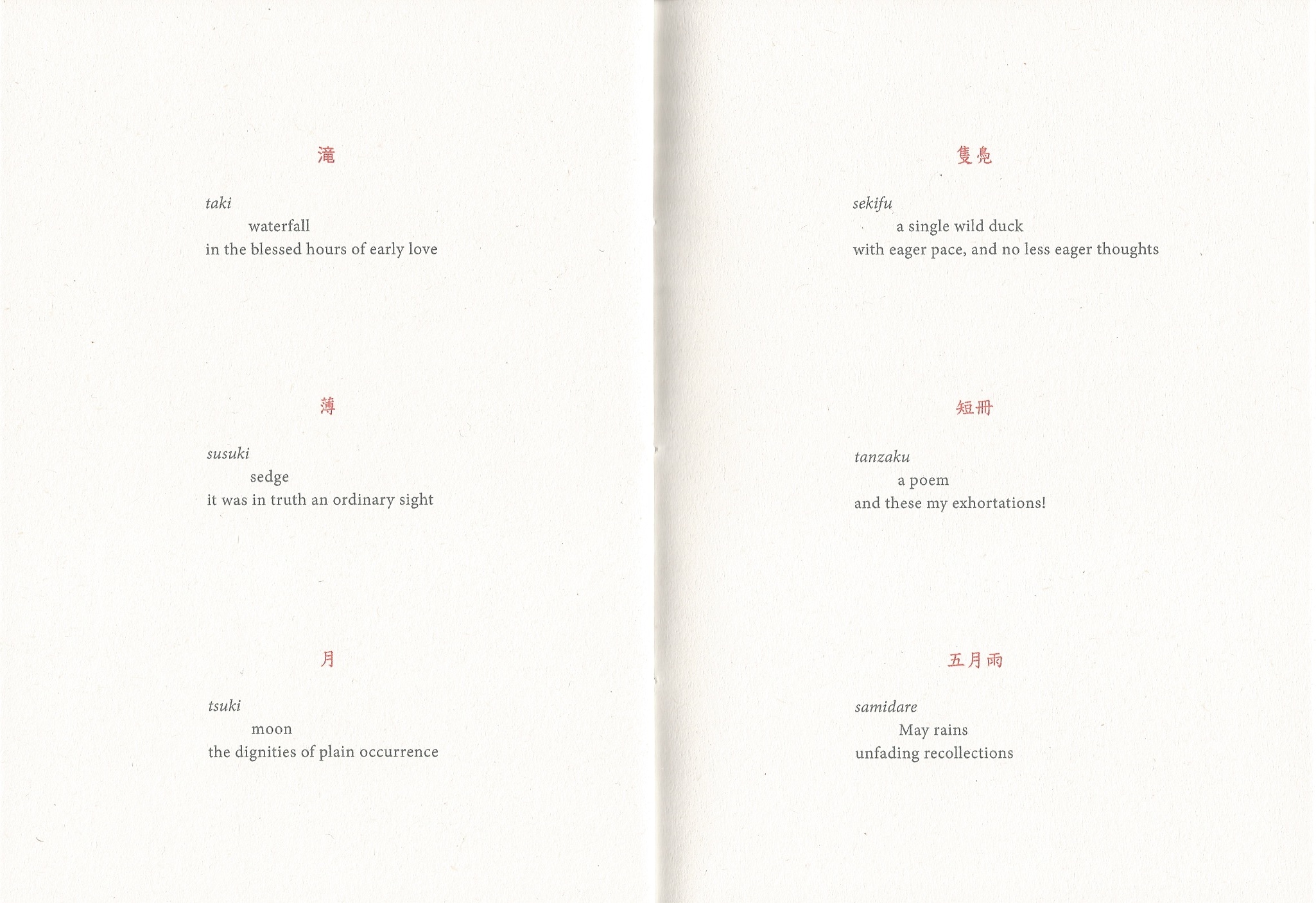
While yet we may is my contribution to the exhibition. It exists as a boxed set of 68 cards, and as a book. “While yet we may is composed of 17 words from Basho’s Oku no hosomichi (best known in English as The Narrow Road to the Deep North, though I worked mainly from the English translation by Cid Corman and Kamaike Susumu published as Back Roads to Far Towns) and 51 extracts from The Prelude, The Recluse and ‘Lines Composed a Few Miles Above Tintern Abbey’ by William Wordsworth. The idea for While yet we may came from a ‘variable construction’ by the poet Gael Turnbull (1928–2004), which consisted of two sets of cards : one of 28 cards, each featuring a noun, the other of 112 cards, each featuring a qualifying phrase. As Turnbull explained, “any one of the one-hundred-and-twelve phrases may relate to any of the twenty-eight nouns”. Of a published version in which each phrase was paired with a noun he wrote, “this version is no less final than any other”. The same applies to the version of While yet we may printed here.”
Copies of While yet we may (book and cards) are available from the bookshop at Dove Cottage, at £8.00 and £25.00; alternatively, you can buy them online at Big Cartel.
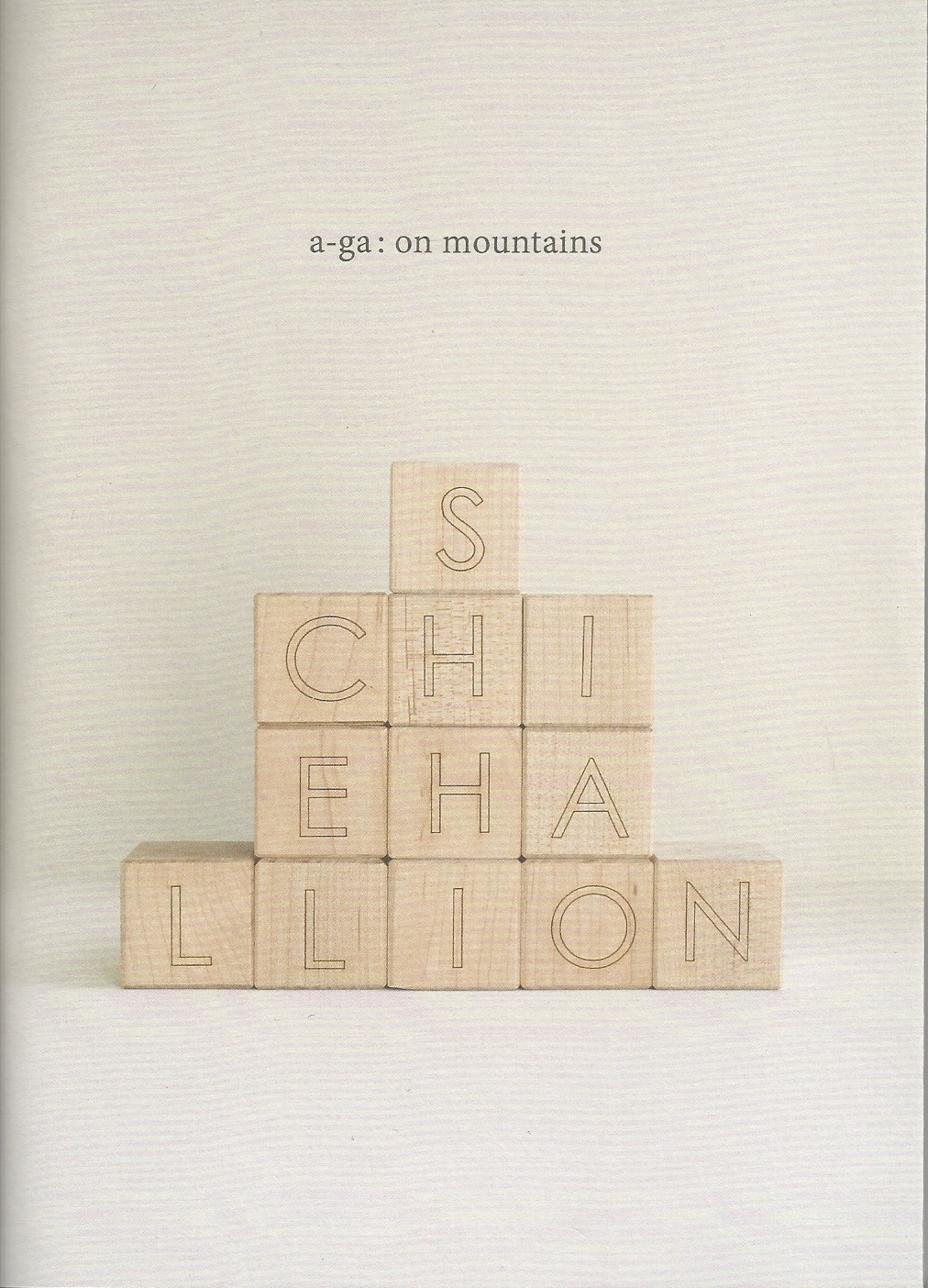
Alec Finlay’s contribution to Walking Poets is the booklet a-ga : on mountains, which includes pieces composed for the road north.
The exhibition catalogue has now been published, a fine full-colour publication edited by Mike Collier, and featuring work by, among others, Autumn Richardson, Richard Skelton. Ayako Tani and Brian Thompson. You can buy a copy here for only £9.99. One of the photos I took on the walk up Easdale Tarn in January has made its way onto the front cover.














 Poems on the page and in the world