I’m aware I haven’t posted here for quite a while, the main reason being that I’ve got into the habit of putting out my news in other ways, mainly regular posts on instagram, and an occasional newsletter sent out via Mailchimp.
You can find the last newsletter, which I sent out at the start of May, here. This is the introduction:
I’ll be leading poetry walks on the Edinburgh Fringe again this year, for the first time since 2019. – Along with Rod Burns and Becky Dwyer, I’ve become co-editor of Presence Haiku Journal, established by the late Martin Lucas and edited since 2014 by Ian Storr. – I have work in a forthcoming exhibition at MOCA Dunoon, paying tribute to Ian Hamilton Finlay whose centenary falls this year. – I’m leading a walking renga at Glasgow Botanic Gardens on Sunday 25th May, i.m Gerry Loose. – Plus a short poem published recently in Poetry Scotland.
If you want to read more about any of these, you can find the mailing here.
And if you want to sign up to receive future mailings, you can do so below.
If instagram is your thing, there I’m @kencockburnedinburgh Last year I took a different theme each month, which turned out to be a lot of work, and this year I’m posting on a more ad hoc basis.
Processing…
Success! You're on the list.
Whoops! There was an error and we couldn't process your subscription. Please reload the page and try again.
Over the Spring Fling weekend (25–27 May) I visited artist studios across Dumfries and Galloway, from Gatelawbridge to Port William, speaking to artists and visitors. As well as seeing a fantastic range of bird-themed artworks, I spoke to lots of folk who shared their sightings and memories of birds.
Lisa Hooper, Friends from the North
Over the next few weeks and I’ll be reflecting on my Spring Fling experiences, and writing a new piece of work to be presented at the Wigtown Book Festival in the autumn.
Amanda Simmons, Arctic Terns
In the meantime here’s a selection of birds from the weekend – some spotted during conversations and workshops, some glimpsed as I travelled, and some contemplated in studios and galleries. My thanks to everyone involved.
Sarah Stewart, origami birds
Conversations I heard of an oystercatcher nesting on a roundabout, a crow that kept banging into the window, and jays burying acorns. I was told there are no magpies around Kirkcudbright and Wigtown – some say they were exterminated, others that they can’t co-exist beside carrion crows. I heard of swallow fledglings standing in a line on a beam, sometimes for three or four days, before they launch themselves, of thrushes littering the garden with broken snail-shells, and of a buzzard swooping to lift a frog from a pond, like an osprey takes fish. I was told of stock doves nesting in owl-boxes, and that there are more egrets now, but fewer lapwings and swallows. I heard from a member of a rowing club who enjoys seeing gulls, sandpipers and herons up close, and a member of a golf club who sees mostly magpies. I was told of a sound like someone in distress, which turned out to be a barn owl, and of green woodpeckers, red kites, small owls and bittern in Cambridgeshire. I heard of a heron which stands in the pond that’s not full of newts, and of a raptor which, falling on chaffinches gathered at the bird-feeder, misjudged its flight and crashed into the fence, before picking itself up and flying away embarrassed. I was told of a thrush singing at Carstairs Station, of blackbirds flying out from the bay tree, and of a hen pheasant which planned to nest in the field behind a house until the neighbour’s cat disturbed it. I heard of the bell in the County Buildings remaining silent when the ospreys didn’t return, and of sedge warblers which sound like techno and hiphop.
Goldfinch, on a chair by Bill Johnston (1893–1974), in Kirkcudbright Galleries
Observations
From the car I notice a woodpecker land on the verge, its distinctive black-and-white striped head, while a large puddle in a lay-by that loops off the road has attracted a duck and several ducklings. The looping flight of siskins around a flowering laburnum tree, oystercatchers heard through an open door, the songs of a Galloway hedgerow in late May. At the Cairnholy stones, a blackbird flies from the nearby house to the far side of the valley in seconds. From within an evergreen a thrush emerges, stands speckled on the threshold a moment as if deciding where to, then off. A buzzard circles above the green slope at Port Castle Bay, now seen, now hidden.
In February and March I ran schools workshops for StAnza, Scotland’s International Poetry Festival. I worked with lower secondary pupils at Madras Academy, Waid Academy and St Leonard’s School, as well as with a group of home-schooled pupils from Lothian and Borders.
St Leonards School 190402
St Leonards School 190402
We looked at three poems as starting points: Zbigniew Herbert’s ‘Journey to Kraków’ (which I’d used with Edinburgh secondary schools last autumn), and two poems about birds – Alastair Reid’s ‘Daedalus’ and Alexander Hutchison’s ‘Gavia Stellata’. ‘Journey to Krakow’, written in the 1950s, describes a scene on a train in which ‘a boy / with a book on his knees’ responds to a stranger’s interest in his reading with brief comments on books he’s read, expressing both ‘rapture and condemnation’. I asked the pupils to reflect on their own reading – and watching and listening – preferences, and to present their work as bookmarks. The voice of ‘Daedalus’ is a father describing his son who ‘has birds in his head’, while ‘Gavia Stellata’ describes the red-throated diver by way of elaborate questions and simple answers. I used both poems to suggest ways the pupils could write about birds using both knowledge and imagination.
The sessions with the Madras pupils took place before StAnza, which took place in St Andrews from 6 to 10 March. During the festival their poems were displayed inside and outside the Byre Theatre, as well as in the garden of the Preservation Trust Museum.
I worked with the home-schooled group in the Japanese garden at Lauriston Castle. We read some haiku and mesostics, went for a walk, wrote poems on labels and made a temporary anthology on a small pine.
My thanks to all the teachers and pupils involved, and to StAnza for making the sessions possible.
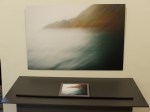
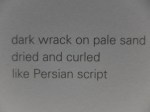
Earlier this year I wrote a sequence of poems about the Isle of Jura, for a book by the photographer Charles March. Charles contacted me out of the blue, thanks in part, I think, to a poem I’d written many years before about the island.
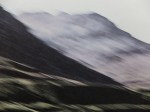
I visited Jura at the start of February, and was taken by boat to Glenbatrick on the west coast, where Charles had taken his photographs over the previous four or five years. Above the beach, and the rugged coastline either side of it, are a number of raised beaches, created by the land gradually rising after the glaciers melted. Looking inland, the Paps of Jura dominate the skyline – Beinn na Oir, Beinn Siantidh and Beinn Chaolias.
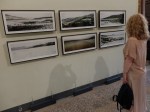
In May and June, Charles’ photographs were featured in an exhibition at the Palazzo Borghese in Rome, where a sample copy of the book was on display.
I received copies of the book just this week – I’d forgotten how large it was. The images are beautifully reproduced, catching the shifting and subtle colours of the Hebrides.
Gleann Badraig is published by Distanz Verlag, Berlin.
390 × 275 mm
96 pages, 60 color images, hardcover with linen
ISBN 978-3-95476-248-4
June 2018
€58.00
I have a few copies for sale – contact me if you’re interested in buying a copy.
You dropped a purple ravelling in, You dropped an amber thread; And now you’ve littered all the East With duds of emerald!
We focused on works by Julie Brook, Caroline Dear, Linder and Sonia Delauney. Juliana read an original text written in response to the artworks, while I read a selection of poems on weaving and colour, including works by Emily Dickinson (above) and verses from the Carmina Gadelica.
I contributed a sequence of seven short poems, taking as my starting point Wordsworth’s ‘The Solitary Reaper’. They were presented as prints, and as a booklet in the display case.
The photographs on the wall are by Tomohiko Ogawa, and show postcards of Scotland ‘matched’ with landscapes in Japan. Tomohiko also took these exhibition photographs.
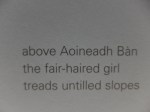
Some of Alec Finlay’s word-mountains were also shown. There is a fine, informative catalogue; below is a page with Tomohiko’s photographs, including one we used on the cover of The Road North (middle left; on the book cover it’s reversed), and a page with background to my take on ‘The Solitary Reaper’.









 Poems on the page and in the world