All posts by Ken Cockburn

Ken Cockburn is an Edinburgh-based poet, translator, editor and writing tutor.

Kakimori Bunko

The exhibition Wordsworth and Basho : Walking Poets was shown at Kakimori Bunko, Osaka, Japan last autumn.

I contributed a sequence of seven short poems, taking as my starting point Wordsworth’s ‘The Solitary Reaper’. They were presented as prints, and as a booklet in the display case.

The photographs on the wall are by Tomohiko Ogawa, and show postcards of Scotland ‘matched’ with landscapes in Japan. Tomohiko also took these exhibition photographs.

Some of Alec Finlay’s word-mountains were also shown. There is a fine, informative catalogue; below is a page with Tomohiko’s photographs, including one we used on the cover of The Road North (middle left; on the book cover it’s reversed), and a page with background to my take on ‘The Solitary Reaper’.

Words on the Street

Canongate Stars & Stories is an illuminated walking trail for Edinburgh’s Old Town, organised by Edinburgh City of Literature Trust. There are 20 lightboxes featuring quotations on the lower High Street, Canongate and surrounding streets and closes. Best seen after dark, they’ll be in situ till, I believe, the end of March. Below are photos of some of the light boxes, and notes about the quotations.

Fountain Close: Blessed be the sempill lyfe, Robert Henryson (c.1420–c.1490), from the fable ‘The Twa’ Mice’ (c.1480s), printed by Thomas Bassandyne (d.1577) who lived in Fountain Close.

Blissed be sempill lyfe withoutin dreid;
Blissed be sober feist in quietie;
Quha hes aneuch, of na mair hes he neid,
Thocht it be littill into quantatie.
Grit aboundance and blind prosperitie
Oftymes makis ane evill conclusioun:
The sweitest lyfe thairfoir, in this cuntrie,
Is sickernes with small possessioun.

The White Horse Inn, Canongate: Every writer has his use, by Samuel Johnson (1709–1784), from Rambler, no.145 (6 August, 1751). Established in 1742, The White Horse is the oldest pub on the Royal Mile and on 14 August 1773 received Johnson, who had arrived in Edinburgh to meet his friend and biographer James Boswell (1740 –1795) before their tour of the Hebrides. Around the corner off St Mary’s Street, a plaque at Boyd’s Entry (named for the proprietor of the White Horse, James Boyd) commemorates the event.
As every writer has his use, every writer ought to have his patrons; and since no man, however high he may now stand, can be certain that he shall not be soon thrown down from his elevation by criticism or caprice, the common interest of learning requires that her sons should cease from intestine hostilities, and, instead of sacrificing each other to malice and contempt, endeavour to avert persecution from the meanest of their fraternity.

Our Dynamic Earth: Nothing but time, by James Hutton (1726 –1797), from Theory of the Earth (1788 / 1795). Edinburgh born and educated, James Hutton is often referred to as the ‘Father of Modern Geology.’ His research into local rock formations, particularly Salisbury Crags in Edinburgh, led him to formulate a new theory of the origins of the earth – an earth much older than previously thought, made of layers or rock with a molten core. He first presented his Theory of the Earth to the Royal Society of Edinburgh in 1785, but his ideas only gained wide circulation and influence after his death.
From the top of those decaying pyramids to the sea, we have a chain of facts which clearly demonstrate this proposition, That the materials of the wasted mountains have travelled through the rivers; for, in every step of this progress, we may see the effect, and thus acknowledge the proper cause. We may often even be witness to the action; but it is only a small part of the whole progress that we may thus perceive, nevertheless it is equally satisfactory as if we saw the whole; for, throughout the whole of this long course, we may see some part of the mountain moving some part of the way. What more can we require? Nothing but time. It is not any part of the process that will be disputed; but, after allowing all the parts, the whole will be denied; and, For what?—only because we are not disposed to allow that quantity of time which the ablution of so much wasted mountain might require.

St John’s Pend: Edinburgh is a hot-bed of genius, by Tobias Smollett (1721 – 1771), from The Expedition of Humphrey Clinker (1771). Smollett occasionally lodged with his sister at St John’s Pend, just off the Canongate. Along with his famous 1755 translation of Cervantes’ Don Quixote, Smollett was a popular author of ‘picaresque’ novels. The Expedition of Humphry Clinker, a epistolary novel, follows Mathew Bramble, his family, and his servants as they travel through England and Scotland.
Edinburgh is a hot-bed of genius. — I have had the good fortune to be made acquainted with many authors of the first distinction; such as the two Humes, Robertson, Smith, Wallace, Blair, Ferguson, Wilkie, &c. and I have found them all as agreeable in conversation as they are instructive and entertaining in their writings. These acquaintances I owe to the friendship of Dr Carlyle, who wants nothing but inclination to figure with the rest upon paper.

Canongate Kirkyard: Ill-fated genius! by Robert Burns (1759–1796), from ‘Lines On Fergusson, The Poet’ (1787). Robert Fergusson (1750 –1774) was a brilliant Edinburgh-born poet who died tragically young, and in such poverty that he was buried in an unmarked pauper’s grave in the Canongate Kirkyard. Dismayed by this injustice, Robert Burns arranged for him to have a proper gravestone.

Ill-fated genius! Heaven-taught Fergusson!
What heart that feels and will not yield a tear,
To think Life’s sun did set e’er well begun
To shed its influence on thy bright career.

O why should truest Worth and Genius pine
Beneath the iron grasp of Want and Woe,
While titled knaves and idiot-Greatness shine
In all the splendour Fortune can bestow?

Jeffrey Street: the happier productions of female genius, by Francis Jeffrey (1773–1850), from a review of a book of poetry by Felicia Hemans (1793–1835) in Edinburgh Review (1828). Francis Jeffrey, after whom Jeffrey Street is named, began his Edinburgh Review in 1802 in order to guide contemporary readers toward works of high acclaim; the magazine was published quarterly until 1929.
No Man, we will venture to say, could have written the Letters of Madame de Sevigné, or the Novels of Miss Austin, or the Hymns and Early Lessons of Mrs. Barbauld, or the Conversations of Mrs. Marcet. These performances, too, are not only essentially and intensely feminine, but they are, in our judgement, decidedly more perfect than any masculine productions with which they can be brought into comparison. (…) We think the poetry of Mrs Hemans a fine exemplification of Female Poetry – and we think it has much of the perfection which we have ventured to ascribe to the happier productions of female genius.

Chessel’s Court: Man is not truly one, but truly two, by Robert Louis Stevenson (1850–1894), from The Strange Case of Dr Jekyll and Mr Hyde (1886). Chessel’s Court was scene of an infamous crime that inspired Stevenson. Deacon Brodie (1741 – 1788), city councillor and master cabinet-maker, used his position to steal from the wealthy who sought his services. A botched robbery of the Customs Office in Chessel’s Court led eventually to his arrest and execution, and revealed to the public his double life. As a child Stevenson slept with one of Brodie’s cabinets in his bedroom (it is now displayed in the Writers’ Museum in the Lawnmarket).
With every day, and from both sides of my intelligence, the moral and the intellectual, I thus drew steadily nearer to that truth, by whose partial discovery I have been doomed to such a dreadful shipwreck: that man is not truly one, but truly two. (…) It was on the moral side, and in my own person, that I learned to recognise the thorough and primitive duality of man; I saw that, of the two natures that contended in the field of my consciousness, even if I could rightly be said to be either, it was only because I was radically both; and from an early date, even before the course of my scientific discoveries had begun to suggest the most naked possibility of such a miracle, I had learned to dwell with pleasure, as a beloved day-dream, on the thought of the separation of these elements.

Dunbar’s Close: A city is a drama in time, by Patrick Geddes (1854–1932) from Civics: as Applied Sociology (1904). Geddes renovated buildings and developed green spaces, including the garden at Dunbar’s Close, in Edinburgh’s delapidated Old Town at the end of the 19th century. Geddes is renowned for his innovative ideas on social reform, environmentalism, and town planning, and his phrase ‘by leaves we live’ lives on in the Scottish Poetry Library’s Twitter handle.
But a city is more than a place in space, it is a drama in time. Though the claim of geography be fundamental out interest in the history of the city is supremely greater; it is obviously no mere geographic circumstances which developed one hill-fort in Judea, and another in Attica, into world centres, to this day more deeply influential than are the vastest modern capitals. […] Again the answer comes through geography, though no longer in mere map or relief, but now in vertical section – in order of strata ascending form past to present, whether we study rock-formations with the geologist, excavate more recent accumulations with the archaeologist, or interpret ruins or monuments with the historian. Though the primitive conditions we have above noted with the physiographer remain apparent, indeed usually permanent, cities have none the less their characteristic phases of historic development decipherable superposed. […] In a word, not only does the main series of active cities display traces of all the past phases of evolution, but beside this lie fossils, or linger survivals, of almost every preceding phase.

The World’s End: For ever and aye till the World’s End, by Sydney Goodsir Smith (1915 – 1975), from Kynd Kittock’s Land (1965). The World’s End pub stands at the top of World’s End Close, on what was once the edge of Edinburgh by the former city walls. Smith’s words conclude his poem based on a character in a medieval poem, an innkeeper who, admitted to heaven after her death, leaves again ‘for to get hir ane fresche drink, the aill of hevin wes sour’.

Here I be and here I drink,
This is myne, Kynd Kittock’s Land,
For ever and aye while stane shall stand—
For ever and aye till the World’s End.

Silence before Speech

sbs-bog-cotton-jm  sbs-im-neil-christie  sbs-time-and-tide-kc
Silence before Speech is a new publication in memory of Neil Christie, a friend who died on Christmas eve three years ago. It’s a boxed set of 16 poem-cards, each featuring a poem by myself or Jane MacKie, and a painting by Dina Campbell. The portfolio was designed by Mary Asiedu.

sbs-barra-kc

We all knew Neil; he had a gift for friendship, and for bringing people together. One of his favourite tricks was to arrange a meeting to which he invited people from different parts of his life, and then cry off at the last moment, leaving us to get to know each other.

sbs-coast-jm

He worked as a graphic designer, and occasional publisher; Reading the Streets was made for his Duende Press, when he linked myself and illustrator Libby Walker. Latterly he lived down by the river at Cramond, and I’ve fond memories of eating fish soup in his small cottage there, packed with books and CDs, before emerging for a riverside stroll.

sbs-winter-solstice-kc

Jane and I both wrote to Dina’s images, and their titles. My poems all came out as unpunctuated six-liners; Jane allowed herself more scope, in length and stanza form.

The cards measure 195 x 94 mm. A set costs £15 – please contact me if you’d like to buy a set.


Apples & Pears


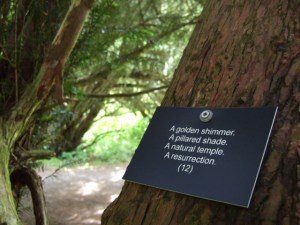
This summer I visited Crailing Community Orchard, near Jedburgh in the Scottish Borders, and wrote a set of short poems about the apple and pear trees it contains. Each poem has the tree name as a title, and a verse of 3 lines. The poems were engraved on botanical labels (white text on a black background) by Sheen Botanical Labels, and the photos below were taken at Harestanes Countryside Visitor Centre, when the poems sat alongside their fruit as part of Apple Day in early October. Soon they will be attached to trees in the orchard, serving in part as practical identity labels, while also articulating something of the tree’s particularities.


CATHERINE is an apple first grown in Combs, Suffolk, outside a pub called Live and Let Live. — CATILLAC is an old pear variety which has been given many different names, including Monstreuse de Landes, Grand Monarque and Grand Mogol. Its current English name derives from the place-name Cadillac in the Gironde area of France.


DISCOVERY was raised c.1949 by a Mr Dummer of Essex, who raised several seedlings from Worcester Pearmain pips and decided to plant the best one in front garden. Having only one arm he needed his wife’s help, but she slipped and broke her ankle, so the unplanted tree remained outdoors during frosts. It survived, indeed thrived, and was later popularised by a Mr Matthews of Suffolk. — HESSLE is named for the Yorkshire village where it was first found. “It [succeeds] in almost every situation and part… the Hessle pear trees in Herefordshire were laden with fruit in the year 1880, when almost all other varieties failed.” (Herefordshire Pomona)

WHITE MELROSE was probably introduced to Scotland by the monks of Melrose Abbey, who as Cistercians wore white robes, to distinguish themselves from the black-robed Benedictines.

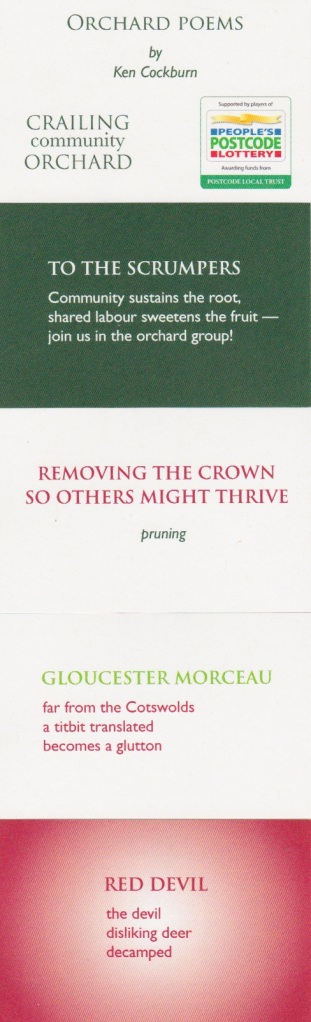
The poems were also printed as a set of cards, designed by Lise Bratton.

crailing-cards
GLOUCESTER MORCEAU is a pear originally raised by Abbé Nicolas Hardenpont in Wallonia in the 18th century, and named after him Beurré d’Hardenpont. However “in the environs of Mons… [it] was more often called the Glout Morceau, converted afterwards by the French, when M. Noisette brought it from Belgium in 1806, into Goulu Morceau. The word ‘glout’ in Walloon signifies dainty or delicate and thus ‘glou morceau’ means daintybit : ‘goulu’ on the contrary, signifies greedy, or great eater; the the Beurré d’Hardenpont has become, through this starnge alteration in name by the Fench, a gluttonous eater, instead of a fruit worthy of being eaten.” (HP) Presumably ‘Gloucester’ derives from a similar ‘translation’ of sound rather than meaning. — RED DEVIL is an apple variety which failed at Crailing.

I drew much of the poems’s content from information found in The New Book of Apples (ed. Richards and Morgan,1993), A Handbook of Hardy Fruits: Apples and Pears (EA Bunyard, 1920), and Herefordshire Pomona (Hogg and Bull,1876–85).

Edinburgh Fringe 2016

ABC KC Clarinda grave

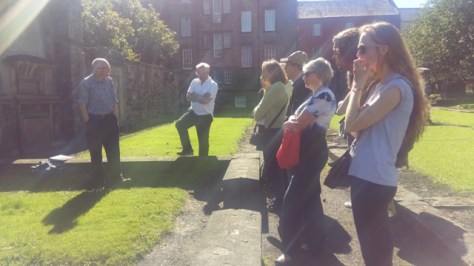
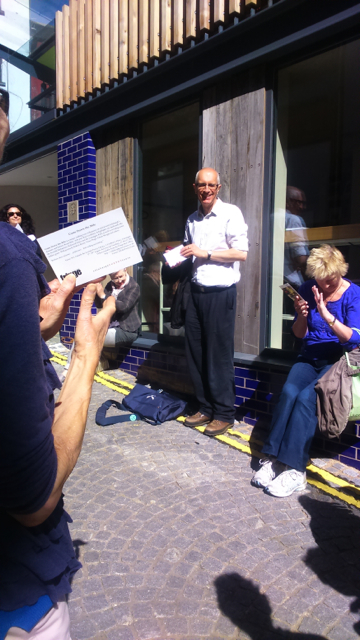
I’ve just finished three and a half weeks of walks as part of the Edinburgh Festival Fringe 2016. It was a new experience for me, and an enjoyable one – walking in the city, meeting people on the walks, running into old friends and acquaintances on the High Street while handing out postcards, and getting to know the poems, and the places I’d matched them with, better. And I enjoyed the buzz of checking each morning to see how many tickets I’d sold for that day’s walk.

ABC KC Fergusson statue 2

Highlights? The young couple from Rio, delighted the Olympics had shunted their winter holiday from July to August, which meant they could come to the Edinburgh Festival. Reading the poem ‘Intercession’, written twenty years ago about St Margaret’s Well in Holyrood Park, at the well, to the sound of its water falling. Getting my tongue around 16th century Scots, which turns out to sound less foreign than it looks. And not having to cope with any serious rain; drizzle, yes, but the heavy stuff, when it come, always fell an hour or two before or after the walk.

ABC KC Holyrood 3

Thanks to everyone who came on the walks, all 150 of you. Thanks to Alice and Tamsin for the photographs here. And now I have the next five months to mull over whether I’ll do it all again next August.

TG SPL

Tunnel & Stars

Royal_Mile_Poetry_Walk.1.2016Earlier this year I led a poetry tour running the length of the Mile, from the Castle Espandade to the Scottish Parliament, for artist Brigid Collins and her students from Edinburgh College of Art. Her brief for them was, working in groups, to create a book inspired by the Mile, and the tour was, for many of the students, their introduction to the area and its history and literature.

They worked in two groups, and these photos show elements from their completed works – a ‘star’ book, and a ‘tunnel’ book.

Art in Aden

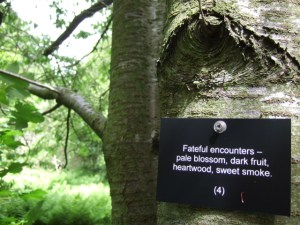
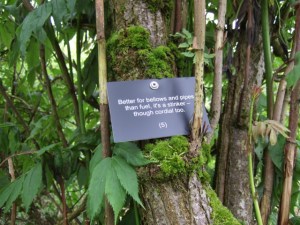
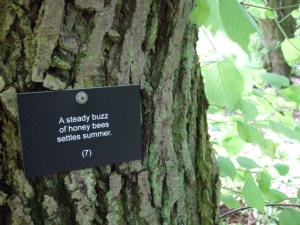
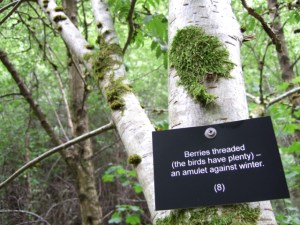
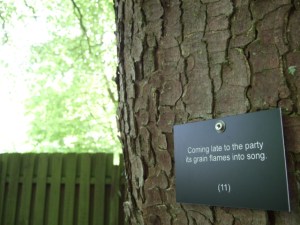
I made What is a tree? for the Midsummer Arts Festival at Aden Country Park, near Mintlaw, Aberdeenshire, on Sunday 19 June. It’s a set of poems on botanical labels attached to trees around the park. The poems aim, as in a riddle, to provide an initially puzzling, but also recognisably accurate, description of the tree in question.

Below are some notes about the ideas behind the poems.

(1) Recognisable by its black buds, the ash is one of the last trees to leaf in spring.

(2) The beech’s smooth bark has made it a favourite for inscriptions over the centuries; these expand as the tree grows.

(3) Their branches used for besoms in the past, birches create an environment favoured by many plants, fungi, moths and birds.

(4) To encounter a cherry was considered auspicious and fateful.

(5) The elder’s branches don’t burn well; its flowers don’t have a very pleasant smell, but make a fine drink.

(6) The horse-chestnut is easily recognisable at different times of year.

(7) Lime flowers attract bees in numbers.

(8) Planted outside houses to fend off evil spirits, the rowan’s red berries worn as a necklace were considered protective.

(9) The water-resistant resin in the wood of the Scots pine makes it good for boat-building; rosin (a residue from pine wood) is used for treating the bows of stringed instruments.

(10) Spruce wood was used in early aircraft construction, including the Wright Brother’s Kitty Hawk.

(11) A non-native tree, it’s unclear when the sycamore first arrived in Scotland. Its wood produces much heat when burned, while trees that show a ‘flame’ patterning in the wood are favoured by violin makers.

(12) Yews are often found in churchyards. The middle two lines are taken from Wordsworth’s poem ‘Yew Trees’.

With thanks to the Friends of Aden Country Park for commissioning this work.


Buson 2016 : Jedburgh

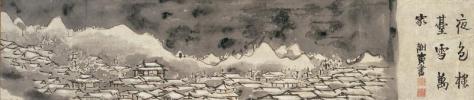
Snowclad_houses_in_the_nightI’m running several events this year under the heading ‘Buson 2016’, celebrating the birth 300 years ago of the great Japanese painter and haiku master Yosa Buson (1716–1783).

This week Andrew Mackenzie and I visited Jedburgh Grammar School, where we worked with S5 and S6 pupils. Andrew and I collaborated on Into Ettrick a couple of years ago, but this is the first time we’ve worked together with a school group. The idea was to create a piece which integrated image and text, as Buson did in many of his works.

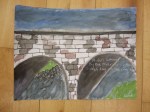
We sketched and took notes at two spots by the Jed Water, near the Abbey Bridge opposite the abbey, and by the Canongate Bridge. Andrew showed them how to sketch with pencil and charcoal, while I encouraged them to be attentive to what has happening as we were there, using Norman MacCaig’s poem ‘Notations of Ten Summer Minutes’ as a model.

Back in school I guided the pupils into writing haiku based on their notes – snapshots capturing when, where and what happened – while Andrew led them in working with watercolour and pen-and-ink to develop sketches made earlier. Then we put the two together – some of the results are below.

David Blake, PT English who organised the school’s side of the session, commented:

Blank space! If there is one thing which I will always remember from the Yosa Buson workshop which I took part in, along with 35 Higher and Advanced Higher English pupils, it is the importance of blank space. As both artist and poet Buson would have instinctively understood the relationship between the visual and the written – something that we often forget.

Our day began somewhat greyer than I had hoped and the pupils’ initial enthusiasm reflected that sombre sky but as the first part of the day proceeded they quickly began to respond to what they saw in both visual and written mediums. Pupils who claimed that they could not draw were working hard to create images of what they saw, within minutes of being given a writing task they were enthusiastically coming up with ideas that I would struggle to draw out of them in the classroom. By the afternoon, armed with the sketchbooks in which we had drawn what we had seen and written down our thoughts, we were ready to embark on the production of ink illustrations and haiku poems. The quality of some of the work that the pupils produced was well beyond their expectations and despite their many claims that their work was rubbish you could see they were secretly pleased with how well their paintings and poems had turned out; one or two even confided that they had gone home that night and made further use of their sketchbooks!

This was one of the most enjoyable workshops that I have experienced in my teaching career and one which I believe that, as well as the wonderful creative experience of producing the visual art, the pupils got a lot out of in terms of their understanding of how to write effectively: in writing, as in art, it is as much about what you leave out as that which you put in – blank space.

With thanks to Jedburgh Grammar School, and to the GB Sasakawa Foundation for funding the work.

Walks on National Poetry Day

KC reading
I ran two walks on National Poetry Day 2015 – Thursday 8 October – starting at the Scottish Storytelling Centre and walking down to the Scottish Parliament. The weather was kind, with some gentle autumn sun, and on the way I read poems by Christine De Luca and Ingrid Murray, Tessa Ransford, Muriel Spark, Norman MacCaig, Roberts Burns, Fergusson and Garioch, Bert Brecht, Stewart Conn, Angus Reid and Edwin Morgan, as well as the great Anon, and one of my own.

I’m grateful to Elaine Erb (from Alberta, Canada), for the photographs here, taken during the morning walk. The large-scale poem on the the printed scaffolding sheet (a huge new development is being put up behind it) is ‘Spiral’ by Elizabeth Burns, installed earlier that morning. At 25 by 12 metres, it’s reputedly the largest poem in the UK, and will stay up on the building until summer 2016.

River Connections, Inverness

lost tongue

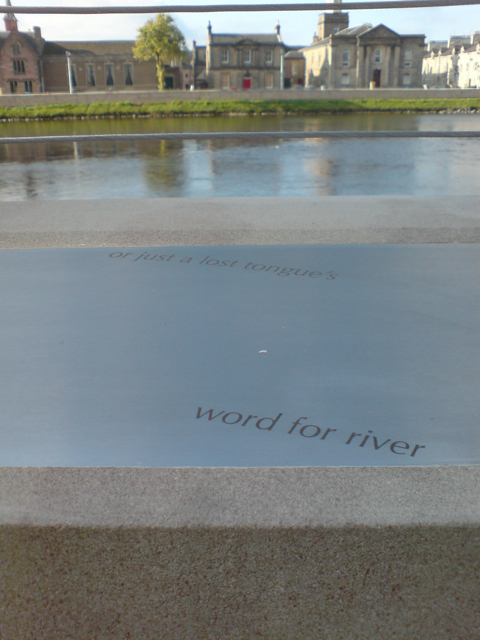
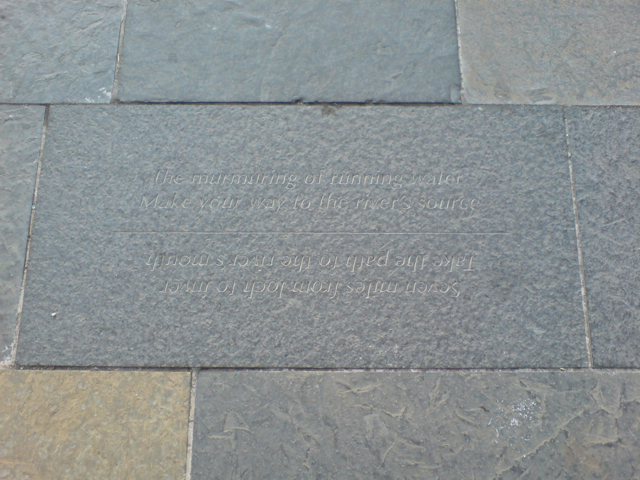
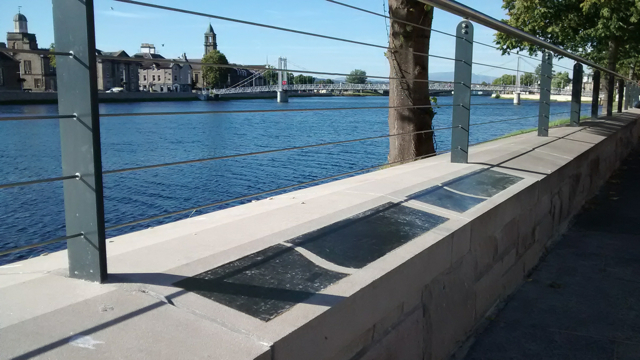
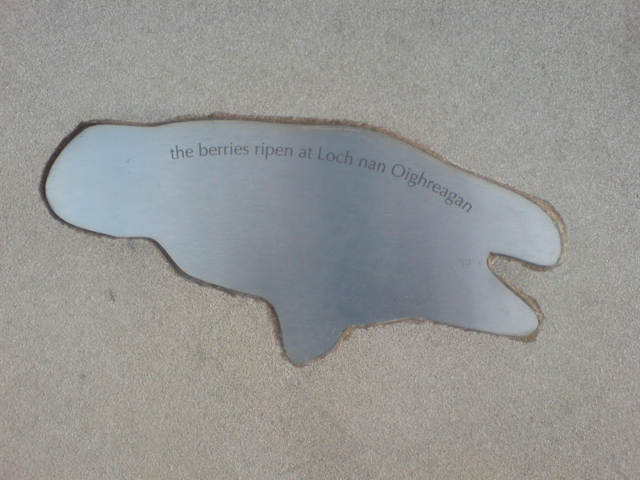
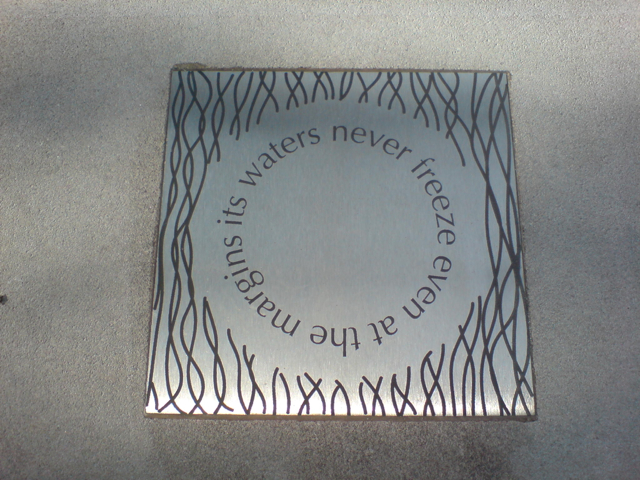
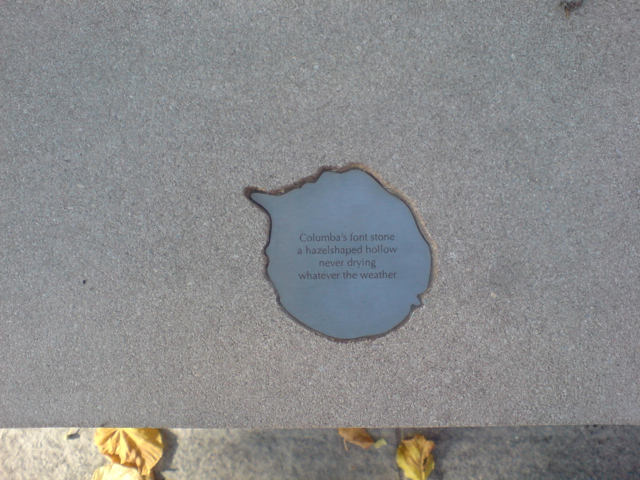
At the end of September I was in Inverness, where I saw a batch of poems I wrote last year about the River Ness and its vast catchment area being installed on the new flood wall. I’d been asked by Mary Bourne to produce the work, which she intended to carve directly onto the wall, but it turned out the stone wasn’t good for carving (a soft sandstone, with hard bits of quartz spread erratically through it), so she had most of the poems etched onto steel and set into the wall. The masons were at work setting them into the coping as we walked along the riverbank in unseasonably warm sunshine.

The poems are mostly on Bank Street, between the Young Street Bridge and the pedestrian bridge, though there are a few beyond that, along Douglas Row towards the Friars Bridge. A further group of texts will be installed on the west bank of the river in the new year, and stones featuring circle poems written by local writers are to be installed at Kessock Road near the mouth of the river shortly.

Seven Miles
Uillte
Loch nan Oighreagan
never freeze
Loch Ness, Columba
immigrants and emigrants