Category Archives: Artists

Kandinsky’s Hymn (1913 / 2022)

In June I was contacted by my friend Barrie Tullett. His wife Jantze had “an idea to illustrate a poem (or three) by Wassily Kandinsky, from his book Klänge, which was published in 1913”. I was asked to translate the eight-line poem from the German, which I did, and recently they sent me a copy of the finished article, a book featuring one line of the poem (in Russian, German and English), with illustrations, on each page-spread. You can read more about it here.
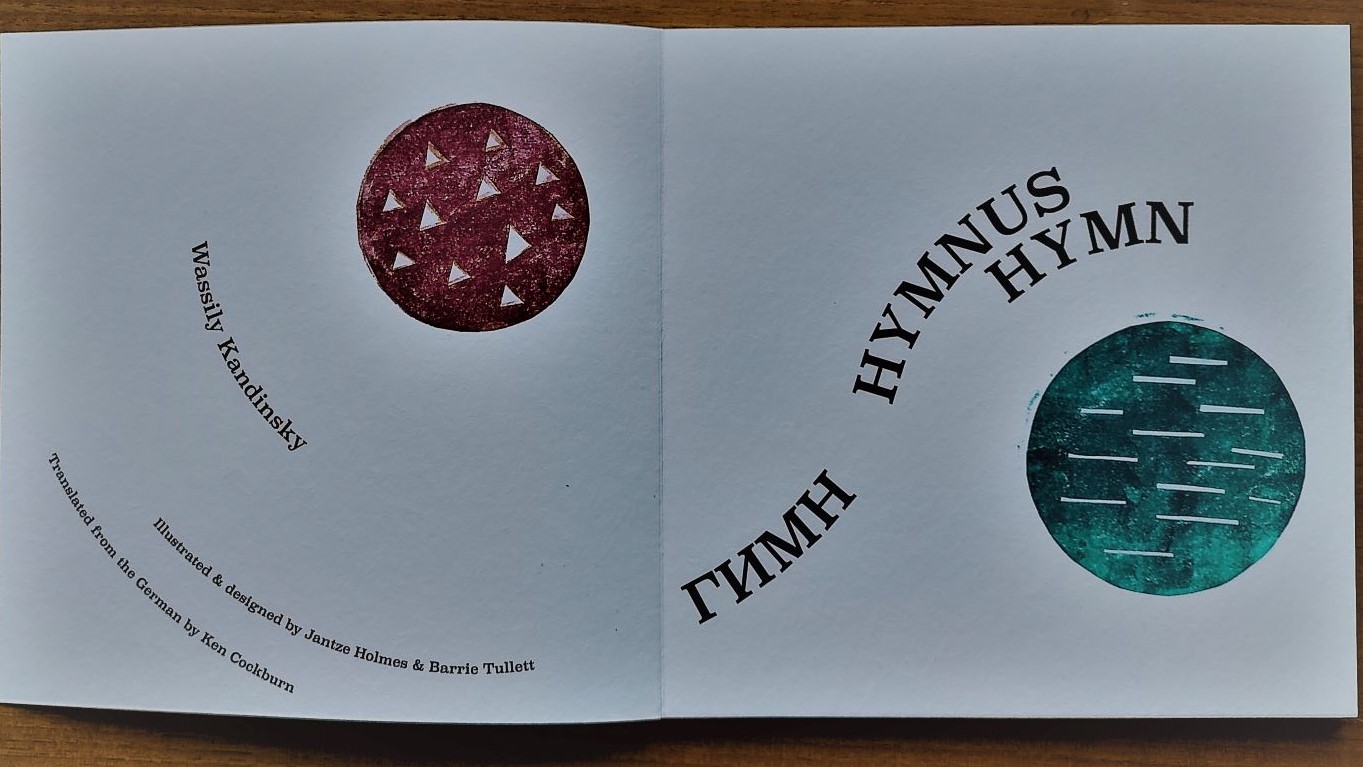
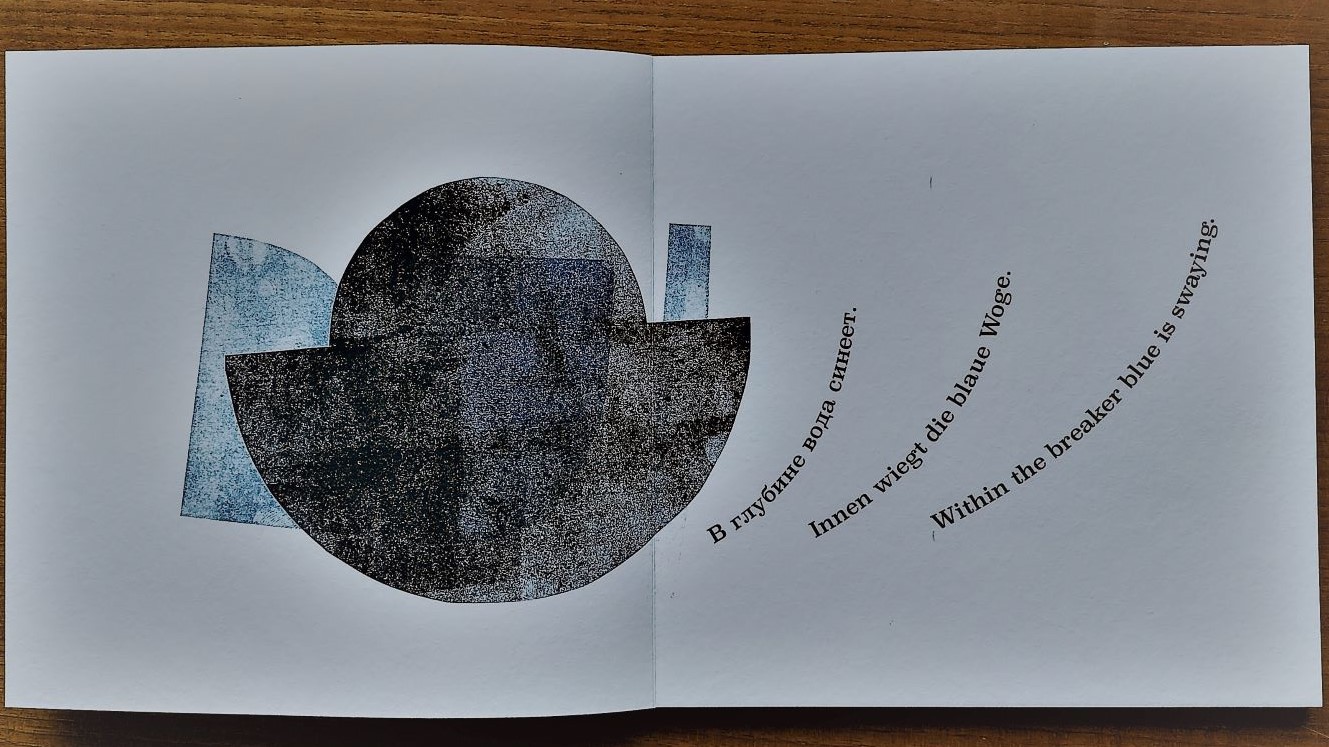
Apparently Kandinsky originally wrote the texts in Russian, but then found a German publisher, so translated them himself. The idea was that after the German edition, they’d make a Russian one – but the German edition didn’t sell, so it never happened.

This is the complete eight-line poem in German, followed by my translation (in which I’ve prioritised the rhythm, and to a lesser extent the rhymes):

Innen wiegt die blaue Woge.
Das zerrissne rote Tuch
Rote Fetzen. Blaue Wellen.
Das verschlossne alte Buch.
Schauen schweigend in die Ferne.
Dunkles Irren in den Wald.
Tiefer werden blaue Wellen.
Rotes Tuch versinkt nun bald.

Within the breaker blue is swaying.
Cloth that’s red is ripped and torn.
Red is shredded. Blue is wavey.
Padlocked shut the book that’s old.
Silent look into the distance.
Err in darkness in the woods.
Deeper darkens blue that’s wavey.
Cloth that’s red will sink down soon.

You can see the pages of the original if you search for ‘Klänge’ here.

There is a recent edition of the woodcuts available on issuu.

And if you want a bit of background, there is always wikipedia.

Robert Burns

I’m now offering a Robert Burns poetry walk, as well as a illustrated talk about Burns and Edinburgh.

NLS Burns 02
Robert Burns by John Tweed

Burns visited Edinburgh twice – first from late November 1786 to early May 1787, and again from mid-October 1787 to mid-February 1788 – and there are many sites on or near the Royal Mile with Burns connections.

In the Canongate Kirkyard is the grave of the poet Robert Fergusson, which Burns commissioned; and that of Nancy McLehose, Burns’ ‘Clarinda’, who he met and fell in love with in Edinburgh, and corresponded with for several years.

His memorial, on the side of Calton Hill, can be seen from the kirkyard, while lower down is Graham Fagen’s work in neon, ‘A Drama in time’ (2016), “centred on the story of the Roselle, a ship that sailed from the Port of Leith to Kingston, Jamaica in 1786. Robert Burns had booked a passage on the boat, but never sailed.”

For more details see Walks and Talks, or get in touch.

Making POETRY for the Inspiration Machine

Thanks to Angus Reid for helping me make a 10-second video for the Edinburgh Fringe’s Inspiration Machine. It takes work to make something that short!  We used an old poem of mine, POETRY, which is based loosely on a Pepsi ad from the 70s. These are Angus’s drawings that we used in the video, throwaway style, like Dylan in ‘Subterranean Homesick Blues’. (Nothing like showing your age…)

DSCF5697
DSCF5698
DSCF5699
DSCF5700
DSCF5701
DSCF5702
DSCF5703
DSCF5704
DSCF5705

DSCF5707

Poets at Edinburgh Park

These are the twelve herms of Scottish poets, overlooking the grandly named Loch Ross just by the Edinburgh Park Central tram stop, to the west of the city. On the sides of the plinth you can find some information about, and a poem by, each poet, though only Edwin Morgan wrote a poem specifically for his herm.

A human head would never do
under the mists and rains or tugged
by ruthless winds or whipped with leaves
from raving trees. But who is he
in bronze, who is the moveless one?
The poet laughed, it isn’t me.
It’s nearly me, but I am free
to dodge the showers or revel in them,
to walk the alleys under the stars
or waken where the blackbirds are.
Some day my veins will turn to bronze
and I can’t hear, or make, a song.
Then indeed I shall be my head
staring ahead, or so it seems,
but you may find me watching you,
dear traveller, or wheeling round
into your dreams.

Paolozzi at Large in Edinburgh


To coincide with the launch of a new book about the artist in his home city, I’m leading two walks featuring poems by Christine De Luca about works by Sir Eduardo Paolozzi (1924–2005). Paolozzi was born in Leith, and while as an adult he lived away from Edinburgh, he was commissioned to make a number of works here during the last twenty years of his life. He also bequested work to the Scottish National Gallery of Modern Art, which houses a reconstruction of his London studio.

The walks are South and East (Friday 2 November, 14.00–16.30) and West and North (Saturday 3 November, 10.00–12.30).

‘South and East’ takes in three groups of sculptures: ‘Egeria and Parthenope’ at King’s Buildings, ‘Early Peoples’ at the Museum of Scotland, and ‘The Manuscript of Monte Cassino’, originally sited at Picardy Place and now temporarily re-located at London Road.

‘West and North’ takes in ‘Wealth of Nations’ at the Gyle Business Park, stained glass windows in St Mary’s Episcopal Cathedral, and works at the Scottish Gallery of Modern Art.

Tickets (£6 / £4) and details of the routes are available via Eventbrite.
‘South and East’ (Friday 2 November, 14.00–16.30)
‘West and North’ (Saturday 3 November, 10.00–12.30).

Paolozzi at Large in Edinburgh (Luath, 2018), edited by Christine De Luca and Carlo Pirozzi, is the first book to look at the artist in his home city. It includes poems written by De Luca, the former Edinburgh Makar, in response to some of Paolozzi’s iconic works which can be seen around Edinburgh, as well as work by many involved in the art world: researchers, archivists and practising (RSA) artists. The book is part of the Eduardo Paolozzi Project created and developed by Carlo Pirozzi (University of Edinburgh). Paolozzi at Large in Edinburgh is to be launched at Blackwell’s Bookshop, South Bridge, Edinburgh on 31 October.

These walks have been developed with the help of funding from this Eduardo Paolozzi Project with the support of Edinburgh World Heritage.

Images, from top: Egeria (detail), Wealth of Nations (detail); MS of Monte Cassino; Paolozzi’s studio (details); Wealth of Nations, Master of the Universe, Egeria.