Tag Archives: Greyfriars Kirkyard

Now Listen

I’ve been reading poems into my phone and my laptop quite often over the past few months.

Earlier this year The Academy of American Poets published ‘Home’ as part of the poem-a-day series. It’s a portrait of my father in his last months of his life, and you can read and listen to it here.

Then there are three poems in edition #10 of iamb: poetry seen and heard – ‘Hands’, ‘Rodney’ and ‘Ward’. I’m in good company – Jay Whittaker, Penelope Shuttle and others.

Last year I was commissioned by Edinburgh’s Push the Boat Out poetry festival to write poems about central Edinburgh for A Poetry Mile. I wrote three new poems, and they also accepted a couple of older poems, ‘Close’ and ‘William ‘Deacon’ Brodie’.

You can find recordings of me reading them on the Poetry Map section of the website -again in good company, including Alan Spence and JL Williams – but you do have to hunt for the poems, as even if you know the city well they’re not quite where they should be.

To listen to ‘Jacob’s Ladder’, click the marker on Calton Road just west of the junction with New Street.

‘Close’ is the marker on the High Street by Filling Station.

The marker for ‘Greyfriars Bobby’ is inside Greyfriars Kirkyard.

Rather than inside his eponymous tavern, ‘William ‘Deacon’ Brodie’ can be found loitering at New College, between Mound Place and Castlehill.

‘The Ballad of William Knox’ should be in the New Calton Burial Ground, or New Calton Cemetery as it’s called on the map, which runs from Regent Road down to Calton Road. Knox’s needle stands roughly between Archibald Elliott and Robert Stevenson, but there’s no marker in the vicinity. If you manage to locate him, let me know.

Duncan Ban MacIntyre

duncan ban mcintyre memorial greyfriars 1

Described on his grave memorial as ‘the celebrated Celtic bard’, Donnachadh Mac An t-Saoir (1724–1812) spent much of his long life in Edinburgh. Known in English as Duncan Ban MacIntyre, he moved from Breadalbane to Edinburgh in 1767, and was employed, like many Highlanders in the city, as a member of the City Guard. His wife ran a pub in the Lawnmarket. They lived in Roxburgh Close, off the north side of the High Street, where this plaque remembers him.

512px-Plaque_to_Duncan_Ban_MacIntyre,_Roxburgh_Close,_Edinburgh

Illiterate, he nevertheless published three editions of his poems as Orain Ghaidhealach (Gaelic Songs) in 1768, 1790 and 1804, assisted by his friend the Rev. John Stewart, ministers being at the time often the only people fully literate in Gaelic. Each edition was funded by subscription, and MacIntyre travelled across Scotland to persuade, with some success, potential readers to sign up.

Additional poems were added to second and third editions. ‘Oran Dhùn Eideann’ (Song to Edinburgh) first appeared in the third edition, and sings the praises of the poet’s adopted city. Below is the poem’s penultimate stanza in Gaelic, then in English and French (translated by, respectively, Angus MacLeod and Donald James Macleod).

Tha Dun-éideann boidheach
Air iomadh seòl na dhà,
Gun bhaile anns an rioghachd so
Nach deanadh striochdadh dha ;
A liuthad fear a dh’innsinn ann
A bélreadh cis do chach,
Daoin-uaisle casg’ an iota
Ag òl air fion na Spàinnt’.

Edinburgh is beautiful
in many diverse ways;
there is no city in this realm
but would yield it precedence.
How many men I could tell of there,
who would give others fee,
while gentlemen slake their thirst
by drinking Spanish wine.

Edimbourg est belle
En bien des façons ;
Il n’y a point de ville dans ce royaume,
Qui ne doive reconnaître sa supériorité ;
Il y a beaucoup de personnes que je pourrais nommer
Qui donnaient des revenus à d’autres,
Des messieurs qui étanchent leur soif
En buvant le vin d’Espagne.

He is buried in Greyfriars Kirkyard.

duncan ban mcintyre memorial greyfriars 2

Photo credits:

“File:Plaque to Duncan Ban MacIntyre, Roxburgh Close, Edinburgh.jpg” by Stephencdickson is licensed under CC BY-SA 4.0

“duncan ban mcintyre memorial greyfriars” by Gary Thomson is licensed under CC BY-NC-ND 2.0

“duncan ban mcintyre memorial greyfriars” by Gary Thomson is licensed under CC BY-NC-ND 2.0

The Gentle Shepherd

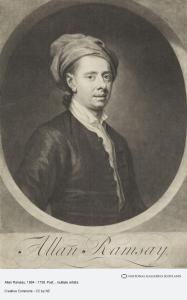
Allan Ramsay

The poet Allan Ramsay died in Edinburgh on 7 January, 1758.

GK Ramsay 1

He is remembered in Greyfriars Kirkyard by this stone, erected a century or so after his death, whose opening text reads:

In this Cemetery
Was Interred the Mortal Part
of an Immortal Poet.
ALLAN RAMSAY
Author of the GENTLE SHEPHERD,
And other admirable Poems in the Scottish Dialect.
He was born in 1686, and Died in 1758.

The following four lines confused me when I first read them, as I knew them from a gravestone elsewhere in Edinburgh.

No sculptur’d Marble here, nor pompous lay,
No storied Urn nor animated Bust;
This simple stone directs pale Scotia’s way
To pour her sorrows o’er the Poet’s dust.

Written in 1787 by Robert Burns for Robert Fergusson, these lines are carved on the latter’s headstone in the Canongate Kirkyard. They have been borrowed, or repurposed, to remember Ramsay, though in the process Burns and Fergusson have been forgotten. Cut-and-paste, 19th century style.

Burns Fergusson epitaph

Ramsay’s The Gentle Shepherd is a pastoral comedy in Scots from 1725. A few steps away from Robert Fergusson’s grave is that of Adam Smith, who said of Ramsay’s work, ‘it is the duty of a poet to write like a gentleman. I dislike that homely style which some think fit to call the language of nature and simplicity and so forth.’

Here’s a brief extract, in which a young man praises his love’s singing.

PATIE.
Jenny sings saft the ‘Broom o Cowdenknowes’,
An Rosie lilts the ‘Milkin o the Yowes’.
There’s nane like Nancy ‘Jenny Nettles’ sings;
At turns in Maggy Lauder’, Marion dings;
But when my Peggy sings, wi sweeter skill,
The ‘Boatman’ or the ‘Lass o Patie’s Mill’,-
It is a thoosand times mair sweet to me;
Tho they sing weel, they canna sing like thee.