I’m now offering a Robert Burns poetry walk, as well as a illustrated talk about Burns and Edinburgh.
Robert Burns by John Tweed
Burns visited Edinburgh twice – first from late November 1786 to early May 1787, and again from mid-October 1787 to mid-February 1788 – and there are many sites on or near the Royal Mile with Burns connections.
Penrhyn
In the Canongate Kirkyard is the grave of the poet Robert Fergusson, which Burns commissioned; and that of Nancy McLehose, Burns’ ‘Clarinda’, who he met and fell in love with in Edinburgh, and corresponded with for several years.
Osterley House
His memorial, on the side of Calton Hill, can be seen from the kirkyard, while lower down is Graham Fagen’s work in neon, ‘A Drama in time’ (2016), “centred on the story of the Roselle, a ship that sailed from the Port of Leith to Kingston, Jamaica in 1786. Robert Burns had booked a passage on the boat, but never sailed.”
These are a few photos from the Edina Europa poetry walks, which took place during the Edinburgh Fringe Festival last month. They were taken by Alison Lloyd; my thanks to her for letting me use them here.
In the Canongate Kirkyard, looking towards the Nelson Monument on Calton Hill and the Old Royal High School.
At the grave of Johann Friedrich Lampe (1703–1751), a composer and bassonist who came to Edinburgh in 1750 to play at the recently opened Canongate Playhouse. I read from Robert Fergusson’s poem, ‘On the Canongate Playhouse in Ruins’, written after the theatre closed in 1769, and which includes the lines evoking the sounds of the playhouse:
Here shepherds, lolling in their woven bowers, In dull recitativo often sung Their loves, accompanied with clangour strong From horns, from trumpets, clarinets, bassoons; From violinos sharp, or droning bass, Or the brisk tinkling of a harpsichord.
Reading from Burns, with the Burns Monument emerging from the trees in the background.
Reading another Burns poem at the grave of Adam Smith.
Taking advantage of having the poet on hand, I asked Angus Reid to read his ‘split sonnet’ about the Scottish parliament building, dedicated to Donald Dewar and beginning with the question:
And with what sign should the gathering place be shown…
Thanks to everyone who came on the walks – it was as ever a pleasure to share the poems with you, and the unfolding conversations.
Edinburgh, like Rome, is a city built on seven hills. I’m running three poetry walks later this month to some of those hills, as part of the preparations for World Heritage Day 2012 on 18 April.
Below Calton Hill
Here are the details: Calton Hill Thursday 22 March, 1.30pm–5.00pm, meet at Scottish Poetry Library, 5 Crichton’s Close, Canongate, Edinburgh EH8 8DT, where we’ll return after the walk
Arthur’s Seat Friday 23 March, 1.30pm–5.00pm, meet at Scottish Poetry Library, where we’ll return after the walk
Castlehill Saturday 24, 1.30pm–5.00pm, meet outside the Scottish Parliament visitors’ entrance (opposite the Queen’s Gallery); the walk will finish at Edinburgh Castle
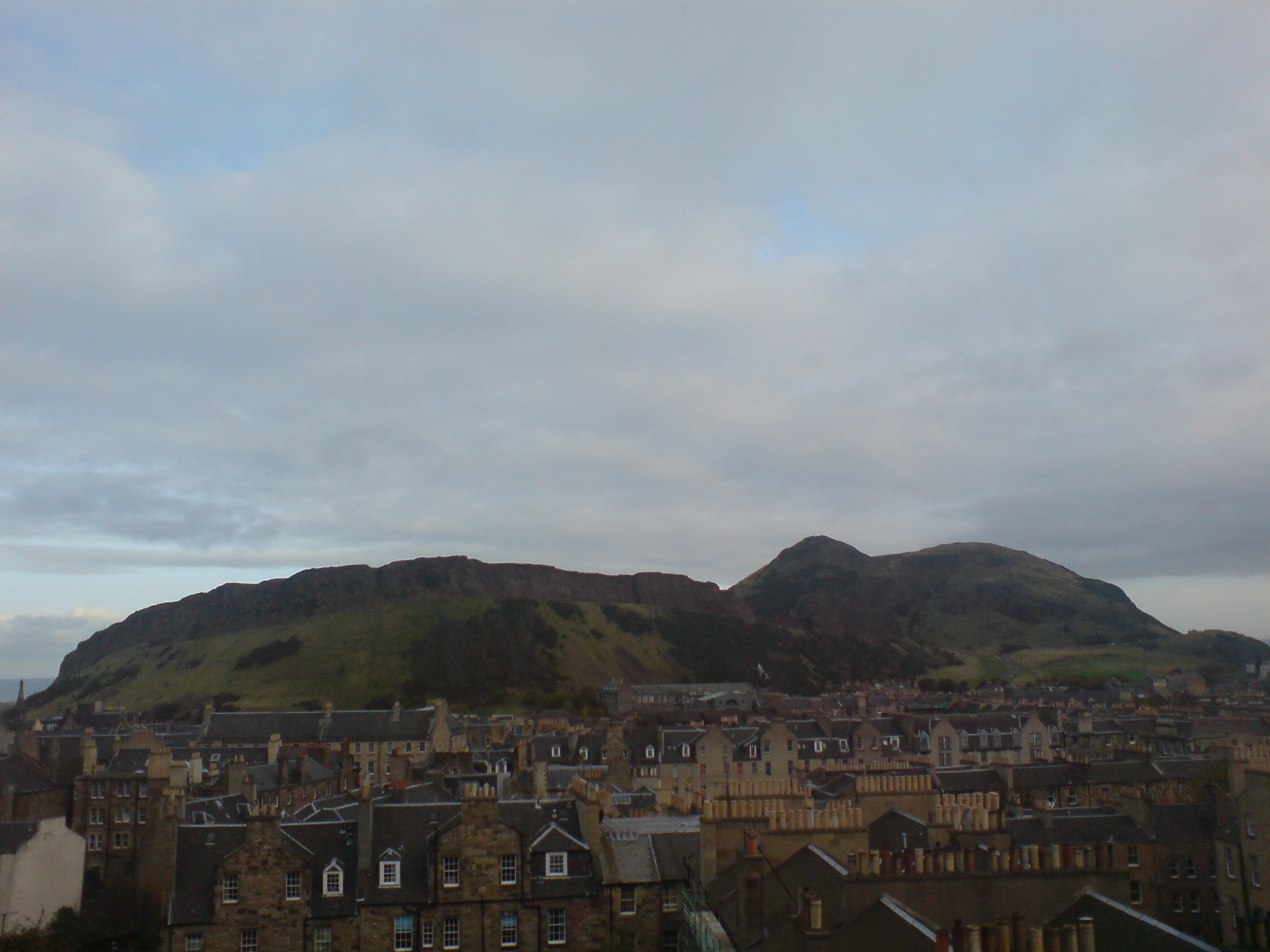
Arthur's Seat seen from the David Hume Tower
All the walks are free, but please book via e-mail as numbers are limited: kencockburn@blueyonder.co.uk
On the day please bring waterproofs and a notebook, and wear footwear suitable for rough underfoot conditions.
At the end of each walk we will spend some time discussing the walk, and reading what we’ve written; on Thursday and Friday at the Scottish Poetry Library, and on Saturday at the Education Room in Edinburgh Castle.
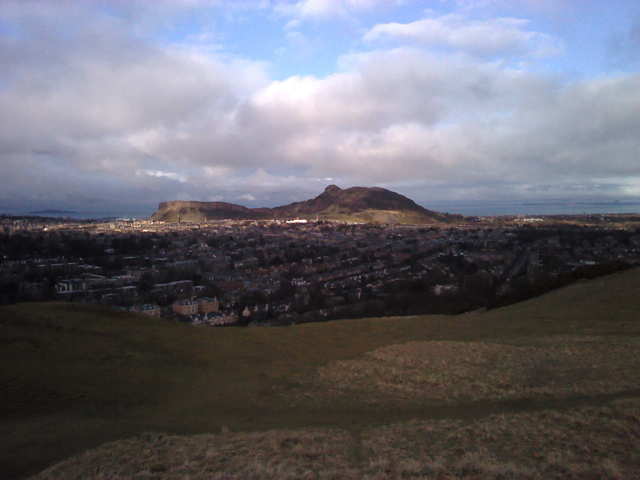
Salisbury Crags and Arthur's Seat, seen from Blackford Hill
A bit of background:
‘Seven Hills’ is part of Shadows of our Ancestors, supported by Historic Scotland and UNESCO, which promotes and celebrates Scotland’s five World Heritage sites – Edinburgh Old and New Towns, New Lanark, the Antonine Wall, St Kilda and The Heart of Neolithic Orkney. A group of five artists – a poet, a sculptor, a performance artist, a photographer and a composer – will each work at one of these sites, developing work for the public celebration of World Heritage Day on Wednesday 18 April, which will take place at Croy Miners’ Welfare, North Lanarkshire, next to the line of the Antonine Wall.
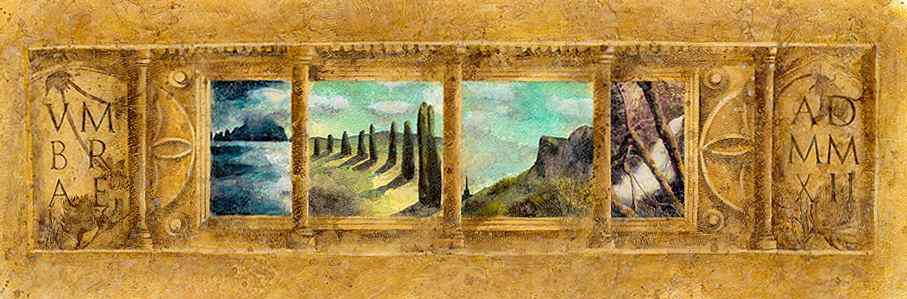
Brigid Collins's artwork for Shadows of our Ancestors 2012
All the artists are working loosely to the theme of ‘AD 142’, the year the Antonine Wall was begun. ‘Seven Hills’ will link to the theme by considering aspects of the land that broadly haven’t changed since Roman times – uplands and lowlands, coast and sea, the Scottish weather – as well as referring to the history of the Roman presence in the area, and considering the changes over time.
I’ll blog the walks to Calton Hill, Arthur’s Seat and Castlehill (as well as further walks I’ll make to Edinburgh’s other hills) and gather texts for the April event. All those coming on the walks will be also invited to contribute work they make up on the hills – poems, photos, recordings – to the project blog, and to the event at Croy.


 Poems on the page and in the world