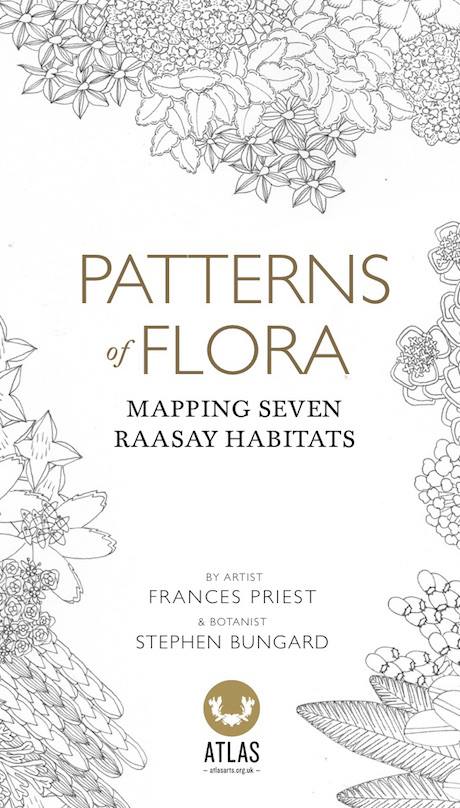
The form and design of the artworks – vases, door knobs, door pushes and pieces for sills – are based on Raasay’s plant life, and in particular seven different habitats that host unique and varying plant species: Bog, Coast, Fresh Water, Limestone, Moor, Mountains and Woodland. Alongside these Frances designed a map, featuring the habitats with associated walks. She collaborated with Raasay-based botanist Stephen Bungard.
(I had worked with Frances several years ago, on Pandora’s Light Box at the Talbot Rice Gallery in Edinburgh, and it was good to catch up with her work in a very different setting.)
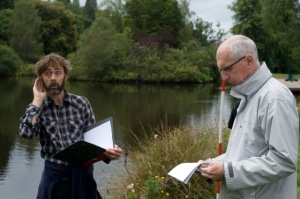
I was there to lead a ‘haiku walk’ on the Saturday afternoon, again working with Stephen. We went to the salt marsh at Oskaig, arriving at a particularly wind- and rain-swept moment, but the weather cleared and there was much to enjoy immediately around us, and looking across the sound to Skye and the Cuillins. I was struck by Stephen’s remark that the four aspen trees we saw were in fact all one, the trunks all sharing a single root.
Back at Raasay House all was notebooks and concentration.
On Sunday, once the morning rain had cleared, I managed a walk with Frances and others on the east coast from Fearns to Hallaig, below the cliffs and into the birchwood the burn runs through. In his poem ‘Hallaig’ Sorley Maclean repeoples the now empty places:
na h-igheanan ’nan coille bheithe, / dìreach an druim, crom an ceann.
the girls a wood of birches, / straight their backs, bent their heads.
The gallery asked Alec Finlay to make a new work for Callendar Park, and invited him to work with the gallery’s Youth Ambassadors (YAs), teenagers drawn from local secondary schools who are involved in different ways with the gallery’s programme. Alec asked me, along with other poets and artists, to work with the YAs over the summer to develop his ideas, centered on creating viewpoints within the park, and linking these to plants brought here by the Romans (the line of the Antonine Wall runs just to the north of Callendar House).
WALLFLOWERS | FLORES MURI – a series of plantings in Callendar Park marked by archaeological poles – was finalised and installed by Alec in spring 2014.
Sadly it was vandalised immediately and thoroughly.
Some flowers among the ruins is a new booklet published by Callendar Park, Falkirk. It invites the reader to walk in their imagination through the park, and to view the plantings that were once there, albeit briefly, rather like the Antonine Wall itself.
If you’d like a copy, send an SAE to Studio Alec Finlay, 53 Prince Regent Street, Edinburgh EH6 4AR. (It measures c.14x11cm, so you don’t need a large envelope.)
You can read the YAs blogs about the project here, and Alec has written a blog about it here. Below are some notes I made about my involvement in the project in 2013.
Alec Finlay & Ken Cockburn
Alec and I had made a couple of preliminary visits in the spring, looking for views. As the gallery is showing Nature Over Again (After Poussin), his initial idea was to set up viewfinders to ‘frame’ certain landscapes in a painterly way; but given the woodland we found too few. What we did find were the golf-course with its flags, the Antonine Wall still casting its Roman shadow, and what we called the ‘declension tree’ (a red maple), whose trunk divided close to the ground.
Come summer the tall limes are flowering and abuzz with bees. Between showers I explore the grounds with the Youth Ambassadors, looking for sites that will work as viewpoints and a views; like a golf flag which draws you towards itself, then points you towards what comes next. Nine in all (like the golf-course); each marked by an flag-topped archaeological pole, and a plant first brought here by the Romans (some of which already grow here, others we’ll plant specially). We write about and sketch the views, compare one with another, contrast different views from the same viewpoint.
After researching our Roman flora, we write very short poems about them, playing with their features, their uses and the meaning of their Latin names. Then we plot a route through the grounds, from one pole to the next, realising they’ll be more visible in winter; the landscape now is like a series of discreet rooms. We finalise the pole locations by photographing them in situ, each with a poem-label for its matched flora. It’s a good way of seeing how the poles link up, and considering the work as a whole.
The last day is spent with photographer Robin Gillanders. At each location Robin takes three photos of each person in a t-shirt (happily there are nine of us, so no-one is left out) – head & torso, facing forwards; full length, ditto; full length, looking away at the view. And at each location Alec and I discuss the poems, already revised, revising some further on the spot (most interestingly the Whitmanesque ‘daffodil’).
Robin speaks about photographing other gardens –Ian Hamilton Finlay’s Little Sparta, and Ermenonville where Rousseau is buried. Later, walking round Nature Over Again (After Poussin), Alec talks us through the images, and his personal memories of their creation; there’s some discussion of why the photos are ‘folded’.
These are some images from the recent opening of the exhibition About Face at Hillhead Library, Glasgow, featuring large-scale polaroid photographs of ten Scottish poets made by Maud Sulter in 2002.
The poets are myself, Stewart Conn, Valerie Gillies, Brian Johnstone, Gerry Loose, Edwin Morgan, Liz Niven, Janet Paisley, Don Paterson, and Maud Sulter. Robyn Marsack, Director of the Scottish Poetry Library, spoke at the opening; the exhibition runs till 28 June 2015.
Maud Sulter was an artist and writer, whose poems featured in Donny O’Rourke’s seminal Dream State anthology. She died in 2008.
I had slightly hazy memories of the photograph being taken, but found the following diary entry.
Tuesday 29 August 2002: I stood for Maud Sulter this morning, just before Jennie Renton. I thought dreamy, Jennie said enquiring. A flicker of a smile. Smart flat by the parliament. Big camera, flash and it’s done.
She used a large-format camera, which came from Prague with a technician; waited for the right moment, pressed the button, then we watched and waited as the paper emerged and the image formed. Later I wrote, “What strikes me about my own portrait is the asymmetry of the face, the light / dark contrast, what seems to be a mixture of curiosity and reticence, alertness and sleepiness”.
The portraits toured to several venues in 2003 and 2004, but this is the first time they’ve been seen since. The exhibition coincides with Passion, a larger show of Sulter’s work, at Street Level Photoworks in Glasgow.
Coinciding with the lunar eclipse on 4 April, and following the recent solar eclipse, David Faithfull’s ‘Moon draws Sun / Earth draws Moon’ has been projected onto the side of Castle Mill Works in Fountainbridge. As part of the Dark Matters project, we discussed in situ the installation and its connections with Enlightenment Edinburgh. (Thanks to Judith Liddle for the photos below.)
The Encyclopaedia Britannica was founded in Edinburgh in the 1760s, and early editions were printed in in Fountainbridge. The city at the time was just beginning to expand from the old town huddled for protection beneath the castle; and of its home city the EB states approvingly that “a plan of a new town to the north is fixed upon, and is actually carrying into execution with surprising rapidity, and with an elegance and taste that does honour to this country.”
I read parts of the ASTRONOMY ‘treatise’ from the first edition of the EB from 1768. While telescopes had given us a sense of the size of the universe, we had as yet no sense of geological time – that had to wait until James Hutton’s Theory of the Earth, elaborated in the 1780s and published in book form in 1795. And the author’s belief in a benevolent deity led him to this, to our minds certainly, surprising conclusion:
[There is] no room to doubt, but that all the planets and moons in the [solar] system are designed as commodious habitations for creatures endued with capacities of knowing and adoring their beneficent Creator. (…) From what we know of our own system, it may be reasonably concluded, that all the rest are with equal wisdom contrived, situated and provided with accommodations for rational inhabitants.
This, the author contends, extends even to comets:
The extreme heat, the dense atmosphere, the gross vapours, the chaotic state of the comets seem at first sight to indicate them altogether unfit for the purposes of animal life, and a most miserable habitation for rational beings ; and therefore some are of the opinion that they are so many hells for tormenting the dammed with perpetual vicissitudes of heat and cold. But when we consider, on the other hand, the infinite power and goodness of the Deity, the latter inclining, and the former enabling him to make creatures suited to all states and circumstances ; that matter exists only for the sake of intelligent beings ; and that where-ever we find it, we always find it pregnant with life, or necessarily subservient thereto ; the numberless species, the astonishing diversity of animals in earth, air, water, and even on other animals ; every blade of grass, every leaf, every fluid swarming with life ; and every one of these enjoying such gratifications as the nature and state of each requires ; When we reflect moreover, that some centuries ago, till experience undeceived us, a great part of the earth was judged uninhabitable, the torrid zone by reason of excessive heat, and the frigid zones because of their intolerable cold ; it seems highly probable, that such numerous and large masses of durable matter as the comets are, however unlikely they be to our earth, are not destitute of beings capable of contemplating with wonder, and acknowledging with gratitude, the wisdom, symmetry, and beauty of the creation ; which is more plainly to be observed in their extensive tour through the heavens, than in our more confined circuit. If further conjecture is permitted, may we not suppose them instrumental in recruiting the expanded fuel of the sun, and supplying the exhausted moisture of the planets? However difficult it may be, circumstanced as we are, to find out their particular destination, this is an undoubted truth, that wherever the Deity exerts his power, there he also manifests his wisdom and goodness.
Reading this, I am surprised Edinburgh was not also the founding city of science fiction literature.
Come dusk, the generator was switched on, and David’s installation played over the wall of the Castle Mill Works, a former rubber factory, earmarked to become the new home of Edinburgh Printmakers Workshop in a few years time.
And come dusk, we were all feeling the cold, and were glad of a chance to warm ourselves around the bonfire.
I spent much of summer 2014 driving the motorways and country lanes of England and Wales with Luke Allan for there were our own there were the others, a project by Alec Finlay for the National Trust to mark the centenary of the outbreak of the First World War. Luke & I visited 23 properties, all of which had some connection to the war – a family member who served and was perhaps killed; a house used as a hospital, grounds used as a training camp; gardens planted as memorials to the carnage. At each I led a silent memorial walk, bookended by a pair of poems from the past century on the theme of conflict. At most properties we set up a pair of lecterns, on which the poems were presented, and at some the lecterns were placed either end of a sandbag wall, reminiscent of the trenches. At a few we flew a red flag featuring a circular version of project’s title. That phrase is taken from Hamish Henderson’s Elegies for the Dead in Cyrenaica, about his experiences in the North African desert in the Second World War, but it seemed an apt way of memorialising all the victims of conflict, rather than just those ‘on our side’, as did the large-scale ceramic poppies installation at the Tower of London.
Osterley House
Killerton Chapel
Stourhead
Liverpool
Burwash Memorial
Penrhyn
Stourhead, Temple of Apollo
This gallery above shows some photos from the tour (all are by me, except Killerton Chapel by Hannah Devereux, and Liverpool, by Luke Allan). The full itinerary is on the website.
After the English and Welsh tours I was able to visit Belgium at the end of September to visit some of the First World War sites near Ypres: graveyards, battlefields, memorials. I also saw the excellent exhibition In Flanders Fields in the Lakenhalle in the centre of Ypres itself, which shows the war from the perspective of the four armies who were fighting there: Belgian, French, British and German. We stayed at Talbot House in Poperinge, a small town which, for most of the war was just far enough behind the front line for it to be fairly safe. Talbot House became a social club for off-duty soldiers, and retains many features of that time.
A book of the same title documents and reflects on the project. It includes poems and prose by myself about the walks and the poems, as well as the poem ‘Cloqueliclot’ about my experiences in Belgium. It also features fine photos by Luke and Hannah.
After the road-trips of 2010 and 2011, Alec Finlay and I wrote a long poem about our travels on The Road North. It’s now been published in book form by Shearsman as the road north: a journey through Scotland guided by Bashō’s oku-no-hosomichi, 15 May 2010–15 May 2011.
You can download an audio version free of charge from iTunes – search for ‘The Road North (Alec Finlay & Ken Cockburn).
With thanks to Tony Frazer at Shearsman, and Tomohiko Ogawa for the cover photograph – it’s a postcard of Scotland which Alec sent to Tomohiko, who ‘matched’ it with a landscape in Japan.
If you’re interested in the background to the project, click on the link below to read an article I wrote for The Author, the magazine of The Society of Authors, earlier this year.
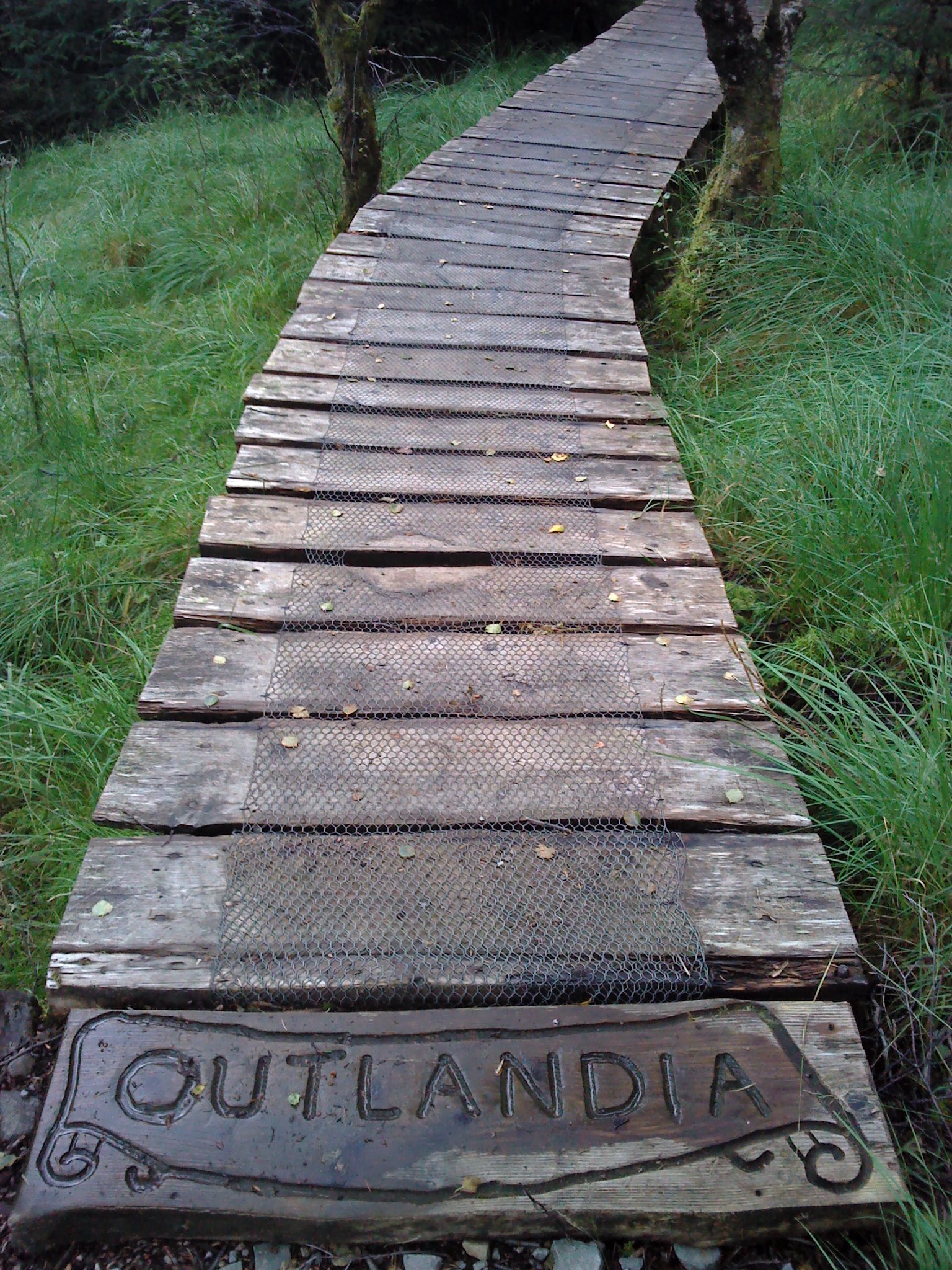
In August 2010 Alec Finlay and I visited Lochaber as part of The Road North. Our destination was Outlandia, a newly-built mountain hut, or artists’ field-station, commissioned by London Fieldworks (Bruce Gilchrist and Jo Joelson), designed by Malcolm Fraser, built by Norman Clark. Located a short, steep walk up from Fort William’s Braveheart car-park, it looks across the glen to the western slopes of Ben Nevis. You can read the account of our visit back then here.
Four years on and we’re returning to take part in Remote Performances, a collaboration between London Fieldworks and Resonance104.4fm. Over the course of a week, a series of specially commissioned artist performances and programmes created with local residents were broadcast live from Outlandia.
Driving north we stop and test the waters of Loch Eilt, a fondly remembered station from 2010, and we’re staying with Bruce and Jo, and many of the participating artists, at Frisealach in Lochailort, the house of Malcolm Fraser and Helen Lucas, where we also stayed a couple of nights in 2010. On the track up to Outlandia, Alec picks and I eat an angel’s-wing mushroom, prompting a Proustian memory of our previous visit; eating them raw in the hut with oatcakes, and cooked for breakfast at Annie Brigg’s the next morning, with fresh eggs from her chickens.
Our contribution to Remote Performances is a reading of the long poem The Road North, which developed after and to some extent out of the blog we kept over the year we were travelling. In the hut we sit with our backs to the window at a table supporting a large sound-desk. There is no electricity supply to the hut, and Bruce tells me all the equipment is powered by a hydrogen generator, which runs off hydrogen drawn from the atmosphere.
When I look up I see tree-tops and rain patterning the high roof-window. After a introduction from Tam Dean Burn, we’re on… back in Outlandia, recalling B-roads and Passing Places, and speaking to people… here, there and everywhere. We read the whole poem apart from the two Epilogues, which we don’t quite have time for.
That reading is available on Sound Cloud, as are all the other Remote Performances broadcast from Outlandia; and the poem will be published in book form by Shearsman Books this autumn.
With thanks to Bruce and Jo for the invitation to take part, and to everyone who made Remote Performances possible.
Earlier this year I mentioned that I was taking part in the exhibition Wordsworth and Basho: Walking Poets at Dove Cottage, Grasmere. That exhibition is now up and running – it closes on 2 November – and this post is about three books connected with it.
While yet we may is my contribution to the exhibition. It exists as a boxed set of 68 cards, and as a book. “While yet we may is composed of 17 words from Basho’s Oku no hosomichi (best known in English as The Narrow Road to the Deep North, though I worked mainly from the English translation by Cid Corman and Kamaike Susumu published as Back Roads to Far Towns) and 51 extracts from The Prelude, The Recluse and ‘Lines Composed a Few Miles Above Tintern Abbey’ by William Wordsworth. The idea for While yet we may came from a ‘variable construction’ by the poet Gael Turnbull (1928–2004), which consisted of two sets of cards : one of 28 cards, each featuring a noun, the other of 112 cards, each featuring a qualifying phrase. As Turnbull explained, “any one of the one-hundred-and-twelve phrases may relate to any of the twenty-eight nouns”. Of a published version in which each phrase was paired with a noun he wrote, “this version is no less final than any other”. The same applies to the version of While yet we may printed here.”
Copies of While yet we may (book and cards) are available from the bookshop at Dove Cottage, at £8.00 and £25.00; alternatively, you can buy them online at Big Cartel.
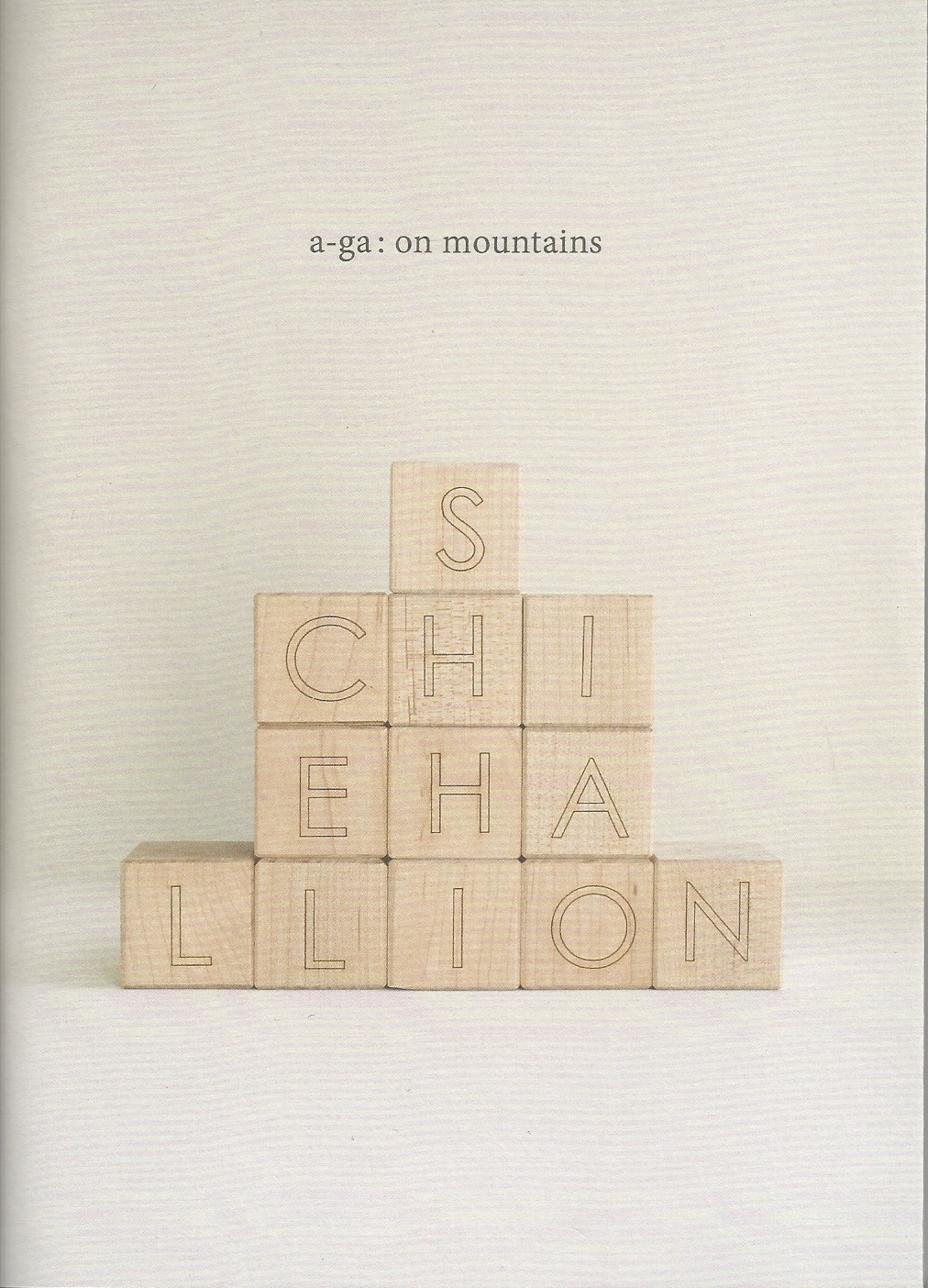
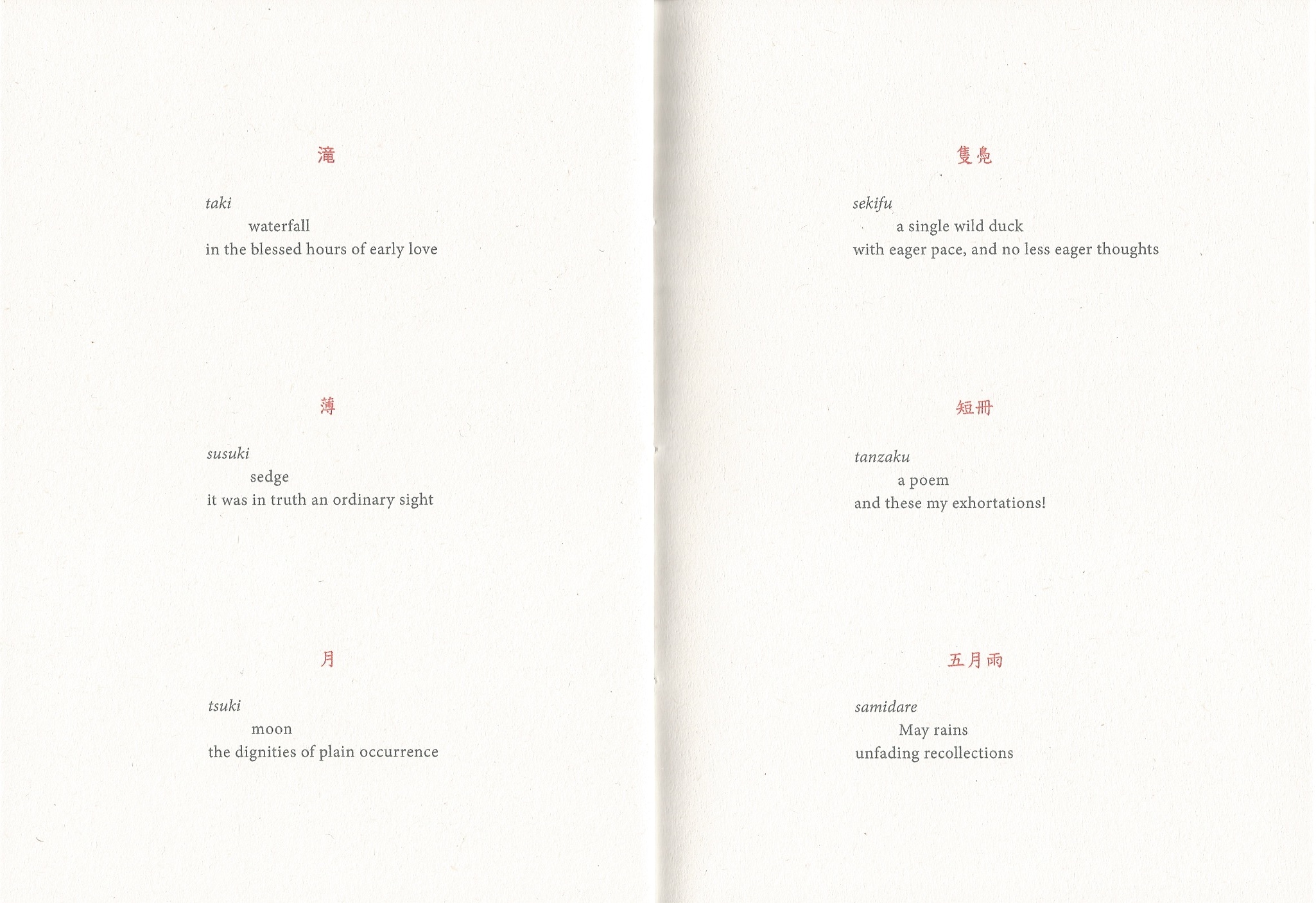
Alec Finlay’s contribution to Walking Poets is the booklet a-ga : on mountains, which includes pieces composed for the road north.
The exhibition catalogue has now been published, a fine full-colour publication edited by Mike Collier, and featuring work by, among others, Autumn Richardson, Richard Skelton. Ayako Tani and Brian Thompson. You can buy a copy here for only £9.99. One of the photos I took on the walk up Easdale Tarn in January has made its way onto the front cover.
Earlier this year with the help of Artlink I devised a performance at the National Library of Scotland for visually impaired and sighted visitors. ‘Some Bat-squeak Echo of Other Time’ took its title from a phrase in Audrey Niffenegger’s novel The Time Traveller’s Wife, and the performance connected various spaces within the library building on George IV Bridge with extracts from fiction – so the grand staircase became the setting for a scene from James Joyce’s Dubliners story ‘The Dead’, while the reading rooms hosted the “stout, middled-aged man with enormous owl-eyed spectacles” (described as being “somewhat drunk”) from The Great Gatsby. I read the extracts along with Jenny Hulse and Lorna Irvine, and we were accompanied by Laure Paterson on fiddle and Sally Thomas on flute – before a four-strong choir closed proceedings with a wonderful rendition of ‘Let’s Do It’ on the staircase.
You can listen to a podcast which features extracts from the performance, and interviews with some of those involved, and there’s more information on the project on the Artlink website.
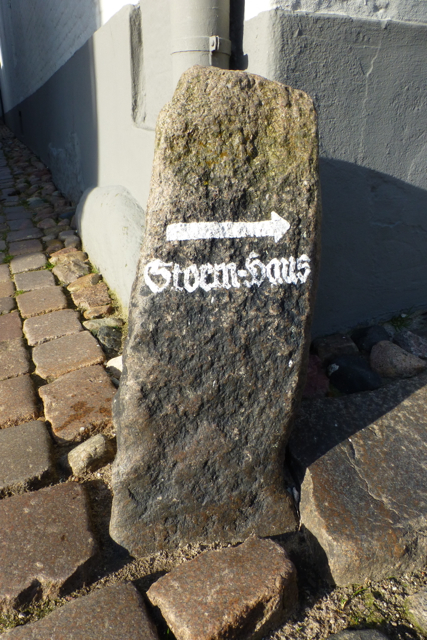
I was in Germany in March, visiting friends in Kiel, and had the chance to visit Husum, on the west coast of Holstein. It was here that the 19th century writer Theodor Storm lived for many years, and I happened to be reading his novella Der Schimmelreiter (The Rider on the White Horse), so I looked into his old house, now a museum.
The copy of Der Schimmelreiter which I was reading had been given to me by a friend, who’d meant to buy an English translation but had got a German edition instead. I thought I should take some photos of the book in situ, having as it were found its way home.
Later I enjoyed a reading by the poets Arne Rautenberg and Hendrik Rost at Der Speicher, an old warehouse on the quay. I spoke to Hendrik afterwards. He has three children, and said he wrote a whole book of poems on the commute between Lübeck and Hamburg, and could even quantify the time thus spent – 560 hours.
Storm’s heavy wooden writing desk – a gift for this 70th birthday – offers a rather different writing environment.
















 Poems on the page and in the world