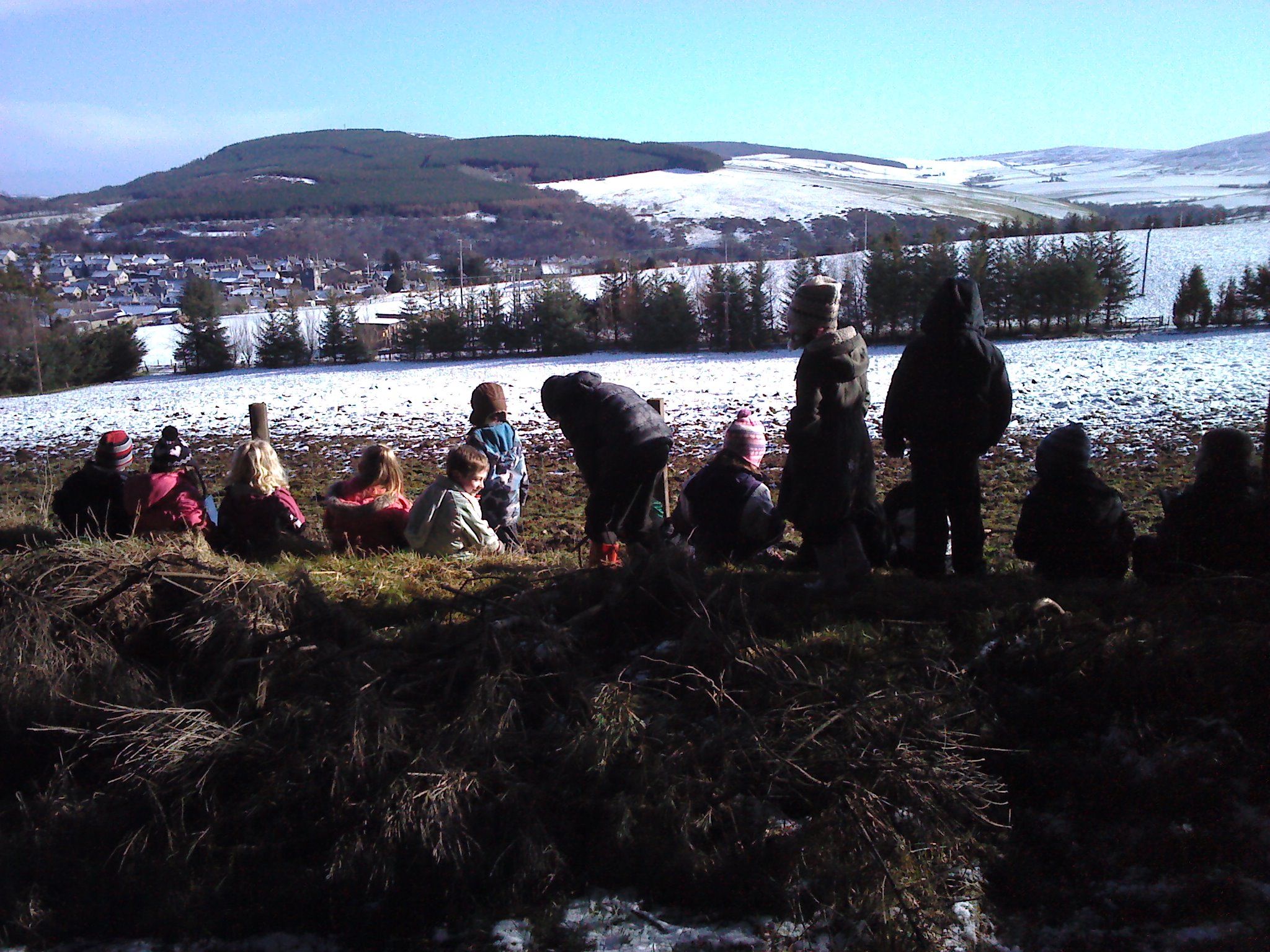
Mortlach Storywalks

P2 looking towards Dufftown from Meg's Widd

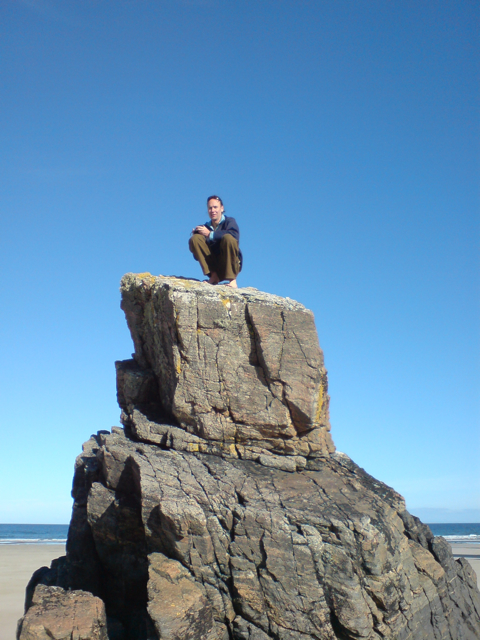
P7 returning from The Giant's Chair

Earlier this year I worked at Mortlach Primary School in Dufftown, mainly with the P2, P4 and P7 classes. We walked – in snow and sunshine – some of the paths around the town, which the kids had already explored with Wild things!, and I got them to write about their impressions of the ground we’d covered. I collated, edited and wrote up their material as stories, which have just been published as three leaflets, designed by Glasgow-based artist Janie Nicoll. P2 collectively describe Meg’s Widd, P4 become Jimbo, a local boy showing visitors round The Toon’s Widd, while P7 encounter a shape-shifter who opens up the history and ecology of The Giant’s Chair. The leaflets are available from Dufftown Tourist Information Centre, and other venues in the town.

The project was co-ordinated by Mary Bourne, sculptor, and a member of the School Council. Her carved stones using poems by children from all classes have been placed along the three walks.

the river meanders beneath the spider spinning its fragile web while the buzzard drifts overhead as the river…

sLender whIte Noisy watErfall, tumbliNg And imPatient, Rushes tOwards dullaN (LINEN APRON)

rocks under water shaded by trees the heron nests in and flies down to stand on rocks…

Works made by P1, P3 and P5 with Janie Nicoll have been installed in Dufftown’s Cottage Hospital, Tourist Information Centre and at the local library. Additional works are in the school itself.

The P6 class prepared an orienteering route around Meg’s Widd, making a map and contributing words for the stones which serve as control points.

The nursery children worked with Vivien Hendry and Mary Bourne, making peg-fairies which they took to Meg’s Widd. I ‘interviewed’ them about their fairies’ skills and adventures, and Vivien has made a limited-edition book, The Magic of Meg’s Widd.
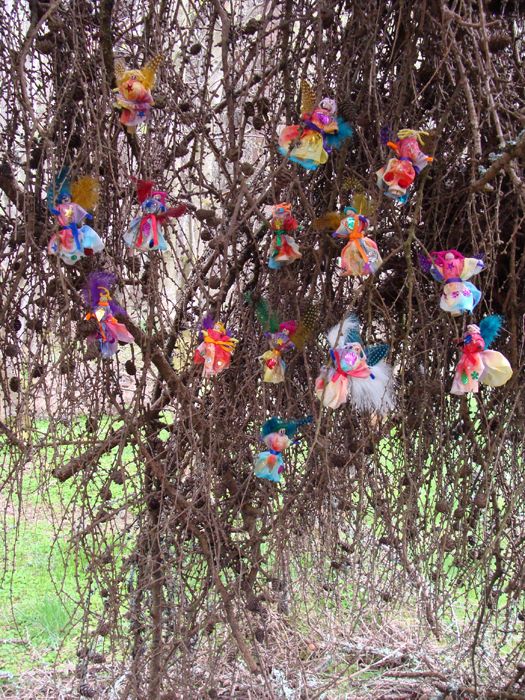
The Magic of Meg's Widd (photo: Mary Bourne)

Mortlach Story Walks is a partnership project between Mortlach Primary School, Dufftown, Moray and the Speyside Paths Network Group to produce arts-based interpretation for the countryside around Dufftown. It is initiated and supported by the school’s Parent Council.

Strathcarron

Sundial

Let others tell of storms and of showers
I’ll only count your sunny hours

In spring and summer 2011 I ran several writing sessions with day-care patients at Strathcarron Hospice near Denny. We talked and wrote about places, objects, gardens, people, sharing and affirming memories, and opening new conversations about previously unsuspected things-in-common. Here’s a group poem –

A Strathcarron Lucky Bag

Sheena Easton, Larry Marshall,
Billy Bremner, Walter Scott,
Taggart, Wallace, Tom Mackay,
Mary Stuart and a’ yon lot

munch Selkirk bannocks, jeely pieces,
Atholl rasps and Cullen Skink,
haggis puddings, drop scones, crumpets,
a pint of IPA to drink

in Denny, Falkirk, River City,
Balquhidder, the Necropolis,
the Tryst Golf Club, Loch Fyne, Loch Tay,
at Mrs Anderson’s, Bo’ness –

and aye a jaunt to Kirriemuir,
I hear yon Camera Obscur–
a there is fairly worth a keek – but that
we’ll have to maybe leave till next week.

At the final session, last September, we read the work to other patients and hospice staff in the day-lounge. and I thought that was that, until this week a bundle of booklets arrived in the post.

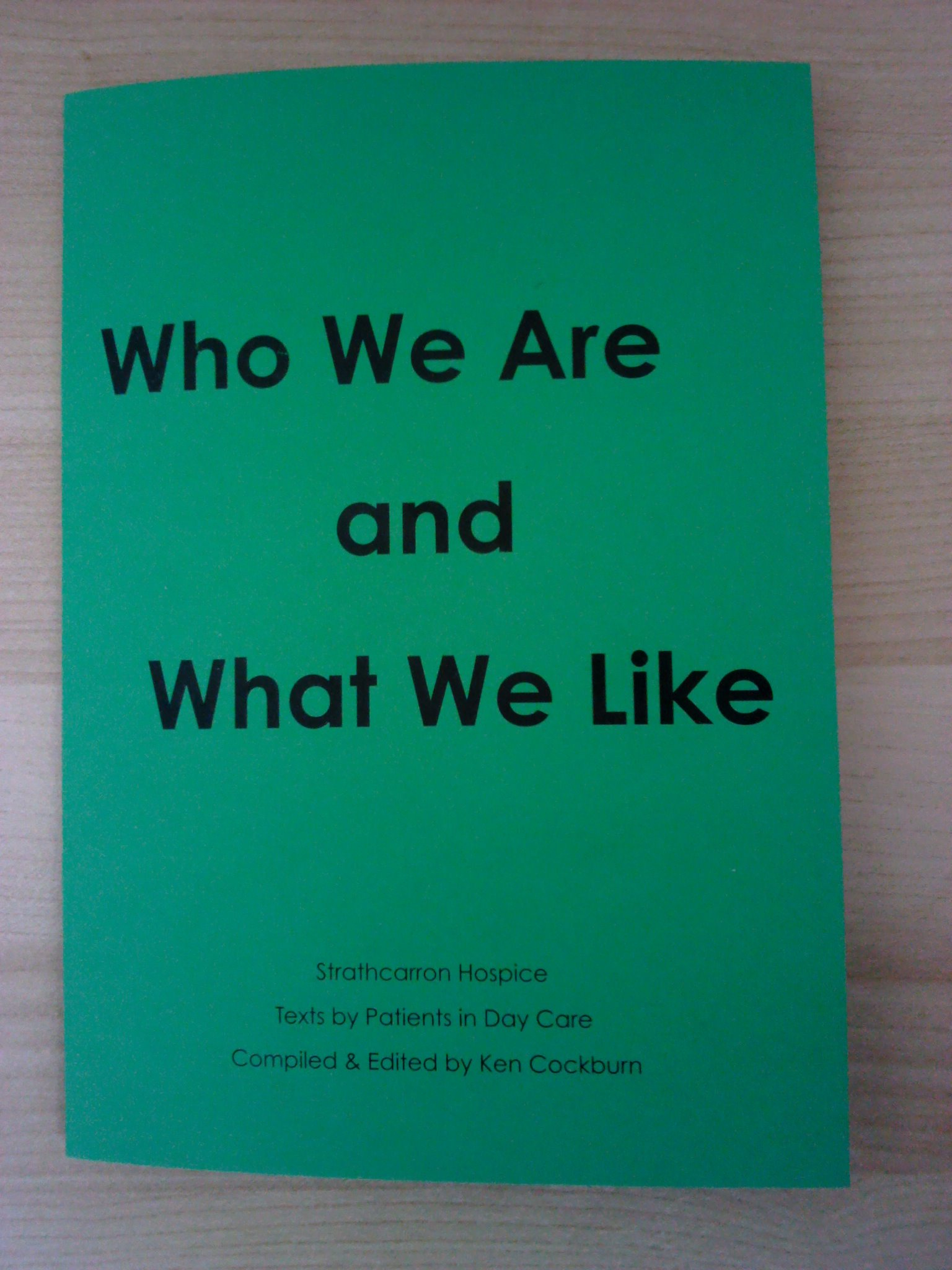
Who We Are and What We Like

Who We Are and What We Like collects the poems and prose we wrote last week in a simple, 12-page, A5 booklet, thoughtfully and carefully crafted.

The photos below show some ‘Garden Haiku’ in the hospice grounds.

Hosta – food for snails

Coloured poppies / at lunch-time the school-kids / came to hear you pop

Rhododendrons / in springtime / in the gardens at Bidduph

If you’d like a copy of the booklet let me know, and I’ll post one out.

The Road North: a matsuri festival


This May, join Alec and Ken Cockburn for a matsuri festival at the Hidden Gardens, Glasgow. For the past year Alec and Ken have been travelling through Scotland, guided by the Japanese poet Basho. On Sunday 15th May, their year-long journey will come to an end, and to celebrate they have invited some of the people they met along the way to join them for an informal afternoon in the gardens. There will be performances of poetry and song, paper wishes to tie, and teas from Japan and China served by the gardens’ cultural cookery group. The performances are scheduled for 3pm.

The Hidden Gardens, 25 Albert Drive, Glasgow G41 2PE

You can follow Alec and Ken’s journey on their blog, and there’s an e-invitation for you here.

Sitting (continued)

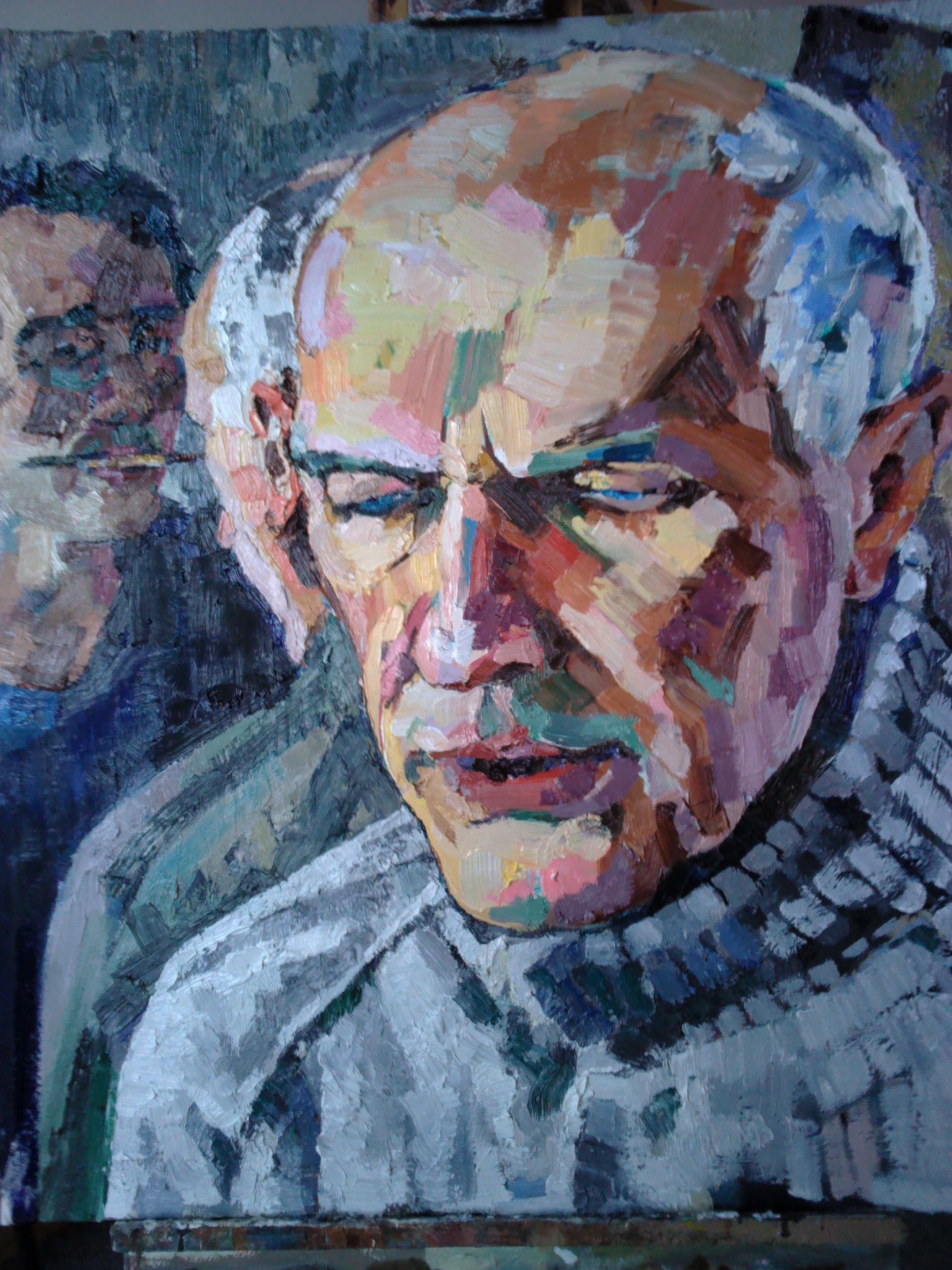
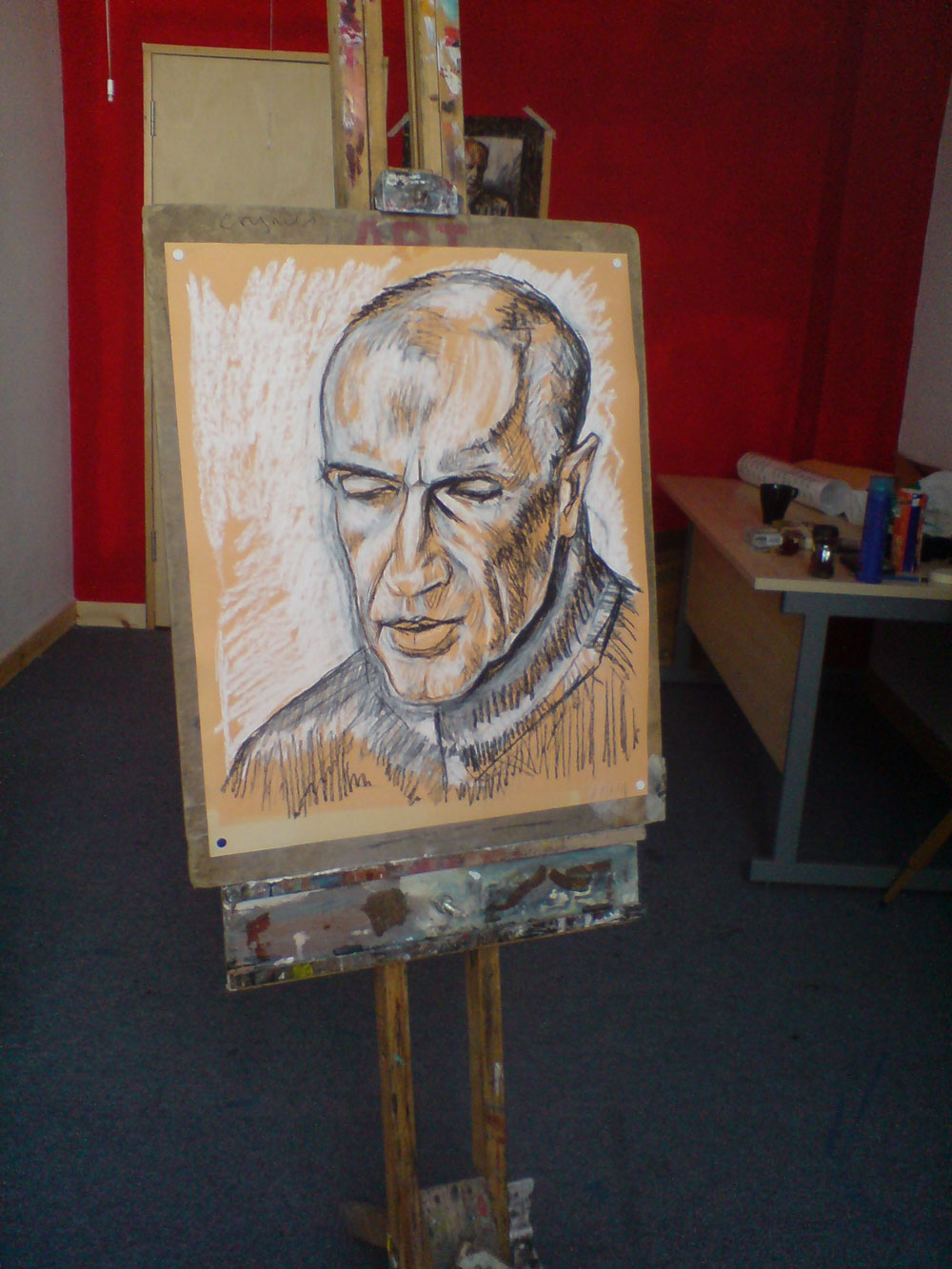
The finished portrait

After the drawing, Angus began a portrait in oils, which took several sittings. Again, I read my way through them – staying in the east with Pasternak and Herbert (Z), and going west with The New American Poetry 1945-1960, especially enjoying Gregory Corso’s ‘Marriage’. Above is the finished portrait, before the paint had even dried. Angus had been wondering about a title, and I wrote to him, ‘Lorna says it captures a lot of me and “it’s not going to be called Mr Fun” – ?! It was an interesting process for me too – to take that time for reading, the pleasure of reading aloud, and to observe your process, the struggle with the material, how that (relatively small) surface gradually became completed.’

Angus replied, ‘Reading Aloud is a very good title… that’s the point, and the thrill of it for me. It starts and anchors itself in the fact of your reading, and as such is a likeness of you and a kind of sketch; but it becomes an image when I began to be able to see that we were both involved (this was a shock, and perhaps the answer to a compositional dilemma). What interested me was to be able to see the exchange between us, the time it took and the process by which it was made… the daydreaming, the distraction, the concentration, the moments of frustration, the memorable line… all the points on the elastic scale of reading and listening…

‘So… whatever Lorna says, it’s the image of a special pleasure, and a celebration of it… And it’s good it’s two men I think. It’s not a parent and child (though it could be) and its not a younger person and an older person: just two men and a common ground we found to share. To me, that is something unusual and beautiful. Interesting too that it was the big expansive world of Milosz that offered the most space to stroll around.

‘I like it that you the sitter do all this active documentation and that there is the flavour of collaboration to it all. I hope other people can see that too…’

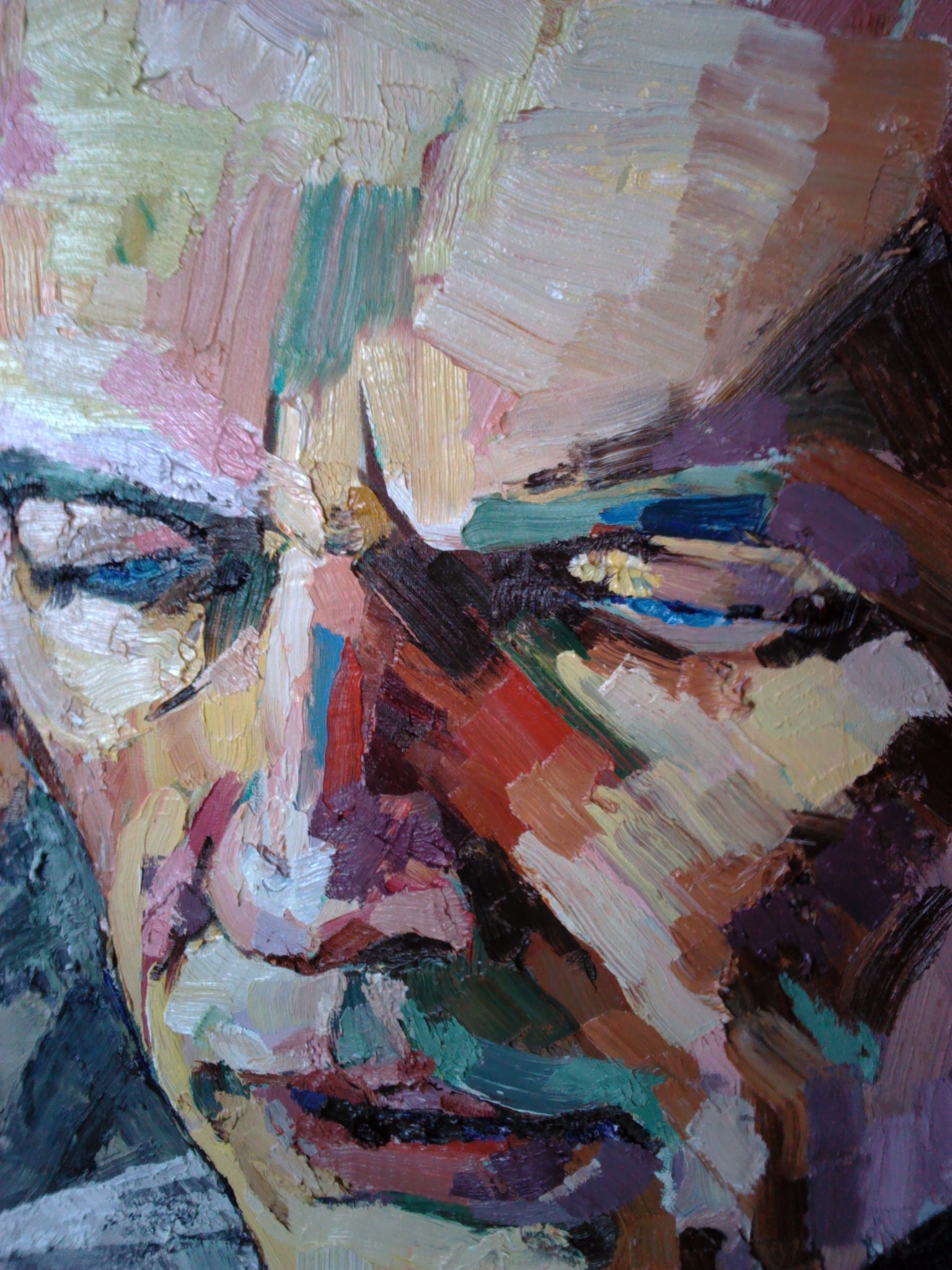
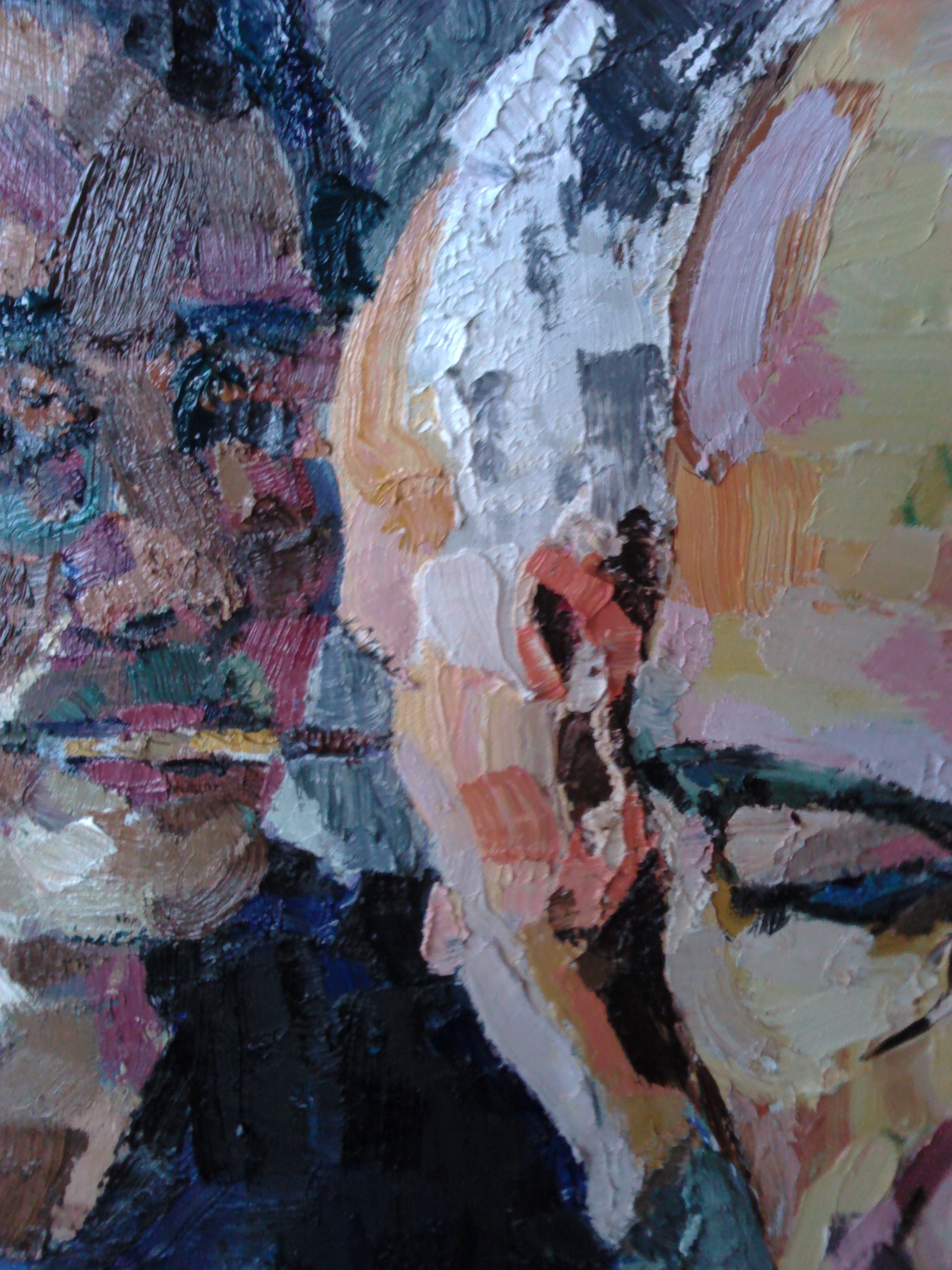
Here are some details from the picture.

Detail 1

Detail 2

Detail 3

Sitting

Angus Reid, 'Hendrix Chord', 2010

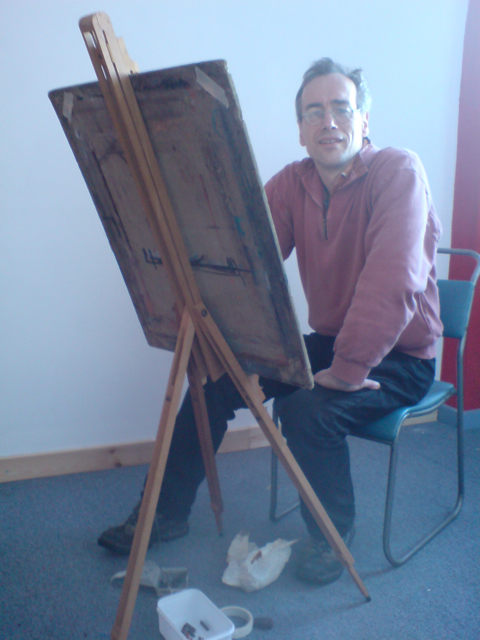
I have been sitting for a painted portrait recently. The artist is my friend Angus Reid, poet, film- and theatre-maker, architectural critic, composer… he painted years ago but has just taken it up again recently, when he persuaded his teenage son Mark to sit for him, guitar in hand. Now he’s taken a studio at the Arts Complex at Meadowbank, and I’m his first sitter.
Inside the Arts Complex

We decide, I can’t quite remember how, that I’ll read poems aloud while he draws and paints. I think this is mainly to stop me getting bored, but it means he’s seeing me with eyes downcast. (One day I play music instead, but this is far less interesting for either of us – I catch myself dropping off on occasion.)
Angus and easel

Reading poems aloud is a fine way of critiquing them – their strengths and weaknesses are thrown into relief. Neruda’s Book of Questions is a life-affirming delight despite its repeated interrogation of death (Neruda wrote it only months before his own death); W.S. Graham is harder work than I had imagined, abstract and angular, the specific setting of ‘Johann Joachim Quantz’s Five Lessons’ giving the most satisfaction; MacCaig keeps producing the most startling and exact images, often in otherwise imperfect poems; but it’s Milosz I most enjoy, the good company of his prosy, conversational, curious, wry, humorous tones, that open up further conversations once the poems return to silence.
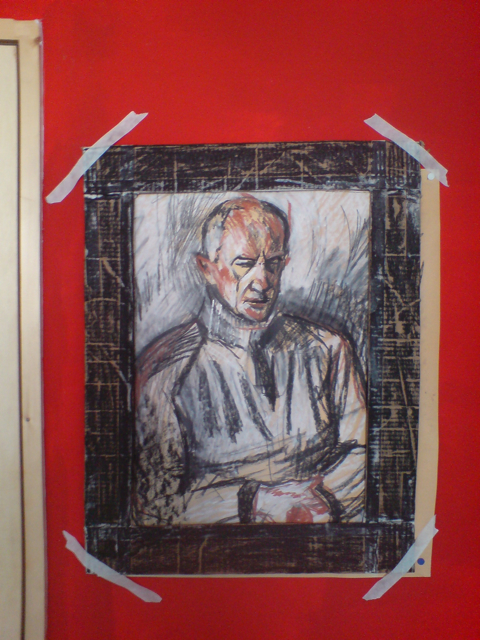
Angus Reid, 'Ken Reading Aloud', 2010

I found Angus’s comments on the process revealing too:
“In the time we have spent together, the image has begun to reflect the pleasure we both take in spoken poetry. The work is still in progress, but one drawing was a break-through, coming after Neruda and Milosz and somewhere in the midst of W.S. Graham and MacCaig: in the face of a middle-aged man reading – a face I know well – there was suddenly a surprise, something unselfconscious, that I was able to observe: small flashes of patience, tenderness and appreciation. The image seemed to be able to go beyond likeness to capture something universal that is otherwise largely hidden by the Ego, and the everyday.”
Angus Reid, 'Ken, with hands crossed&#039

At one level sitting seems an egotistical exercise, spending time having an image made of one’s transient, imperfect self; but at another, like many activities where you give in to time rather than trying to manage it, it’s a way of losing yourself, losing track of time, and finding what else there is.

Hidden in Hilton

The Wildwood

Back in April I ran workshops with Year 5/6 pupils at Hilton Primary School in Newcastle-upon-Tyne, as part of a project by Alec Finlay about habitat and outdoor learning. The focus was on exploring and redeveloping an overgrown garden known as ‘the wildwood’.
cHerry rIpening, pLum bursTing, Oak flamiNg

hawtHorn growIng, appLe fruiTing, cOtoneaster twistiNg

Poet-botanist Colin Will spoke to the children about what was growing there. The visit with Colin gave them a lot of stimuli, and they made notes as they went round. What helped them differentiate the plants was a memorable detail – the ash’s ‘black fingernails’, making it a ‘goth tree’, for example.
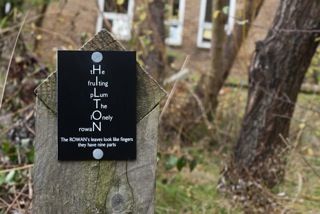
tHe fruIting pLum, The lOnely rowaN

sHaking wIllow, fLowering blackThorn, smOoth rowaN

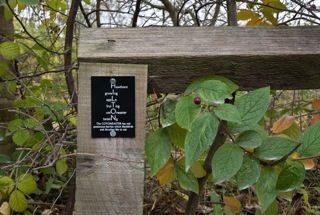
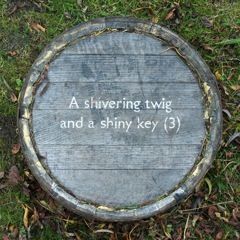
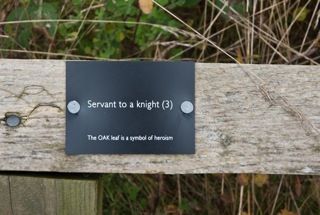
I showed the kids different ways to write about the plants they’d discovered and observed. The mesostic poems have a central stem-word, while embedded poems have a word hidden within it, like a cryptic crossword clue. The two below include tree names.
A shivering twig and a shiny key (3)

Servant to a king (3)

The poems have now been installed in the garden, as labels, bird-boxes and on barrel-seats.

Lewis horizons

Stornoway

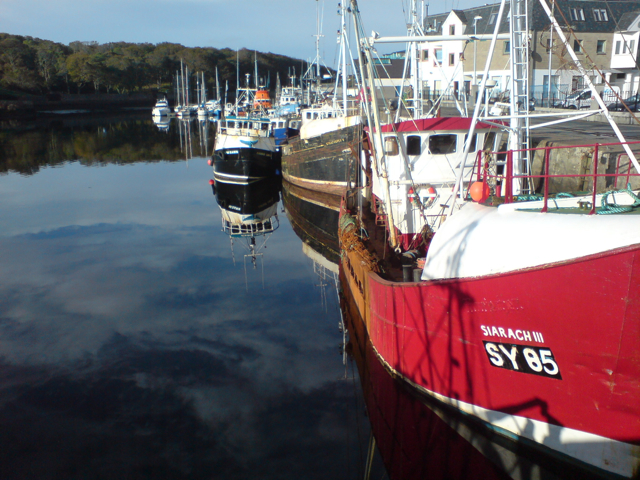
Stornoway harbour

Last month I spent ten days on Lewis and Harris, running schools workshops around the Artist Rooms exhibition Ian Hamilton Finlay: Sailing Dinghy at An Lanntair in Stornoway. The centrepiece of the show was a real dinghy given to Finlay, but it was too big for the lochans at Little Sparta. So it was never sailed, and it’s also unamed.
Jon Macleod

I worked alongside artist Jon Macleod, and as well as working in the gallery, we were able to take some groups out to the beach. Most of the pupils we worked with were familiar with boats, having sailed themselves or, if not, seeing the array of boats in Stornoway harbour or at other moorings around the island.
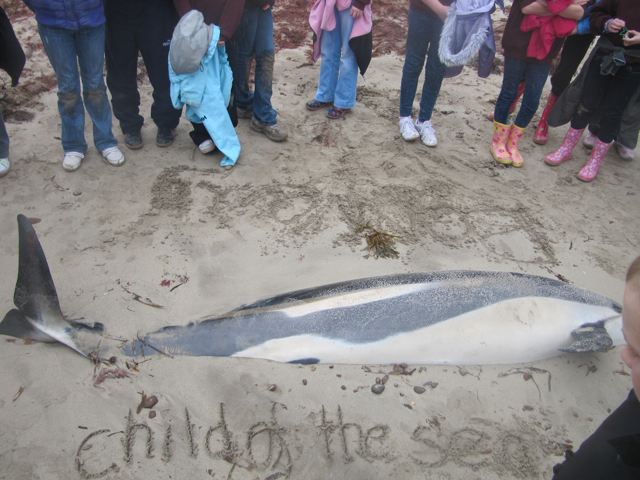
Bon voyage / child of the sea

The Gliding Water

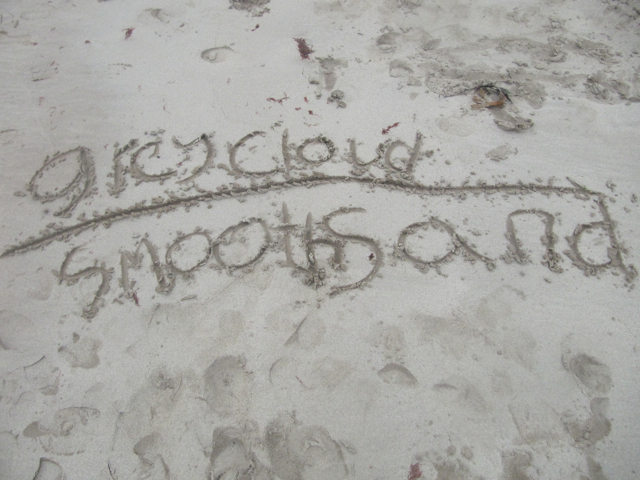
Horizon poem

At the beach we said sad farewells to a dead dolphin beached after a high tide, named and drew boats, and wrote ‘horizon poems’ – the line in the middle is the horizon, and above it you write a few words describing what you see above the horizon; and below the line, what you see below.
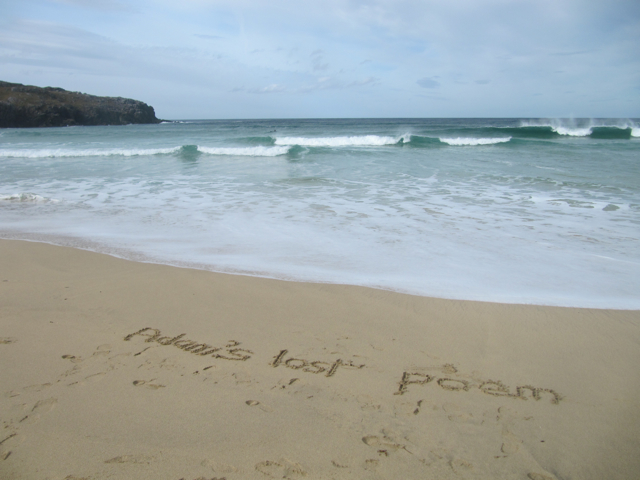
Adam's lost poem

Sometimes the waves got the better of us. When I asked Adam what he written, he cried ‘I can’t remember!’ So he got on with writing a new poem.
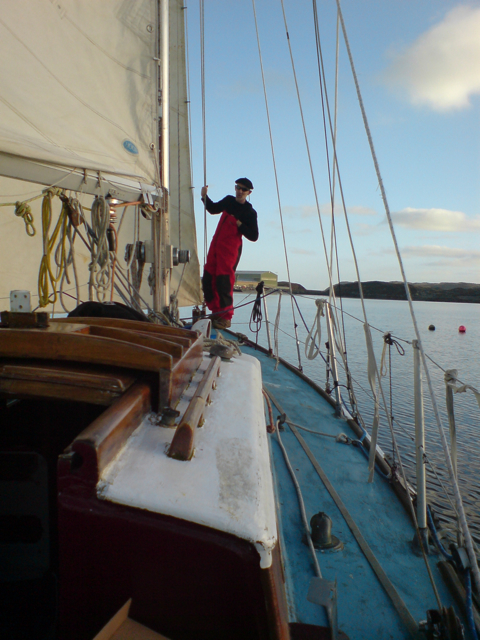
Ian Stephen on El Vigo

Wake

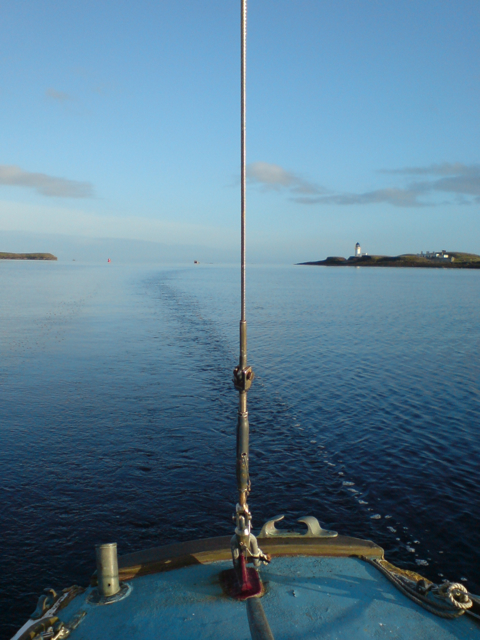
While there I met writer and sailor Ian Stephen, and one afternoon he took me out on El Vigo across a sunny and becalmed Stornoway Bay.
Carloway broch

Signpost on Harris

I also managed a couple of stations for The Road North, Dun Carloway on the west coast of Lewis, and Rhenigidale on Harris; the blogs about these will appear soon on the website.

Krakow October

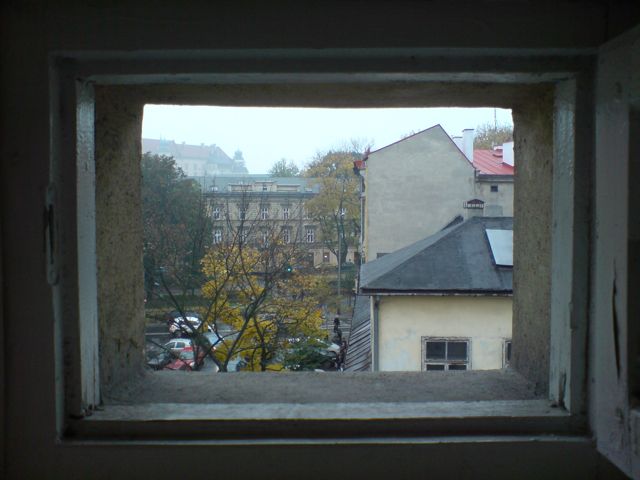
View from Hotel Spatz

Planty leaves

I have a couple of friends who are members of Zielony Balonik, a Polish book group who meet in Edinburgh and Glasgow. Not that I’ve been to any of the meetings, but when I met Grazyna and Robin back in July they told me about a exchange visit they’d organised with a book group near Krakow for October. Why didn’t I come? And Lorna as well? We’d never been to Poland, and it seemed like a good reason to go. In the end we couldn’t make the meeting with the other book group, at Limanova, which sounded like a great success.

On Saturday morning we rendezvoused at Camelot on Tomasza, and fortified by good breakfasts walked to the National Museum, to meet Grazyna, Alexander and Larissa. We walked round the 20th century Polish paintings galleries, stopped longest at the Witkacy self- and commercial portraits, though we lacked the code to know which particular high guided them.

The Witkacy portraits in the National Museum

Kantor’s Powrót Odysa (The Return of Ulysses)

I sat a while in the full-size set reconstruction for Kantor’s Powrót Odysa (Return of Ulysses), performed covertly in the Nazi-occupied city in 1944, and which by (apparent) coincidence a friend had mentioned only recently.
Michal, Robin, Grazyna, Larissa at Plac Nowy

On Sunday we enjoyed a tour of Kazimierz, the former Jewish quarter, with the novelists Małgorzata and Michał Kuźmińscy, who’ve written two books set there, one just before World War Two, and one just after, when it was a real centre of the black market.
Manghha
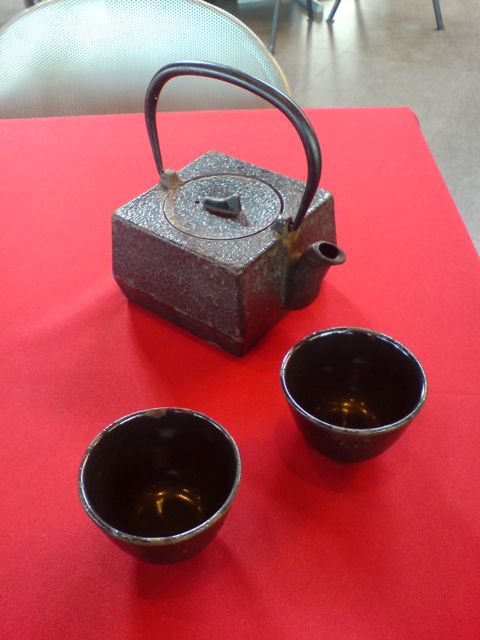
One highlight of the rest of our stay was our visit to the Manggha Museum of Japanese Art and Technology, where we saw still life with a japanese doll, a nicely curated exhibition of early 20th century Polish paintings influenced by Japonisme, and featuring many of the Japanese artefacts (woodblocks, robes, figures) portrayed in the paintings. The café does excellent Japanese tea – I enjoyed the kokeicha, a type new to me – and we’d recommend the sushi set.
Manggha interior

Metal teapot and bowls

One evening I met the poet Wojciech Bonowicz, who introduced me to a group of writers preparing a ‘magazine’, that is a live presentation of selected texts – a throwback to the Communist days, apparently, when publishing was difficult and risky. They invited me to read as well but, having no Polish and other plans for that evening, I made do with their company there and then, against a backdrop of 60s Polish pop they merrily sang and occasionally danced along to.
Disturbed Calm in St Katherine's

We attended the concert Disturbed Calm at St Katherine’s Church, part of the Unsound festival – were lucky to get in, as the 800 tickets were sold out in advance, but did so after a long wait. The venue rather outdid the music during Canadian ‘sound sculptor’ Tim Hecker’s set, but Swedish percussion-and-voice duo wildbirds and peacedrums were more compelling, especially when complemented by a 14-strong choir.
And we were taken with the Schindler Factory, a rich and sobering presentation of Krakow during the dark days of World War Two. There’s a mini-model of the Powrót Odysa set here too, without further explanation.
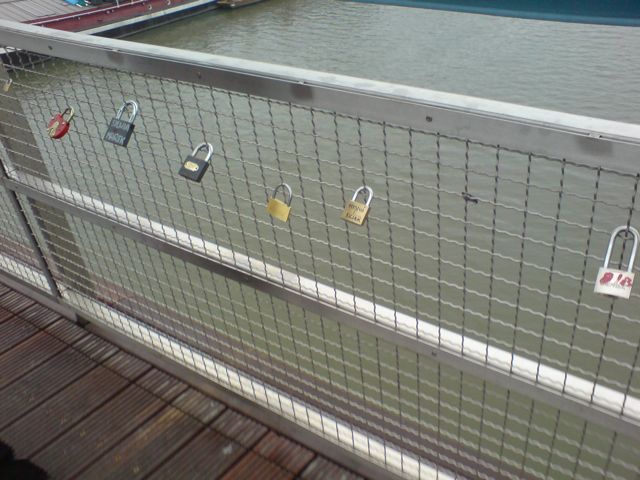
Padlocks on the bridge

On the way there, we were charmed by these annotated padlocks on a pedestrian bridge over the Vistula – contemporary beechbark lovehearts. Lorna thought the keys would have been thrown in the river.
Underpass whale

Argyll

Whiskies from & for Argyll

Cullipool on Luing

Last week The Road North led to Argyll. It was part family holiday as well, and there were six of us in total. Fewer stations than Perthshire, and no two-in-one-day, so we should get the blogs up sooner than last time. There’s a new web address, which takes you to a map of Scotland with all the stations marked; the darker ones are those we’ve blogged to date, the lighter ones those to come.

Other than Dunstaffnage Castle which I visited in 1998, when I was visiting primary schools in the area with the Scottish Poetry Library van, last week’s destinations were new to me – Achnabreck, Kilmartin, Dunadd, Kilmichael Galssary, Luing, Crinan. The cup-and-ring marked rocks at Achnabreck are astonishing beautiful, a density of perfect circles rippling through milennia… and despite the rain, the walk cairn-to-cairn along the ‘linear cemetery’ in Kilmartin Glen was one of the highlights of the week for the girls.

Achnabreck cup-and-ring-marked rocks

Kilmartin Glen, Temple Wood from Nether Lairgie South cairn

The black slate beach at Luing was a revalation to me, and my thanks go to Norrie Bissell for showing us round there; that was our Matsushima, Basho’s ‘magnificent vista’ where ‘all sorts of islands gather’ – fourteen in our case, compared to his 263, but magnificent it certainly was that bright afternoon, as we looked from Jura across the Garvellachs to the south coast of Mull. I missed the beach at Carsaid, as I was walking to (and nearly missing) Castle Dounie above Crinan; again the view was spectacular, and now I had a much better idea of what I was looking at.

Castle Dounie looking NW towards Mull

Alec led us to Loch Na Torrnalaich, between Kilmartin and Kilmichael… or, as it turned out, the unnamed lochan just to the south (he said it was smaller than he remembered). But there were waterlilies there too, and we swam, and it was beautiful, other than the bites I took away with me.

In the unnamed water-lily lochan

We ended the week with Pat Law, her husband Andy and daughter Kirsty, who’d sailed over from Lochmaddy, having dropped a dozen messages-in-bottles into the Minch, to await their fate. Over the table in the Crafty Kitchen at Ardfern, we toasted ‘journeys’. Long may they continue.

Looking west from Beregonium

Setting out


I recently spent a week in Perthshire with Alec Finlay, the first big trip of our project The Road North. We stayed in Acharn, on the south shore of Loch Tay, and Dunira, between Comrie and St Fillans. From Acharn, guided by Basho (and assisted by amongst others The Modern Antiquarian) we travelled to Aberfeldy, Weem, Fortingall, Glen Lyon and Schiehallion; from Dunira we went to Dalchonzie, Dundurn, Glen Lednock, Dunkeld and Birnam. Alec’s father lived at Dunira in the 1950s, and we found his shepherd’s cottage there, smartened up as a hunting-lodge; his poem ‘Dalchonzie’ features “the railway” and “the mill”, and we found both, and though neither now run, the mill-building has been renovated as a self-catering cottage.

The weather was very kind to us; there was sun and little wind at Schiehallion’s summit, we river-bathed a couple of times, and both came back more tanned than weather-beaten, though did suffer from the midges. My only soaking was at the top of Birnam Hill, after a steep, clammy and midgey climb through the woods, so the rain wasn’t so unwelcome. We’re currently writing up the trip for the blog, and in the longer term will write a renga / word-map / skyline poem for each location.

Next stop is Argyll in a fortnight – Crinan, Dunadd, Kilmartin, Luing, Dunstaffnage – mostly places new to me.

Ken Cockburn's website & blog