Category Archives: Visual Arts

Some flowers among the ruins

Callendar House
Callendar House

In summer 2013 the Park Gallery in Callendar House, Falkirk, exhibited Ian Hamilton Finlay’s Nature Over Again (After Poussin), part of the Artist Rooms collection.

The gallery asked Alec Finlay to make a new work for Callendar Park, and invited him to work with the gallery’s Youth Ambassadors (YAs), teenagers drawn from local secondary schools who are involved in different ways with the gallery’s programme. Alec asked me, along with other poets and artists, to work with the YAs over the summer to develop his ideas, centered on creating viewpoints within the park, and linking these to plants brought here by the Romans (the line of the Antonine Wall runs just to the north of Callendar House).

WALLFLOWERS | FLORES MURI – a series of plantings in Callendar Park marked by archaeological poles – was finalised and installed by Alec in spring 2014.

Sadly it was vandalised immediately and thoroughly.

Some flowers among the ruins is a new booklet published by Callendar Park, Falkirk. It invites the reader to walk in their imagination through the park, and to view the plantings that were once there, albeit briefly, rather like the Antonine Wall itself.

If you’d like a copy, send an SAE to Studio Alec Finlay, 53 Prince Regent Street, Edinburgh EH6 4AR. (It measures c.14x11cm, so you don’t need a large envelope.)

You can read the YAs blogs about the project here, and Alec has written a blog about it here. Below are some notes I made about my involvement in the project in 2013.

Alec Finlay & Ken Cockburn

Alec and I had made a couple of preliminary visits in the spring, looking for views. As the gallery is showing Nature Over Again (After Poussin), his initial idea was to set up viewfinders to ‘frame’ certain landscapes in a painterly way; but given the woodland we found too few. What we did find were the golf-course with its flags, the Antonine Wall still casting its Roman shadow, and what we called the ‘declension tree’ (a red maple), whose trunk divided close to the ground.

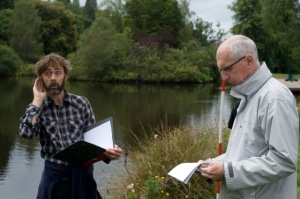
Come summer the tall limes are flowering and abuzz with bees. Between showers I explore the grounds with the Youth Ambassadors, looking for sites that will work as viewpoints and a views; like a golf flag which draws you towards itself, then points you towards what comes next. Nine in all (like the golf-course); each marked by an flag-topped archaeological pole, and a plant first brought here by the Romans (some of which already grow here, others we’ll plant specially). We write about and sketch the views, compare one with another, contrast different views from the same viewpoint.

After researching our Roman flora, we write very short poems about them, playing with their features, their uses and the meaning of their Latin names. Then we plot a route through the grounds, from one pole to the next, realising they’ll be more visible in winter; the landscape now is like a series of discreet rooms. We finalise the pole locations by photographing them in situ, each with a poem-label for its matched flora. It’s a good way of seeing how the poles link up, and considering the work as a whole.

The last day is spent with photographer Robin Gillanders. At each location Robin takes three photos of each person in a t-shirt (happily there are nine of us, so no-one is left out) – head & torso, facing forwards; full length, ditto; full length, looking away at the view. And at each location Alec and I discuss the poems, already revised, revising some further on the spot (most interestingly the Whitmanesque ‘daffodil’).

Robin speaks about photographing other gardens –Ian Hamilton Finlay’s Little Sparta, and Ermenonville where Rousseau is buried. Later, walking round Nature Over Again (After Poussin), Alec talks us through the images, and his personal memories of their creation; there’s some discussion of why the photos are ‘folded’.

2013-06-12 12.54.48

About Face

These are some images from the recent opening of the exhibition About Face at Hillhead Library, Glasgow, featuring large-scale polaroid photographs of ten Scottish poets made by Maud Sulter in 2002.

The poets are myself, Stewart Conn, Valerie Gillies, Brian Johnstone, Gerry Loose, Edwin Morgan, Liz Niven, Janet Paisley, Don Paterson, and Maud Sulter. Robyn Marsack, Director of the Scottish Poetry Library, spoke at the opening; the exhibition runs till 28 June 2015.

Maud Sulter was an artist and writer, whose poems featured in Donny O’Rourke’s seminal Dream State anthology. She died in 2008.

I had slightly hazy memories of the photograph being taken, but found the following diary entry.

Tuesday 29 August 2002: I stood for Maud Sulter this morning, just before Jennie Renton. I thought dreamy, Jennie said enquiring. A flicker of a smile. Smart flat by the parliament. Big camera, flash and it’s done.

She used a large-format camera, which came from Prague with a technician; waited for the right moment, pressed the button, then we watched and waited as the paper emerged and the image formed. Later I wrote, “What strikes me about my own portrait is the asymmetry of the face, the light / dark contrast, what seems to be a mixture of curiosity and reticence, alertness and sleepiness”.

The portraits toured to several venues in 2003 and 2004, but this is the first time they’ve been seen since. The exhibition coincides with Passion, a larger show of Sulter’s work, at Street Level Photoworks in Glasgow.

ECLIPSE: Enlightenment

DF Lunar Eclipse Solar Eclipse

Coinciding with the lunar eclipse on 4 April, and following the recent solar eclipse, David Faithfull’s ‘Moon draws Sun / Earth draws Moon’ has been projected onto the side of Castle Mill Works in Fountainbridge. As part of the Dark Matters project, we discussed in situ the installation and its connections with Enlightenment Edinburgh. (Thanks to Judith Liddle for the photos below.)

The Encyclopaedia Britannica was founded in Edinburgh in the 1760s, and early editions were printed in in Fountainbridge. The city at the time was just beginning to expand from the old town huddled for protection beneath the castle; and of its home city the EB states approvingly that “a plan of a new town to the north is fixed upon, and is actually carrying into execution with surprising rapidity, and with an elegance and taste that does honour to this country.”

I read parts of the ASTRONOMY ‘treatise’ from the first edition of the EB from 1768. While telescopes had given us a sense of the size of the universe, we had as yet no sense of geological time – that had to wait until James Hutton’s Theory of the Earth, elaborated in the 1780s and published in book form in 1795. And the author’s belief in a benevolent deity led him to this, to our minds certainly, surprising conclusion:

[There is] no room to doubt, but that all the planets and moons in the [solar] system are designed as commodious habitations for creatures endued with capacities of knowing and adoring their beneficent Creator. (…) From what we know of our own system, it may be reasonably concluded, that all the rest are with equal wisdom contrived, situated and provided with accommodations for rational inhabitants.

This, the author contends, extends even to comets:

The extreme heat, the dense atmosphere, the gross vapours, the chaotic state of the comets seem at first sight to indicate them altogether unfit for the purposes of animal life, and a most miserable habitation for rational beings ; and therefore some are of the opinion that they are so many hells for tormenting the dammed with perpetual vicissitudes of heat and cold. But when we consider, on the other hand, the infinite power and goodness of the Deity, the latter inclining, and the former enabling him to make creatures suited to all states and circumstances ; that matter exists only for the sake of intelligent beings ; and that where-ever we find it, we always find it pregnant with life, or necessarily subservient thereto ; the numberless species, the astonishing diversity of animals in earth, air, water, and even on other animals ; every blade of grass, every leaf, every fluid swarming with life ; and every one of these enjoying such gratifications as the nature and state of each requires ; When we reflect moreover, that some centuries ago, till experience undeceived us, a great part of the earth was judged uninhabitable, the torrid zone by reason of excessive heat, and the frigid zones because of their intolerable cold ; it seems highly probable, that such numerous and large masses of durable matter as the comets are, however unlikely they be to our earth, are not destitute of beings capable of contemplating with wonder, and acknowledging with gratitude, the wisdom, symmetry, and beauty of the creation ; which is more plainly to be observed in their extensive tour through the heavens, than in our more confined circuit. If further conjecture is permitted, may we not suppose them instrumental in recruiting the expanded fuel of the sun, and supplying the exhausted moisture of the planets? However difficult it may be, circumstanced as we are, to find out their particular destination, this is an undoubted truth, that wherever the Deity exerts his power, there he also manifests his wisdom and goodness.

Reading this, I am surprised Edinburgh was not also the founding city of science fiction literature.

DF Eclipse

Come dusk, the generator was switched on, and David’s installation played over the wall of the Castle Mill Works, a former rubber factory, earmarked to become the new home of Edinburgh Printmakers Workshop in a few years time.

And come dusk, we were all feeling the cold, and were glad of a chance to warm ourselves around the bonfire.

Bonfire

Walking Poets: the books

Earlier this year I mentioned that I was taking part in the exhibition Wordsworth and Basho: Walking Poets at Dove Cottage, Grasmere. That exhibition is now up and running – it closes on 2 November – and this post is about three books connected with it.

While yet we may coverA-ga coverWalking Poets cover

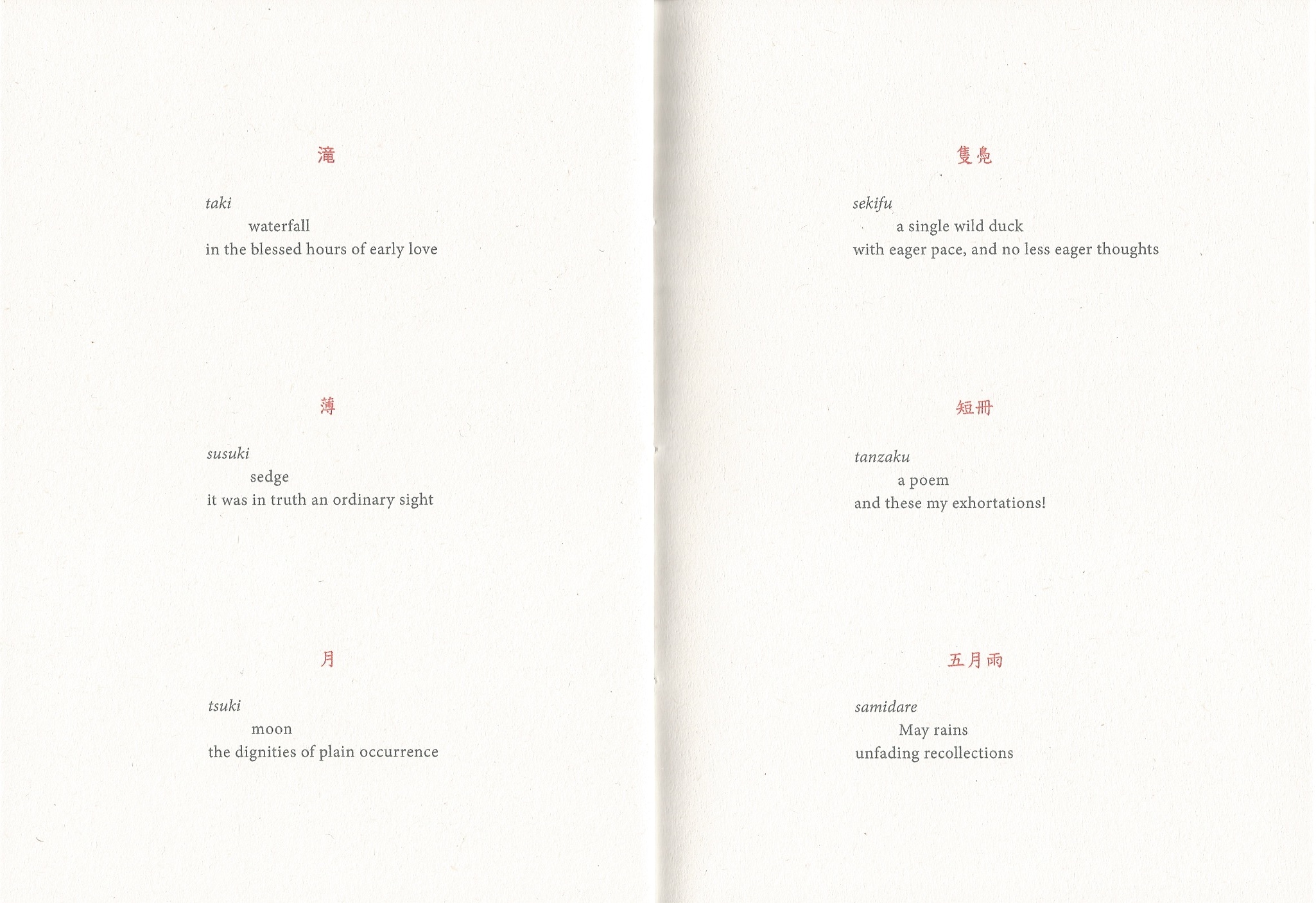
While yet we may is my contribution to the exhibition. It exists as a boxed set of 68 cards, and as a book. “While yet we may is composed of 17 words from Basho’s Oku no hosomichi (best known in English as The Narrow Road to the Deep North, though I worked mainly from the English translation by Cid Corman and Kamaike Susumu published as Back Roads to Far Towns) and 51 extracts from The Prelude, The Recluse and ‘Lines Composed a Few Miles Above Tintern Abbey’ by William Wordsworth. The idea for While yet we may came from a ‘variable construction’ by the poet Gael Turnbull (1928–2004), which consisted of two sets of cards : one of 28 cards, each featuring a noun, the other of 112 cards, each featuring a qualifying phrase. As Turnbull explained, “any one of the one-hundred-and-twelve phrases may relate to any of the twenty-eight nouns”. Of a published version in which each phrase was paired with a noun he wrote, “this version is no less final than any other”. The same applies to the version of While yet we may printed here.”

While yet we may spread
While yet we may cards
Copies of While yet we may (book and cards) are available from the bookshop at Dove Cottage, at £8.00 and £25.00; alternatively, you can buy them online at Big Cartel.

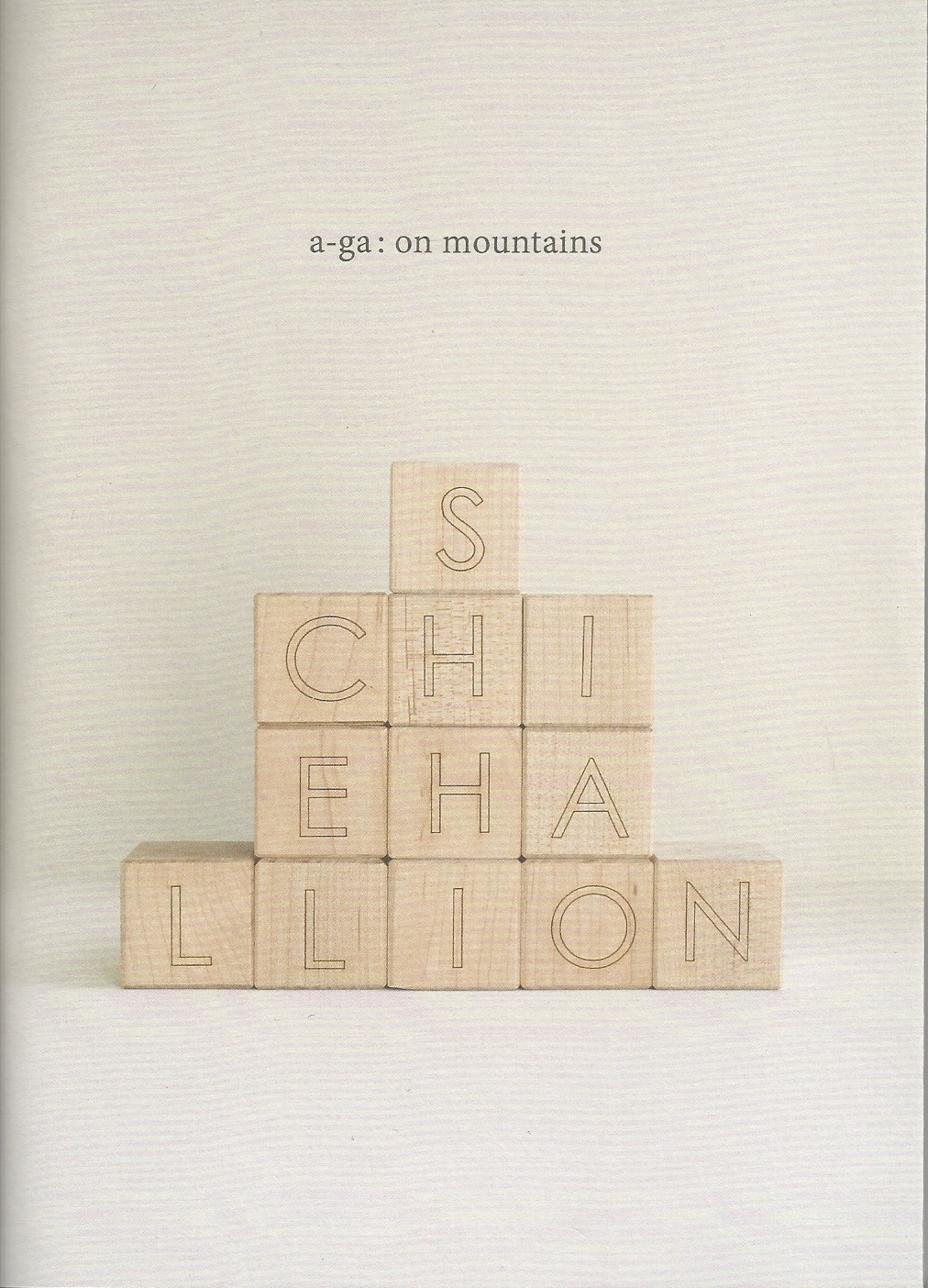
Alec Finlay’s contribution to Walking Poets is the booklet a-ga : on mountains, which includes pieces composed for the road north.

A-ga spread

The exhibition catalogue has now been published, a fine full-colour publication edited by Mike Collier, and featuring work by, among others, Autumn Richardson, Richard Skelton. Ayako Tani and Brian Thompson. You can buy a copy here for only £9.99. One of the photos I took on the walk up Easdale Tarn in January has made its way onto the front cover.

Walking Poets cover
Walking Poets back cover

Ettrick Valley

I visited the Ettrick Valley with painter Andrew MacKenzie on Easter Monday, April 21 – a field-trip of sorts, as Andrew and I have been talking about a collaboration, and this is a first step.

We drove along the B7009 which runs alongside (more or less) Ettrick Water, through Ettrickbridge, then turned off at Wardlaw / Hopehouse. Leaving the car we follow a path above the river, which snakes between the spruce woods on the hillside and the ‘Ettrick Marshes’ next to the river, as far as a (slightly dilapidated) bird-hide. From there, in the shadow of the spruce-wood, we look down over the pale sunlit marshland and over to the pale spring hillsides opposite.

Back in the car, we stop at the Hogg Memorial, or ‘Monument on Birthplace of James Hogg’, as the OS has it, with its image of Hogg in profile surmounting four well-horned sheep-heads. There’s a dog barking either side: it must be those sheep… While there’s no line from Hogg on the memorial, behind it runs a semi-circular stone bench, where visitors can read lines of their own choosing; perhaps these from The Queen’s Wake, said to be a self-portrait:

The Bard on Ettrick’s mountains green
In Nature’s bosom nursed had been,
And oft had marked in forest lone
Her beauties on her mountain throne;
Had seen her deck the wild-wood tree,
And star with snowy gems the lea;
In loveliest colours paint the plain.
And sow the moor with purple grain;
By golden mead and mountain sheer,
Had viewed the Ettrick waving clear,
Where shadowy flocks of purest snow
Seemed grazing in a world below.

Further on, the road’s mainly used for taking timber from the surrounding hillsides. We park at a locked gate, and walk towards the last house, Potburn, where the Borders historian Walter Elliot grew up, and where the painter William Johnstone lived in the 1960s. It’s been empty for some years now, and while the roof is more or less intact, it is gradually decaying, especially the outhouses.

We continue along the track past a caravan, presumably the residence of a forestry worker – perhaps the one who just passed us on a quad-bike – and make for Over Phawhope Bothy. Andrew made a wall-drawing here a year or two ago, which is still intact, though with a few additions, which he doesn’t seem to mind.

Our last stop is at Ettrick Kirk, where Hogg is buried. It’s an neat little church, the wooden pews inside admitting no disorder; outside I enjoy the combination of spring sunshine and still leafless trees. The graveyard is dominated by the remarkably well-maintained monument of Thomas Boston (1676–1732), an uncompromising but popular minister from the Covenanting tradition. Hogg’s stone is more modest, but has been cleared of the springy green moss spreading over its neighbours.

Orkney

we sail past Stroma’s empty fields
the Maidens grind the sea-gods’ salt
binoculars to scan the scene
the latent power the races hold

the Romans came and saw and left
Vikings named themselves in runes
a hoard of shards the dig unearthed
the sacred grove is made of stone

unfurl your banner to the breeze
starlings wheel across the sky
a spotted orchid in the verge
the wind is in the blades and flags

divers down among the wrecks
I don’t know what it is I’ve found
a haar drifts in across the rocks
the crab’s blue shell fades in the sun

Last autumn I took part in The Written Image, an exhibition organised by Edinburgh Printmakers Workshop and the Scottish Poetry Library. Poets and printmakers were paired, and I worked with Cat Outram. When we met she was just about to visit Orkney for the first time, and I’d visited the previous summer, so that became our theme. We came to settle on four of Cat’s images that seemed to give a good overview of Orkney: FERRY (geography), FARM (economy), BEACH (ecology), and BRODGAR (archaeology). I returned to a notebook I’d kept while there in 2012, and another relating to an unrealised project at John O’Groats; for each image I composed a 4-line stanza, guided by half-rhymes. The order in which the stanzas can be read is interchangeable. ‘The Maidens’ are one of the powerful tidal currents, or ‘races’, in the Pentland Firth.

Orkney print 2

Wordsworth & Basho: Walking Poets

Sill Stone

I was in the Lake District last week for a symposium on ‘Wordsworth and Basho: Walking Poets’. A group of us were there to meet and discuss what we might make for a forthcoming exhibition at Dove Cottage, Grasmere, home to the Wordsworths from 1799 to 1808, now a museum and home of the Wordsworth Trust.

The Prelude mss

Curator Jeff Cawton shared his enthusiasm for ‘The Prelude’ and its various manuscripts. Most are written in the hand either of Mary, the poet’s wife, or Dorothy, his sister, with amendments by William; apparently he found writing physically painful, so composed in his mind while out walking, dictating the results when he came home.

Wordsworth ms

The pages above show a draft of Book 10, with William’s revisions on the left hand page:

… As a light
And pliant harebell, swinging in the breeze
On some grey rock, its birth-place, so had I
Wantoned, fast rooted on the ancient tower
Of my beloved country, wishing not
A happier fortune than to wither there
And now was from that pleasant station plucked
And tossed about in whirlwind. I rejoiced…

Wayfinder

A group of us managed a walk in Easedale, up Sour Milk Gill (a fast-flowing stream) to Easedale Tarn (a placid lake). At the foot I read ‘Emma’s Dell’, one of the ‘Poems on the Naming of Places’ – right place, wrong season, as the poem is set on “an April morning, fresh and clear”, whereas we had damp January.

Easedale Sour Milk Gill

Though with all the recent rain, it was still true that

The Rivulet, delighting in its strength,
Ran with a young man’s speed…

The white waters reminded me the Inverianvie, of one of our stations on The Road North, so I adapted a line from Basho to fit the new location.

Poem-label gillEasedale label rapidsEasdale 1

Composite Landscapes

‘Composite Landscapes’ is a paper on my work with artists ~in the fields, which I delivered at the conference Writing into Art held at the University of Strathclyde and Kelvingrove Museum and Art Gallery, Glasgow, on 18–19 June 2013.
01 ~in the fields

Since 2008, I have collaborated on several projects with the artist collective ~ in the fields, Nicole Heidtke and Stefan Baumberger. Their work, in their own words, “emphasizes natural phenomena and condenses poetic moments into inventions of closed systems”. Their visual art practice draws on archival material and often involves environmental topics.

Our collaborations include a publication, an exhibition and public art projects, and I would like to consider some of the approaches to writing these different projects suggested, in terms of our collaborative methods, as well as the ways in which the content, form and sequencing of the resultant texts developed.

In particular I’ll consider two works: ink, for which text, written in response to an extant sculptural work, features in and shapes a book publication; and yen to see distant places, an interactive work made for an exhibition last summer at New Media Scotland, Edinburgh.
02 soccer

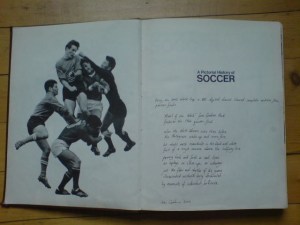
Our initial connection was a shared interest in the relationship of the handwritten inscription to the printed book – the individual to the mass-produced. I wrote a sequence of poems, On the flyleaf, notionally written in and relating to particular books, and I continue to have an interest in marginalia – readers writing in books. The image above features one of the ‘flyleaf’ poems.
03 parallel_view_on_programming_det

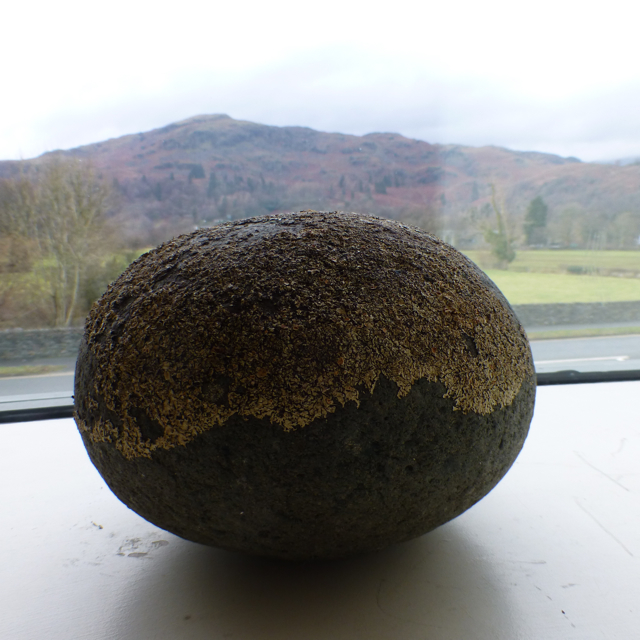
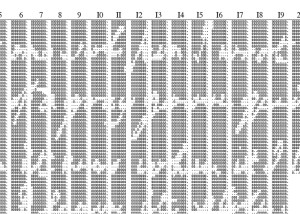
~ in the fields’ work incorporates new and old media, and their sculptural work ink used digitised versions of handwritten inscriptions found in five printed books from five centuries. This inscription – here represented in digital form – is taken from a 1634 edition of Pliny’s Natural History:

With one sole pen I wrote this book
Made of a grey goose quill;
A pen it was when I it tooke,
And a pen I leave it still.

04 ink_threespheres

Ink – the sculptural work – consists of five colourless clear glass bulbs – each partly filled with blue ink. When the visitor approaches, the bulbs begin to rotate, causing a layer of ink to coat the inside surface. Through the ink, illuminated handwritten inscriptions become visible on a spinning armature – a rotor with LEDs which pulse very quickly – and the inscriptions are given to the visitor individually. The visitor’s presence initiates the offering of the inscription once again.
05 Ink upright

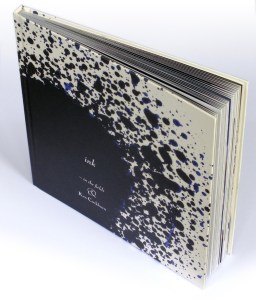
In the book Ink, images and texts relating to the sculptural work ink are augmented by texts by myself – original poems, found poems and reflective prose – which consider the sculptural work itself as well as the related topics of marginalia and the colour blue. An alphabet poem – on imaginary shades of blue – came to define the structure and extent of the book.

06 Ink French folds

The book is bound using French folds – the main text is all printed on one side of the paper – but between the pages, as it were, there is a background text – the alphabet poem – glimpsed out of the darkness. The book is 52 pages, so two pages for each letter of the alphabet.
07 Ink Circles

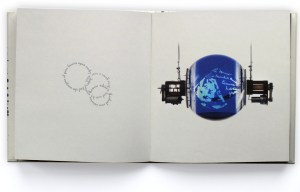
The poems in the book move off in different directions from the sculptural work. As well as the blue alphabet, there are found poems using parts of the handwritten descriptions; these additionally reflect the globes of sculptural work by being presented as circle poems, a form I had previously attempted without much success, but which seemed to work for me in this context. There are also poems reflecting on the sculptural work directly – on movement – on the propriety, or otherwise, of writing in books – and on the happenstance of the collaboration occuring in the first place. Here are two short poems – original, rather than found – from the book.

A paradox – before
this or any other book
absorbs the library-
stamp of ownership.
marginalia’s
a proper response, a nod
to posterity; but afterwards
unwanted, wanton, an act
of desecration,
proper grounds for censure.

*

It felt like a gift, such an encounter, out of the blue.

*****

08 Myriorama

“Landscape is not seen as merely dramatic background but as a force which shapes and directs the minds of its inhabitants.” (James Reed)

yen to see distant places from 2012 projects composite landscapes drawn from early 19th century etchings of Scottish landscapes, creating – perhaps somewhat in the manner of historical fiction – an image each of whose elements is based in reality, but which has never yet appeared in quite this context or combination.

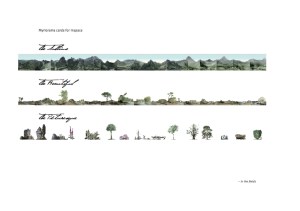
Each composite image consists of three elements – background (The Sublime), middleground (The Beautiful) and foreground (The Picturesque).

~in the fields wrote to me: “[we are] working with the ‘Sublime’ as landscape elements which are rough and evoke respect. The ‘Beautiful’ (Edmund Burke) are the small elements, smooth, delicate. The ‘Picturesque’ (William Gilpin) element is something like a ruin of a castle… We decided also to have the introduction of the rhododendron, etc.”
09 backgrounds 1-9

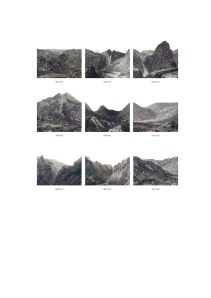
Here are some of the backgrounds. Individual elements are sourced from different books, mainly Walter Scott’s Provincial antiquities and picturesque scenery of Scotland: with descriptive illustrations, published in the 1820s. Other sources are books from the Botanic Garden Library, for example, Scottish trees with a history or a connection to a famous place. There are also some landscape drawings by Robert Kaye Greville (mainly for ‘the beautiful’) from the 1830s.
10 3 x 15

Fifteen images were selected, and individually coloured, for each element, and thus in total there are over three thousand possible combinations(15x15x15), or composite landscapes. The idea is also that the composite images can also connect horizontally to form a continuous landscape, or ‘myriorama’ – an idea taken from 19th century sets of cards featuring landscapes, which could be placed in any order and still produce a coherent image.
11 0001wG

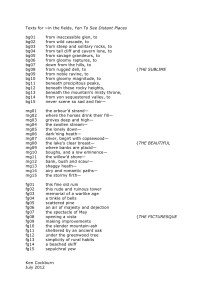
I was originally asked to provide a short caption or title for each image, but in fact produced a short poetic line, mostly taken or adapted from the work of Sir Walter Scott and other Romantic writers. Like the images, these lines were adjusted so that when combined they form a composite three-line verse, or Romantic haiku. The first and second lines – background and middleground – are linked by prepositions ‘from x to y’ – with the third line following after a dash, thus precluding the need for more specific syntax, yet qualifying the previous couplet in some way.

12 2012-08-09 16.17.56

Here is a shot from the exhibition. You can see how each of the images is presented on a glass screen on a pole. When these are moved into a certain position, they are projected on to the screen at the back as a combined image, and the text appears with them.

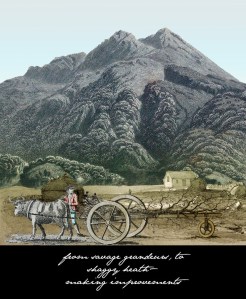
Here is the composite landscape, and poem, formed from the three elements in the bottom right of this image.
13 4_27_38

The text reads

from savage grandeurs, to
shaggy heath –
making improvements
14 2012-08-09 16.14.56

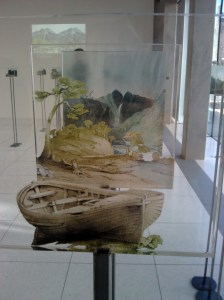
Another exhibition shot of the three elements – and the composite landscape which they form.

15 1_24_43

from wild cascade, to
boughs, and a low eminence –
a beached skiff

Here are a series of images, as presented on the screen during the exhibition, shifting from right to left.
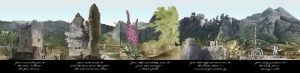
16 panorama

In this case, the user experience is very different from that of ink, as they participate and create one image out of three parts, anticipating what the composite image will look like and seeing this as a part of an ongoing panorama, and then being surprised by the related poem they have also “composed”.

*****

To conclude: poetry is about structures, about form as well as content, and sometimes the most interesting way of producing content is to focus on the form, and let the content as it were come of its own accord. I enjoy the way ~in the fields focus on thinking through and making their highly conceptualised and technically ambitious works, and I hope the poems can work in similar ways, as intricate machines which fascinate in terms of both their engineering and their output.

Ken Cockburn, June2013

Letterpress & Typewriters

I spent Saturday at the Scottish Poetry Library in Edinburgh. They were running their annual bookfair, By Leaves We Live, and it must have been one of the best attended ever. I was mostly at The Caseroom Press table with Barrie Tullett, who brought a small selection from his typewriter collection to display, and be used. They were joined by Edwin Morgan’s Blue Bell (part of his archive held by the SPL), and a red Olivetti Valentine, which Angus Reid had bought for his daughter in a Stockbridge charity shop for a tenner, but which drew admiring and even covetous looks from those that know about typewriters.

Barrie recently drew on the old Pepsi advert to write a text about LETTERPRESSIN’, which he letterpressed as a poster, and asked if I’d contribute something similar about POETRY. I obliged, and the result is above. It’s in an edition of 25, at £25.00 each, and copies are still available from the SPL.

A good day of conversations, rounded off with a party for Hamish Whyte’s Mariscat Press, now thirty years young and still going strong.