Tag Archives: Scottish Poetry Library

Miłosz 2011


30 June 2011 was the centenary of the birth of Czesław Miłosz. He’s a poet I’ve begun to read just in the past year, after the Krakow visit. I returned with a copy of his New & Collected Poems, bought on the last morning of the trip with the spare zlotys, and begun on the bus out to the airport.

Thumbing its pages, I made a couple of immediate connections: his appreciation of the Japanese haiku masters – Issa, rather than Basho, perhaps simply because he liked the coincidental link with the Issa Valley in his native Lithuania – and his ‘Notes’, a series of single sentences each under a short heading (‘The Perfect Republic’, ‘Epitaph’, ‘Mountains’), which are reminiscent of Ian Hamilton Finlay’s one-word-poems and monostichs, and Günter Eich’s (even briefer) ’17 Formeln’. Neither ‘Reading the Japanese Poet Issa (1762-1826)’ nor ‘Notes’ are entirely typical of his work, but they were useful landmarks I could start to navigate by.

I read him over the winter (in English, having no Polish). I read him aloud while sitting for my portrait, when Angus and I enjoyed enjoyed the discursive prose of ‘La Belle Epoque’, especially its closing section, ‘The Titanic’. When I proposed running sessions on his work for secondary schools, it became one of those rare and serendipitous projects everyone says ‘yes’ to.

In the summer term I visited schools in Edinburgh, East Lothian, Fife, Highland and South Lanarkshire, and will visit several more schools over the coming weeks. The poem I’ve come to focus on most is ‘The Dining Room’ (‘Jadalnia’) from the sequence ‘The World’ (‘Świat’), a seemingly straightforward description of an interior whose place and date of composition – Warsaw 1943 – soon open up deeper, darker layers of resonance.
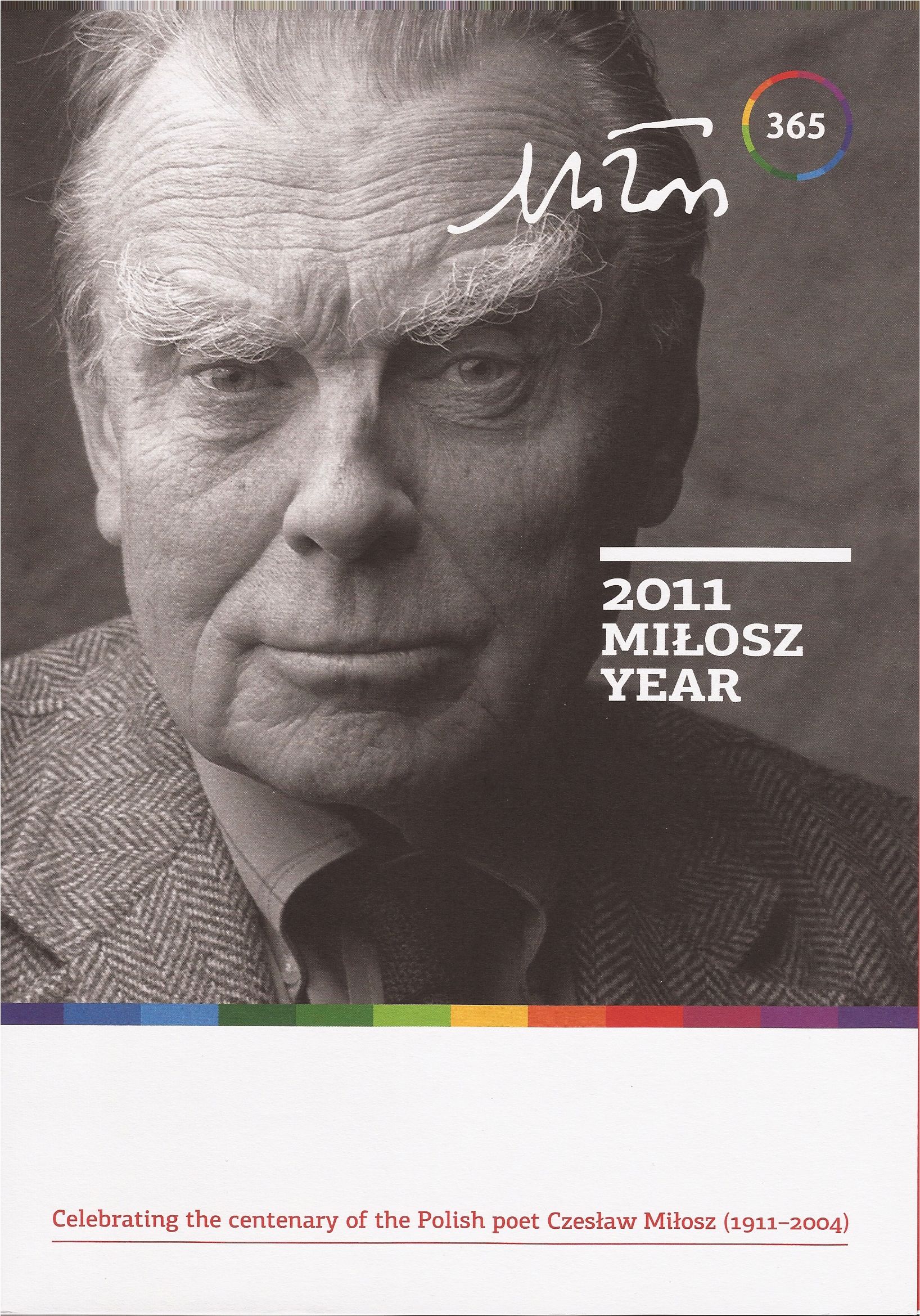
The Scottish Poetry Library has produced a Miłosz 2011 poster, featuring the poem ‘Song on the End of the World’ (‘Piosenka o Końcu Świata’) in English and Polish, along with background information, weblinks, and a couple of photos of the poet in later life, craggy and bushy-eyebrowed.

There is also a series of Polish Poems on the Underground at the moment, including Miłosz’s ‘And Yet the Books’ and ‘Blacksmith Shop’, as well as poems by Zbiginiew Herbert, Wisława Symborska and Adam Zagajeweski.
I’m also running an event on Saturday 10 September at Macdonald Road Library, Edinburgh, for the Polish book group Zielony Balonik, focussing on Miłosz’s poems.

The Road North at the Scottish Poetry Library

Friday 5 August – Saturday 3 September

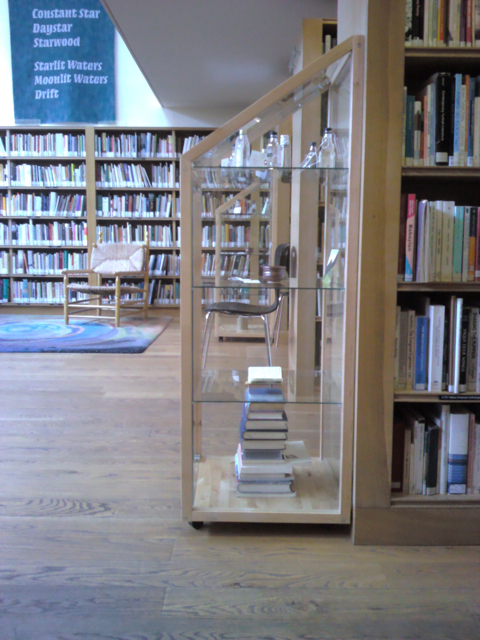
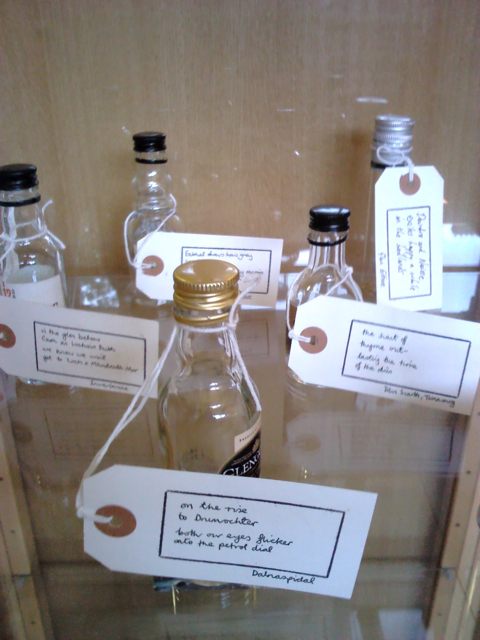
Below are photos of our ‘sampler’ of The Road North at the Scottish Poetry Library in Edinburgh in until 3 September – a display of poems written on the road, written on labels attached to whisky miniatures which we sampled while we travelled. And below the photos is a description of the project and the show. There’s also an article about The Road North in the current issue (no. 9) of Poetry Matters, the biannual newletter sent to all Friends of the SPL.


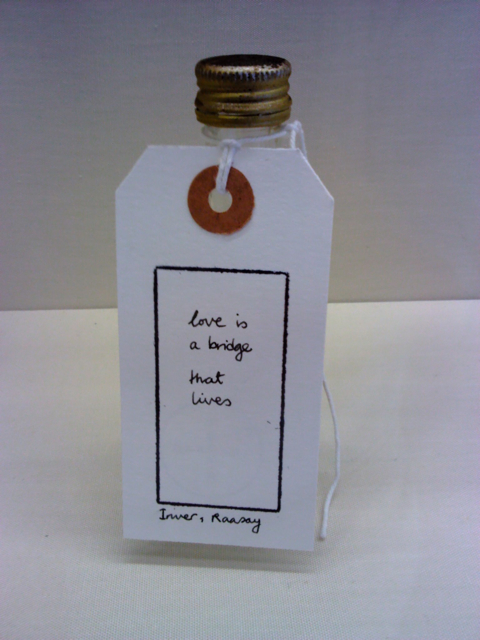
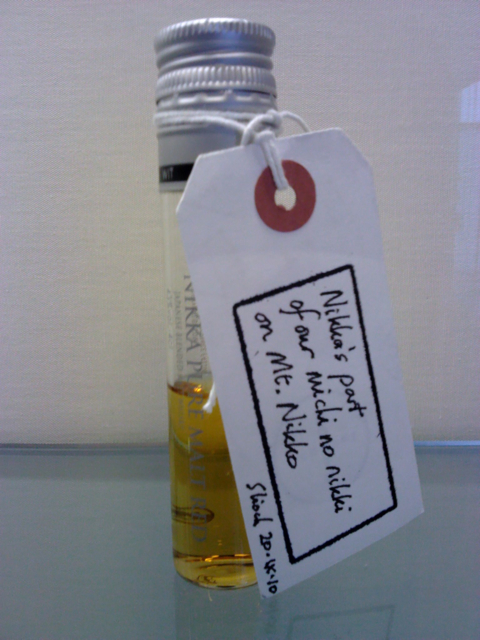
Bottles & hokku-labels

love is / a bridge // that / lives (Inver, Raasay) Alec Finlay

swallows skim ripples / on mirror-pond stillness / cup-and-ring marked rocks (Luing) Ken Cockburn

Nikka’s part / of our michi no nikki / on Mt. Nikko (Slioch) Ken Cockburn

pulling mussels / from a shell // parting the paired / tea-cups (the hidden gardens) Alec Finlay

 
The Road North is a word-map of Scotland, composed by Alec Finlay & Ken Cockburn as they travelled through their homeland in 2010 and 2011. They were guided on this journey by the Japanese poet Basho, whose Oku-no-hosomichi (Narrow Road to the Deep North) is one of the masterpieces of travel literature.
 
Following Basho and his travelling companion Sora, their journey took in 53 ‘stations’, from Pilrig to Pollokshields via Berneray, Glen Lyon, Achnabreck and Kirkmaiden. At each place they wrote and left poems in situ, as well as drinking a tea and a whisky, and leaving a paper wish. At several they met and wrote with other poets, including Meg Bateman, Gerry Loose and Angus Dunn.
 
This ‘sampler’ features the 53 (miniature) whisky bottles, each with a poem-label attached. These are complemented by a selection of books, word-drawings, texts and objects gathered and made on The Road North.
 
Scottish Poetry Library
5 Crichton’s Close, Canongate, Edinburgh EH8 8DT
t: 0131 557 2876
w: www.spl.org.uk
blog: www.scottishpoetrylibrary.wordpress.com
on twitter: @byleaveswelive
*New opening hours: Tuesday, Wednesday, Friday 10-5; Thursday 10-7; Saturday 10-4; Closed Monday, Sunday

The Road North: a matsuri festival


This May, join Alec and Ken Cockburn for a matsuri festival at the Hidden Gardens, Glasgow. For the past year Alec and Ken have been travelling through Scotland, guided by the Japanese poet Basho. On Sunday 15th May, their year-long journey will come to an end, and to celebrate they have invited some of the people they met along the way to join them for an informal afternoon in the gardens. There will be performances of poetry and song, paper wishes to tie, and teas from Japan and China served by the gardens’ cultural cookery group. The performances are scheduled for 3pm.

The Hidden Gardens, 25 Albert Drive, Glasgow G41 2PE

You can follow Alec and Ken’s journey on their blog, and there’s an e-invitation for you here.

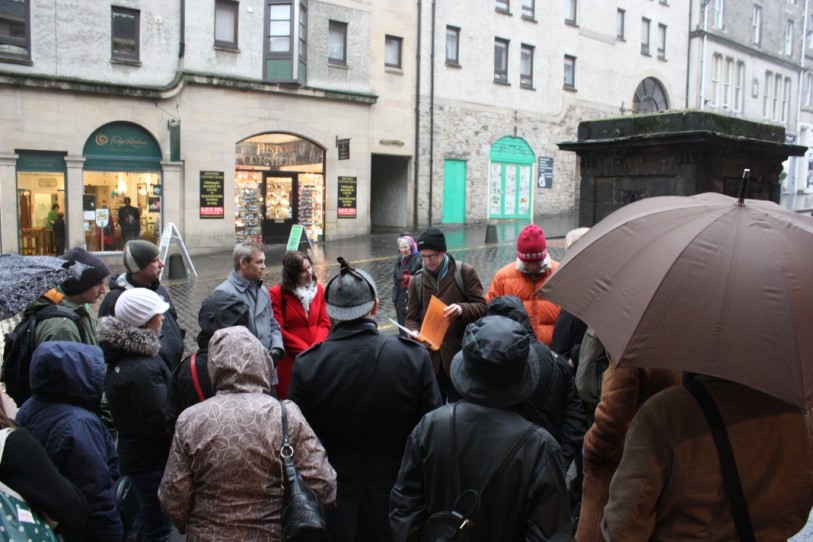
Edinburgh Old Town Walking Tour – 6 Feb

After a morning of drizzle, it was fair at lunchtime, but the weather closed in atmospherically as we walked, all the shades of grey you could ever wish for.

Tweeddale Court, with its publishing connections past and present (Oliver & Boyd, Canongate, The List), and the former home of the Scottish Poetry Library, was very still, bolted doors and no sign of life. As I read my poem ‘Courtyard Reading’, about the open festival events the SPL used to run there, I felt like I was raising a few ghosts. From Jeffrey St the Old Royal High School, mentioned in Robert Garioch’s ‘Embro to the Ploy’, was invisible through the fog.

After a children’s rhyme in the spacious Chessel’s Court, and a tragic ballad in the vennel at John Street, we paid homage to Robert Fergusson at the Canongate Kirk. His sculpted image strides energetically downhill, while his gravestone bears a verse written by his great admirer Robert Burns.

Ken reading by the statue of Robert Fergusson on the Canongate

Sadly Dunbar’s Close was locked, but we were able to glimpse the ornamental hedges through the gate.

We were lucky to have on the tour the poet Angus Reid, who read his sonnet about the Scottish parliament building, and the shapes that pattern its exterior. Inexplicable to many, they are to Reid a clear emblem of democracy:

not the fingers not even the palm but
the power of the right hand the hammer
the sign of assent the vote the demos

(That last word means in Greek ‘the people’, and is where the word ‘democracy’ comes from, government by the people.)

We concluded in Crichton’s Close at the new home of the Scottish Poetry Library, with another sonnet, by Iain Crichton Smith, part of which is inscribed in the fabric of the building: ‘this house, this poem… this fresh hypothesis’.

Outside the Scottish Poetry Library

I’ll be running another poetry tour on 27th February – email events@cityofliterature.com to book.
These events are part of the Carry a Poem programme.