Category Archives: Visual Arts

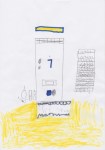
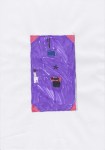
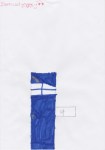
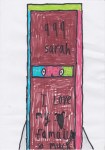
Primary Four’s Doors


Over the past few years I’ve been involved with a performance project with Leith Primary School.

Organised by the church of St James the Less, Leith, this year Suzanne Butler, Lorna Irvine and I worked on the theme of ‘building’ with three classes.

Suzanne (of Fischy Music) wrote a song with P4/3, Lorna and P4B made a drama piece, ‘The Three Wee Leithers’ (based on the fable of ‘The Three Little Pigs’), while I helped P4A to write about life in Leith, and also in a realm of the imagination which they named ‘Minecraft Pugs’.

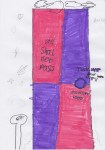
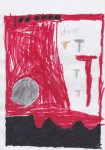
One of the poems I’d read to kick the project off was Holub’s ‘The Door’. During one of our sessions, I asked the pupils to imagine and draw their own door.

The plan was to show these during today’s performance, but we were in the brand new school hall, and no-one knew how to get the brand new projector to talk to a laptop.

I thought the doors deserved some sort of public display, so here they are, in ascending numerical order, from 3 to 1,000,000.

Thanks again to all the pupils for their imagination and enthusiasm!

The Stuarts’ Memorial in Rome


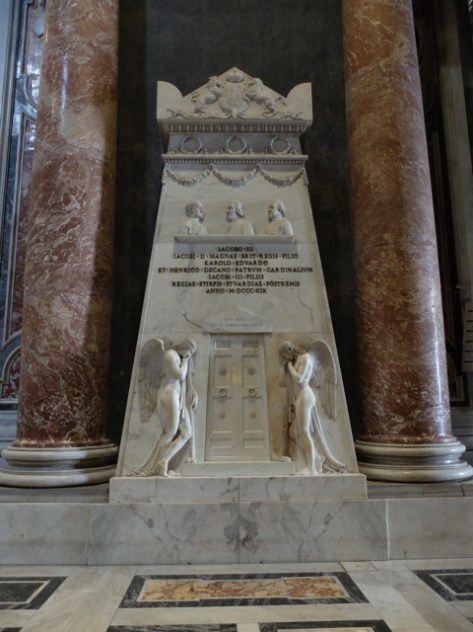
As a follow-up to two earlier posts about the Jacobites in Edinburgh (here and here), these photos from St Peter’s Basilica in Rome show the memorial created in 1819 to three Stuarts: James, and his sons Charles (aka Bonnie Prince Charlie, the only one of the three who set foot in Edinburgh) and Henry.

St Peter's Stuarts 06

On it James is styled James III (of Great Britain), and while he was recognised as such by many European states he never actually sat on the throne. After his death in 1766 some contemporary Jacobite diehards liked to refer his sons as Charles III and, following Charles’ death, Henry IX, but diplomatically and realistically the Roman memorial foregoes such  numerical aspirations.

St Peter's Stuarts 01

The text above the door between the angels attempts to offer some consolation for their exile and failure to ascend a throne they believed was rightly theirs: it translates roughly as ‘blessed are the dead who die in the Lord’.St Peter's Stuarts 04

Immediately opposite it, above a doorway, sits an elaborate memorial to Maria Clementina Sobieska, daughter of the Polish king Jan III, who was unhappily married to James, was the mother of Charles and Henry. She died aged 32 in 1735.

St Peter's Maria Clementina


Daughters of Penelope

These photos were taken at Edinburgh’s Dovecot Studios on 24 October 2017, during an event I created with Juliana Capes for the exhibition Daughters of Penelope (which runs till 20 January).

You dropped a purple ravelling in,
You dropped an amber thread;
And now you’ve littered all the East
With duds of emerald!

We focused on works by Julie Brook, Caroline Dear, Linder and Sonia Delauney. Juliana read an original text written in response to the artworks, while I read a selection of poems on weaving and colour, including works by Emily Dickinson (above) and verses from the Carmina Gadelica.

Photographs courtesy of Dovecot Studios.

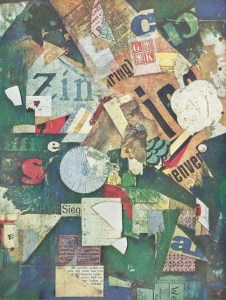
Kurt Schwitters

Schwitters_Collage

A Hanover bourgeois, Kurt Schwitters,
Grew tired of painting his sitters.
In sentences terse
He declared all art Merz
And made poems from sneezes and titters.

A limerick for Kurt Schwitters on 8 January 2018, the 70th anniversary of his death.

Below are some photos from a visit in 2014 to Cylinders in the Lake District, where Schwitters made his last Merzbau in the 1940s (the barn he made it was recently in the news again), and there is a bench with extracts from his ‘Ursonate’ (to hear an extract performed by Florian Kaplick click here).

Cylinders_Merzbarn

Buson by the Firth of Forth

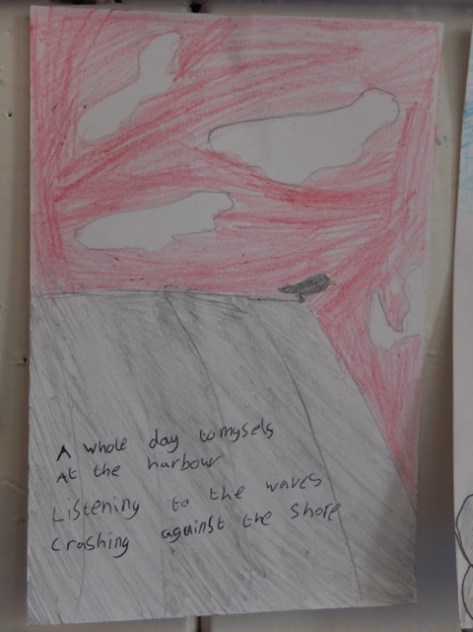
HarbourOn a grey September morning, I walked to Newhaven harbour with the P5 class from Edinburgh’s Victoria Primary School. The earlier rain had stopped, and the tide was out, beaching the small boats moored there. We walked out to the lighthouse at the harbour mouth, and looked upriver to the three Forth bridges, and north over to Fife. The walk was a preliminary to reading and writing haiku, and looking at the work of Yosa Buson (1716–1783), one of the great haiku poets of Japan who was also a painter. As with last summer’s workshop at Jedburgh Grammar School I wanted the pupils to think about combining visual and verbal elements in their work.

Back at school we read these haiku by Buson (all taken from Collected Haiku of Yosa Buson, trans. Merwin & Lento, 2013).

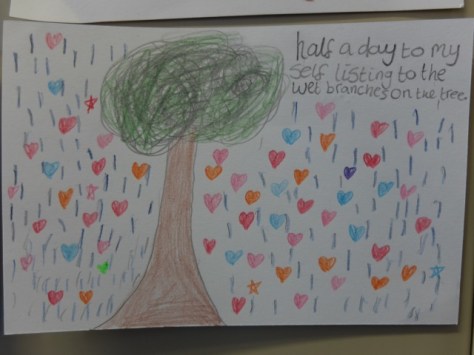
Half a day to myself
by the nettle tree
listening to the cicadas

Summer afternoon downpour
a flock of sparrows
hanging on the grass

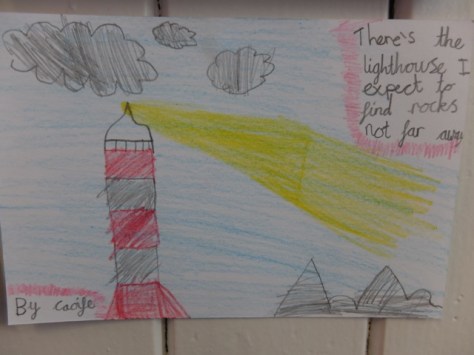
There’s silver grass
I expect to find bush clover
not far away

We used some as models to write from. I retained their structure, and asked the pupils to fill them with their own content. We made some together, as I wrote down their suggestions, and then I asked them to write some on their own.

Buson VPS 02 Buson VPS 01

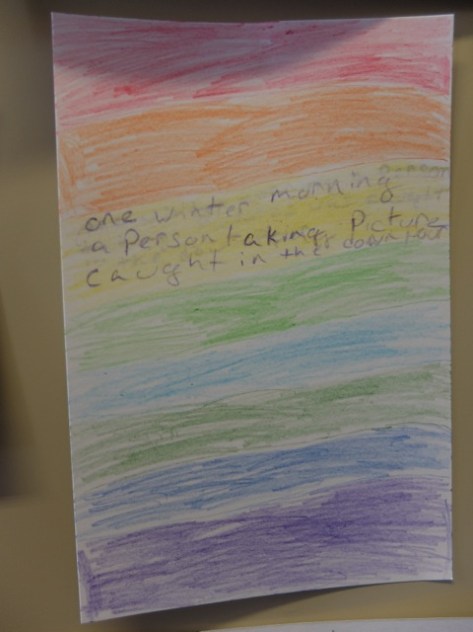
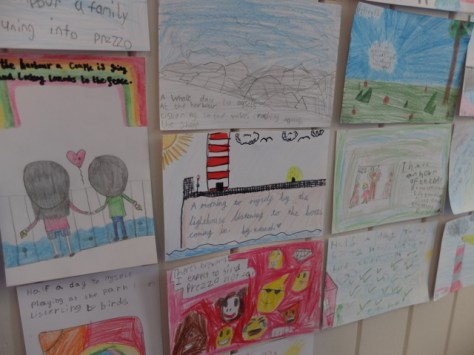
A couple of days later I did a second session. This time I asked them to choose one of their verses, and to present this on a postcard, together with a drawing of their choice. I showed them examples of other postcards which used text and image in different ways – sometimes as separate blocks, sometimes completely integrated.

Buson VPS 04 Buson VPS 05 Buson VPS 06
Buson VPS 08 Buson VPS 16 Buson VPS 17
Buson VPS 09 Buson VPS 20

Buson VPS 19  Buson VPS 18  Buson VPS 10

I also asked them to made folding cards, again thinking about the relationship between their words and images (though we didn’t have time to explore this fully).

Buson VPS 13 Buson VPS 11

With thanks to the teachers Mrs Gorrie, Miss Blyth and Mrs Sim at Victoria Primary School, and to the GB Sasakawa Foundation for funding the work.

Buson VPS 21 Buson VPS 15 Buson VPS 03

Kakimori Bunko

The exhibition Wordsworth and Basho : Walking Poets was shown at Kakimori Bunko, Osaka, Japan last autumn.

I contributed a sequence of seven short poems, taking as my starting point Wordsworth’s ‘The Solitary Reaper’. They were presented as prints, and as a booklet in the display case.

The photographs on the wall are by Tomohiko Ogawa, and show postcards of Scotland ‘matched’ with landscapes in Japan. Tomohiko also took these exhibition photographs.

Some of Alec Finlay’s word-mountains were also shown. There is a fine, informative catalogue; below is a page with Tomohiko’s photographs, including one we used on the cover of The Road North (middle left; on the book cover it’s reversed), and a page with background to my take on ‘The Solitary Reaper’.

Buson 2016 : Jedburgh

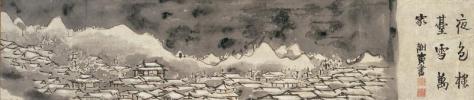
Snowclad_houses_in_the_nightI’m running several events this year under the heading ‘Buson 2016’, celebrating the birth 300 years ago of the great Japanese painter and haiku master Yosa Buson (1716–1783).

This week Andrew Mackenzie and I visited Jedburgh Grammar School, where we worked with S5 and S6 pupils. Andrew and I collaborated on Into Ettrick a couple of years ago, but this is the first time we’ve worked together with a school group. The idea was to create a piece which integrated image and text, as Buson did in many of his works.

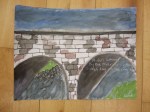
We sketched and took notes at two spots by the Jed Water, near the Abbey Bridge opposite the abbey, and by the Canongate Bridge. Andrew showed them how to sketch with pencil and charcoal, while I encouraged them to be attentive to what has happening as we were there, using Norman MacCaig’s poem ‘Notations of Ten Summer Minutes’ as a model.

Back in school I guided the pupils into writing haiku based on their notes – snapshots capturing when, where and what happened – while Andrew led them in working with watercolour and pen-and-ink to develop sketches made earlier. Then we put the two together – some of the results are below.

David Blake, PT English who organised the school’s side of the session, commented:

Blank space! If there is one thing which I will always remember from the Yosa Buson workshop which I took part in, along with 35 Higher and Advanced Higher English pupils, it is the importance of blank space. As both artist and poet Buson would have instinctively understood the relationship between the visual and the written – something that we often forget.

Our day began somewhat greyer than I had hoped and the pupils’ initial enthusiasm reflected that sombre sky but as the first part of the day proceeded they quickly began to respond to what they saw in both visual and written mediums. Pupils who claimed that they could not draw were working hard to create images of what they saw, within minutes of being given a writing task they were enthusiastically coming up with ideas that I would struggle to draw out of them in the classroom. By the afternoon, armed with the sketchbooks in which we had drawn what we had seen and written down our thoughts, we were ready to embark on the production of ink illustrations and haiku poems. The quality of some of the work that the pupils produced was well beyond their expectations and despite their many claims that their work was rubbish you could see they were secretly pleased with how well their paintings and poems had turned out; one or two even confided that they had gone home that night and made further use of their sketchbooks!

This was one of the most enjoyable workshops that I have experienced in my teaching career and one which I believe that, as well as the wonderful creative experience of producing the visual art, the pupils got a lot out of in terms of their understanding of how to write effectively: in writing, as in art, it is as much about what you leave out as that which you put in – blank space.

With thanks to Jedburgh Grammar School, and to the GB Sasakawa Foundation for funding the work.

River Connections, Inverness

lost tongue

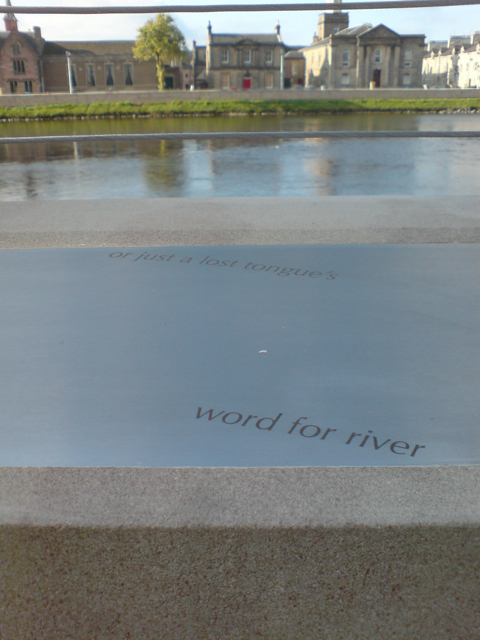
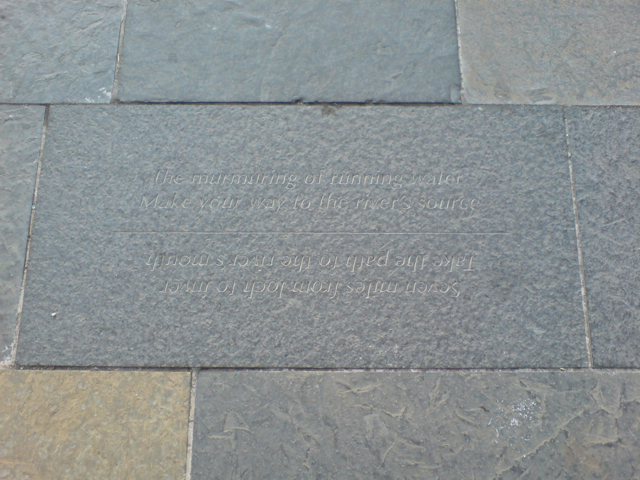
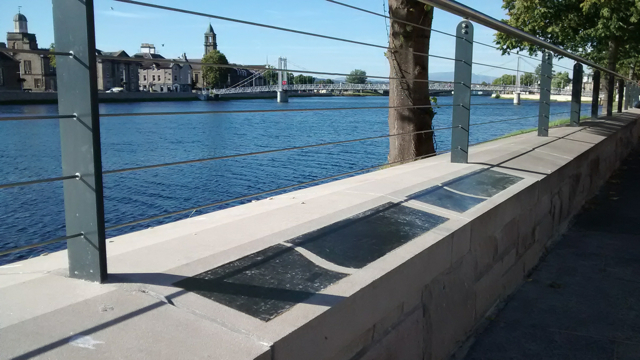
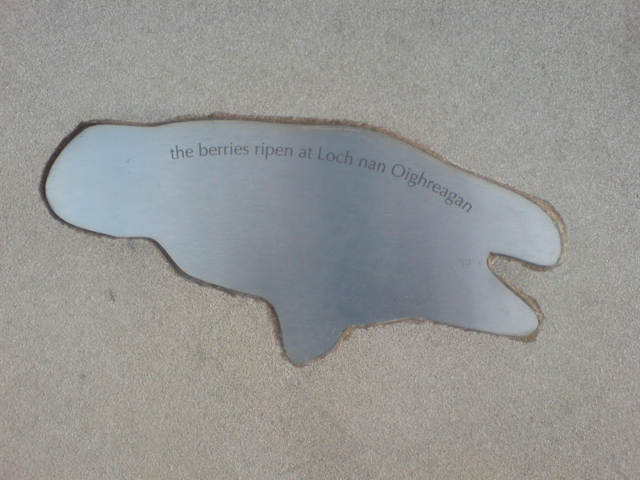
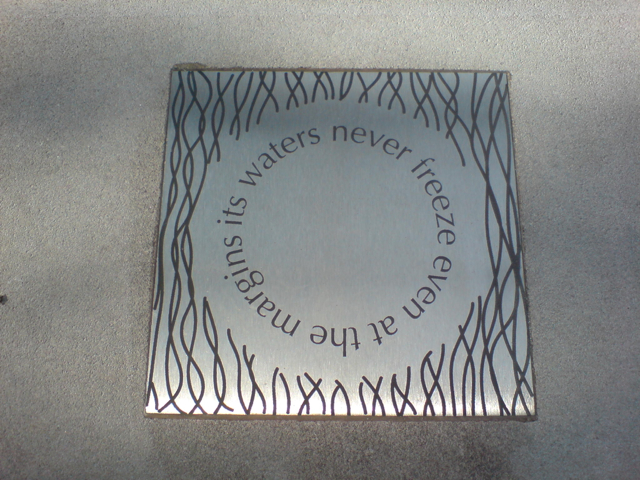
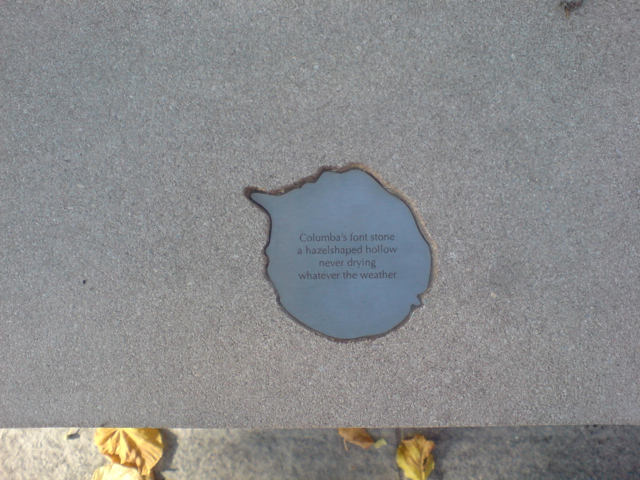
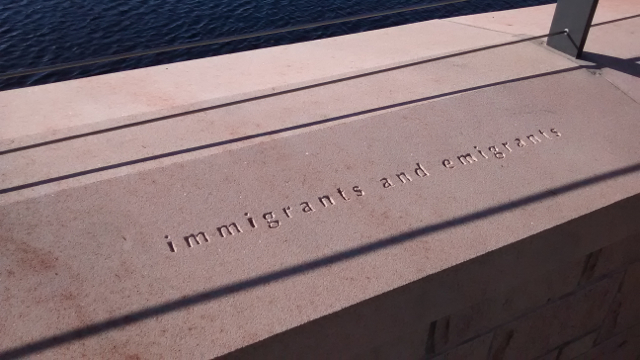
At the end of September I was in Inverness, where I saw a batch of poems I wrote last year about the River Ness and its vast catchment area being installed on the new flood wall. I’d been asked by Mary Bourne to produce the work, which she intended to carve directly onto the wall, but it turned out the stone wasn’t good for carving (a soft sandstone, with hard bits of quartz spread erratically through it), so she had most of the poems etched onto steel and set into the wall. The masons were at work setting them into the coping as we walked along the riverbank in unseasonably warm sunshine.

The poems are mostly on Bank Street, between the Young Street Bridge and the pedestrian bridge, though there are a few beyond that, along Douglas Row towards the Friars Bridge. A further group of texts will be installed on the west bank of the river in the new year, and stones featuring circle poems written by local writers are to be installed at Kessock Road near the mouth of the river shortly.

Seven Miles
Uillte
Loch nan Oighreagan
never freeze
Loch Ness, Columba
immigrants and emigrants

Curved Stream at Traquair House

Curved Stream

Curved Stream is an exhibition by seven artists and one writer (myself) at Traquair House, near Innerleithen in the Scottish Borders. Each of the artists has a work in one of the garden pavilions to the rear of the house, and a related work in the main house and / or in the gardens and grounds.
Pavilion painting D&A

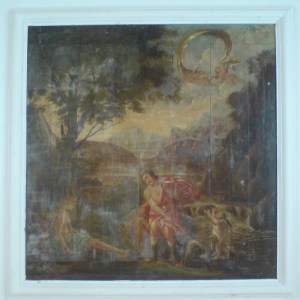
One of the pavilions has, as its centre-piece, an anonymous ceiling-painting depicting an episode in the story of Diana and Actaeon (told by Ovid in his Metamorphoses), just before the transformation of Actaeon into a stag. The survival, intact, of this beautiful artefact, embedded in the fabric of the building, exemplifies many of the special qualities of the site as a whole.

The work I’ve made is called DEA SILVARUM (Goddess of the Woods), as Ovid describes Diana, and is a walk with poems on the theme of hunting in the gardens and grounds of Traquair House. The poems include Ted Hughes’ version of Ovid, plus works by Robert Burns, Edna St Vincent Millay and the great Anon, among others. I led a first walk at the exhibition opening on 5 September, and will lead a second on Saturday 10 October at 2.30pm.

In the pavilion is a printed sheet listing the poems I selected for the walk, typeset by Barrie Tullett, with handwritten annotations featuring extracts from and reflections on the poems, as well as notes as to where I’d planned to read them. The sheet is in a drawer, so you have to open it to read the text – the idea for that was taken from a Victorian Game Book which was (but is not longer) on display in the house, in a glass below a window with a sheet of dark fabric draped over it to protect it from the light. I liked that ‘reveal’, and it seemed to echo the events in Actaeon’s story as well, so the text is hidden in the drawer, until its own ‘reveal’.

If you don’t know the story: Actaeon has been hunting deer with his friends in the woods. After a successful, bloody morning, they pause; Actaeon wanders off alone and stumbles upon a cavern where the goddess Diana, is bathing. Angry that he has seen her naked, she turns him into a stag, and he is hunted down and killed by his own dogs.)

The artists involved are Gordon Brennan, Mark Haddon, Jane Hyslop, Paul Keir, Deirdre Macleod, Andrew Mackenzie and Mary Morrison. There is more information about the exhibition and their work at the Curved Stream website and Facebook page.

On Raasay

11401101_920675431288859_1939139233689863194_n

I was on the Isle of Raasay in early June, for the launch of Patterns of Flora | Mapping Seven Raasay Habitats. ATLAS Arts, based on nearby Skye, had commissioned Edinburgh-based ceramicist, Frances Priest to develop a series of handmade, ceramic artworks for permanent installation in Raasay House.

The form and design of the artworks – vases, door knobs, door pushes and pieces for sills – are based on Raasay’s plant life, and in particular seven different habitats that host unique and varying plant species: Bog, Coast, Fresh Water, Limestone, Moor, Mountains and Woodland. Alongside these Frances designed a map, featuring the habitats with associated walks. She collaborated with Raasay-based botanist Stephen Bungard.

(I had worked with Frances several years ago, on Pandora’s Light Box at the Talbot Rice Gallery in Edinburgh, and it was good to catch up with her work in a very different setting.)

10676329_921396287883440_1629111481114513217_n

I was there to lead a ‘haiku walk’ on the Saturday afternoon, again working with Stephen. We went to the salt marsh at Oskaig, arriving at a particularly wind- and rain-swept moment, but the weather cleared and there was much to enjoy immediately around us, and looking across the sound to Skye and the Cuillins. I was struck by Stephen’s remark that the four aspen trees we saw were in fact all one, the trunks all sharing a single root.

Back at Raasay House all was notebooks and concentration.

On Sunday, once the morning rain had cleared, I managed a walk with Frances and others on the east coast from Fearns to Hallaig, below the cliffs and into the birchwood the burn runs through. In his poem ‘Hallaig’ Sorley Maclean repeoples the now empty places:

na h-igheanan ’nan coille bheithe, / dìreach an druim, crom an ceann.

the girls a wood of birches, / straight their backs, bent their heads.